
Non-FictionBusiness BriefPharmacy
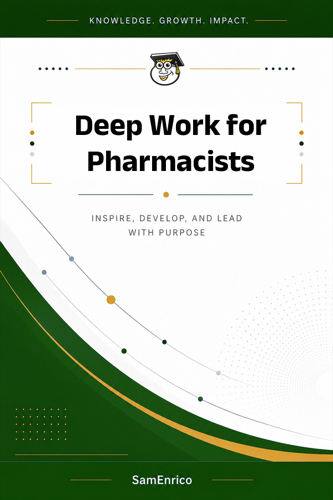
Deep Work for Pharmacists eBook
Protect clinical review and patient counseling pre
by Crane Lorna
Protect clinical review and patient counseling preparation from dispensing interruptions.
Formats
Free sample
Chapter 1: The 34 Thefts--–- The drive-through bell rang. The phone on line two lit up. A technician called out, “Insurance reject on this one.” A patient tapped their foot at the pickup counter. The pharmacist’s pager buzzed. The verification queue showed thirty-one prescriptions waiting.
And somewhere in the middle of all this noise, a seventy-three-year-old woman on warfarin was about to receive an antibiotic that would send her to the hospital with a gastrointestinal bleed.–- This is not a scene from a dysfunctional pharmacy. This is a typical Tuesday morning in thousands of pharmacies across the country. The pharmacist at the center of this chaos is not lazy, incompetent, or poorly trained. She is a twelve-year veteran with a doctorate in pharmacy, two board certifications, and a genuine commitment to patient care. But none of that matters when her brain is torn in six directions at once.–- She saw the interaction.
In the three minutes she had to review the warfarin prescription before the drive-through bell rang, she had already noticed that the newly prescribed antibiotic—trimethoprim-sulfamethoxazole—potentiates warfarin’s effect. Her finger was hovering over the phone to call the prescriber. Then the bell rang. She answered it. Then she took the insurance call.
Then she checked on the waiting patient. Then she signed for the controlled substance order. Twenty minutes later, she returned to the warfarin prescription. She could not remember where she had stopped. She verified it anyway, because the queue was now forty deep.–- Two weeks later, that patient was readmitted with an INR of 9.2 and an actively bleeding gastric ulcer.
The interaction she had almost caught—the one interrupted by the drive-through bell—was the cause.–- This is not a story about a bad pharmacist. It is a story about a broken system. And if you are reading this book, you have lived some version of this story yourself. Perhaps not a readmission or a bleed, but the sick feeling of realizing you missed something. The nagging sense that you are not stupid, you are not lazy, and you are not bad at your job—you are simply being interrupted into incompetence.The Hidden Epidemic–- Welcome to the central problem of modern pharmacy practice.
Your brain is capable of extraordinary clinical reasoning. It can integrate laboratory data, medication histories, pharmacokinetic principles, and patient preferences into life-saving clinical decisions. But it cannot do that while answering “Where are the bandaids?” The cognitive architecture that allows you to catch a drug-dosage interaction is the same architecture that collapses when you switch tasks every two to six minutes. This is not a matter of willpower, time management, or “working harder.” It is a matter of neurobiology. And until you understand how deeply the interruption epidemic has wounded your clinical abilities, no productivity hack, no scheduling app, and no positive attitude will save you.–- The pharmacy profession has a hidden epidemic.
It is not opioid abuse, though that is a crisis. It is not drug shortages, though those are real. It is not staffing ratios, though those matter. The hidden epidemic is interruption. And unlike other epidemics, this one has no task force, no CDC warning, no congressional hearings.
It happens quietly, in every pharmacy, every shift, every day. It harms patients not through dramatic, single-point failures but through the slow accumulation of cognitive degradation—missed interactions, rushed reviews, incomplete counseling, and the gradual erosion of clinical reasoning.–- I have spent the past several years studying this epidemic. I have observed pharmacists in community chains, independent stores, hospital inpatient pharmacies, ambulatory clinics, and centralized verification centers. I have shadowed them, timed them, interviewed them, and analyzed their error reports. The pattern is unmistakable.
The average pharmacist is interrupted thirty-four times per shift. That is one interruption every fourteen minutes. During the busiest two hours of the day, pharmacists switch tasks every two to six minutes. They are not performing clinical review. They are not performing Drug Utilization Review.
They are not counseling patients. They are constantly, relentlessly, and structurally being pulled away from the very work that requires their highest level of training.–- This chapter is called “The 34 Thefts” because that is precisely what interruptions are. They are thefts. Each interruption steals not just the fifteen or thirty seconds it takes to answer a question or handle a task. It steals the twenty-three minutes your brain needs to return to the same depth of cognitive processing.
It steals the clinical reasoning you had built. It steals the confidence that comes from a thorough review. It steals the time you could have spent with your next patient. And over the course of a career, thirty-four interruptions per shift, two hundred and fifty shifts per year, thirty years—that is more than 250,000 interruptions. That is 250,000 thefts of your attention, your time, and your clinical judgment.The Neuroscience of Fragmentation–- To understand why interruptions are so damaging, you must understand how your brain actually works.
The popular notion of multitasking—that you can do two things at once, or rapidly switch between tasks without penalty—is a myth. It is not a harmless myth. It is a dangerous myth that has been debunked by decades of cognitive psychology research.–- Your brain has two distinct attentional systems. The first is focused attention, which allows you to concentrate deeply on a single task. This system is slow, effortful, and easily disrupted.
It is what you use when you perform a clinical review. The second is divided attention, which allows you to monitor multiple low-demand inputs simultaneously. This system is fast, automatic, and error-prone. It is what you use when you walk and chew gum, or when you scan a shelf for a medication while vaguely listening to background noise. The critical insight is this: you cannot use focused attention and divided attention at the same time.
They are mutually exclusive states.–- When you are interrupted during a clinical review, you are forced to switch from focused attention to divided attention. Your brain must disengage from the complex mental model you were building, shift to processing the interruption (a question, a phone call, a bell), formulate a response, and then attempt to re-engage focused attention on the original task. This switch is not instantaneous. It is not cost-free. It takes time, and it leaves residue.–- The residue effect is the hidden killer of clinical reasoning.
When you stop a clinical review to answer a phone call, your brain does not fully unload the first task. It keeps a half-processed clinical question, a partially evaluated interaction, a dangling “I need to check that creatinine clearance” running in the background. That residue consumes cognitive resources even as you perform the second task. Then, when you return to the original review, you must not only reload the clinical context but also overcome the residue of the interruption itself. The result is a brain that is working harder and achieving less.–- Functional MRI studies have captured this process in real time.
When subjects switch tasks, their brains show a spike in activity in the prefrontal cortex—the executive control center—followed by a prolonged period of elevated…
This is the end of the free sample. Get the eBook to keep going. Buy now
About this book
Details
- Author
- Crane Lorna
- Publisher
- SamEnrico
- Language
- English
- Genre
- Non-Fiction, Business Brief, Pharmacy
- Released
- 2026-06-06
- Pages (approx.)
- 138
- Available as
- eBook, Audiobook

Read better in the ZLOADR app
Your eBooks on your phone or tablet. Sign in with your SamEnrico account and start reading.
More by Crane Lorna
 Remote Retreats IC PerspectiveCrane Lorna$11.99
 Business Plan Market Analysis GuideCrane Lorna$11.99
 Retirement Housing Contingency Planning BriefCrane Lorna$11.99
 Men's Heart Attack Prevention GuideCrane Lorna$11.99
 The Last Unknown Frontier: The 1957 British-Sarawak Expedition to Borneo's HeartCrane Lorna$11.99
 Neon Shadows: The Rise and Fall of the Silk Road DarknetCrane Lorna$11.99
 Understanding Chromosome 10Crane Lorna$17.99
 Vendor Termination ProtocolCrane Lorna$12.99
 Insurance Customer RetentionCrane Lorna$12.99
 Shipping ClerkCrane Lorna$11.99
 How to Become a Traverse-rod AssemblerCrane Lorna$11.99
You may also like
 Hong Kong Handover 1997Dunn Johnnie$11.99
 Zumba For Postnatal Recovery CourseNeal Christian$11.99
 Zumba for BeginnersLadner Nikia$11.99
 YouTube Comment Mining GuideHumes Pandora$12.99
 Worry Box MeditationCarlin Rudy$11.99
 Workplace Stress MeditationNguyen Lynn$11.99
 Workplace Stress and Sleep RepairHawley Ivory$11.99
 Workplace Perfectionism CureDelaney Jeffry$11.99
 Workplace Injustice Anger GuideWallen Isabelle$11.99
 Work Addiction and Burnout LinkGreenwood Ester$11.99
 Women in Yoga and WellnessBeattie Galina$11.99
 Women in Stand Up ComedyChun Evangeline$11.99