
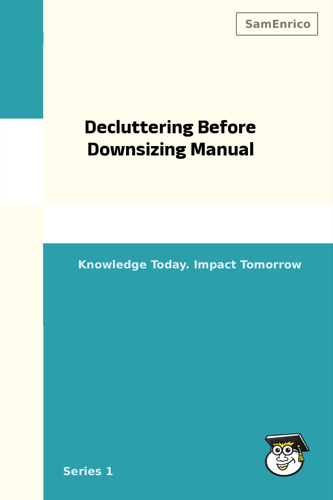
Decluttering Before Downsizing Manual eBook
Room by room system to reduce possessions by seven
by Roby Mia
Room by room system to reduce possessions by seventy percent.
Formats
Free sample
Chapter 1: The Gift You Owe--–- The first time I watched a grown woman weep over a china cabinet, I was twenty-two years old, working as a mover’s assistant to pay for graduate school. Her name was Eleanor. She was seventy-four. She had just sold the three-bedroom colonial where she had raised four children and buried one husband. The china cabinet was solid mahogany, eight feet tall, six feet wide, and so heavy that three of us could barely slide it across the carpet.
It contained twelve place settings of Royal Doulton, each piece individually wrapped in yellowed newspaper. Eleanor stood in the doorway of the empty dining room, one hand pressed against the wall for balance, and said something I have never forgotten.“I thought one of them would want it.”None of her children wanted the china cabinet. None of them wanted the china. They had flown in from California, Texas, and Florida to help her move, and they had spent the morning gently but firmly explaining that their own homes were already full. They had no room for a mahogany monument to formal dinners that no longer happened.
One daughter suggested taking a single place setting for sentimental reasons. Another asked if the local antique dealer might offer fifty dollars for the set. Eleanor had paid nearly four thousand dollars for that china in 1985.The cabinet went to a charity that charged her two hundred dollars to haul it away. The china went to a consignment shop that sold it for eight dollars per place setting. Eleanor cried again when she saw the check for ninety-six dollars.
She had not cried when she said goodbye to the house. She cried over the china.I tell you this story not to make you sad, but to save you from the same fate. Eleanor’s tragedy was not that she loved her possessions. It was that she had mistaken the weight of her love for the weight of their value. She had kept the china not because she used it—she had not hosted a formal dinner in over a decade—but because she believed that keeping it was an act of love.
She believed that passing it down was how she would be remembered.She was wrong. Her children remember her laugh. They remember the way she sang off-key in the kitchen. They remember the Thanksgiving when the turkey fell on the floor and she said, “Well, we have a lot of bread.” They do not remember the china. They will never remember the china.This chapter is about the single most important mental shift you will make in the entire downsizing process.
Before you touch a single object, before you open a single drawer, before you buy a single box, you must understand why you are doing this. The reason is not “to have less stuff.” The reason is not “to fit into a smaller home.” The reason is not “to make moving easier,” though all of those things will happen.The reason is this: you are going to die.Not tomorrow, probably. Not next year, with any luck. But someday. And on that day, everything you own will become someone else’s problem.
Every cabinet you filled, every box you labeled “sentimental,” every thing you kept because you thought someone might want it—all of it will land on the shoulders of the people you love most. They will have to sort it, haul it, donate it, or pay to throw it away. They will do this while grieving you. They will do this while trying to remember who you were, and they will have to wade through fifty boxes of who you were not.That is not a legacy. That is a burden.The Swedish Secret You Need to Know There is a word in Swedish that has no perfect English equivalent: döstädning.
It combines dö (death) and städning (cleaning). The British journalist Margareta Magnusson popularized the term in her book The Gentle Art of Swedish Death Cleaning, but the practice itself is generations old. In Sweden, elderly people often spend time systematically reducing their possessions so that when they die, their children are not left with a house full of stuff. It is considered a kindness. It is considered an act of love.Notice what death cleaning is not.
It is not morbid. It is not a rush to throw everything away. It is not a denial of life. On the contrary, death cleaning is an acknowledgment that life has a shape and an endpoint, and that the final chapter of that life should be written by you, not by your grieving heirs. Death cleaning is the gift of not being a burden.When I explain this to audiences, I watch their faces change.
At first, there is discomfort. No one likes to think about their own death. Then there is recognition. They have been on the receiving end of this burden. They have stood in a parent’s garage, staring at thirty years of accumulated junk, wondering where to even begin.
They have felt the resentment bubbling up beneath the grief—the unspoken thought: Why did you leave this for me? They have felt guilty for feeling that resentment. And then, finally, there is resolve. They do not want to do that to their own children.That resolve is the engine of the entire 70% Purge. You are not decluttering because you hate your things.
You are decluttering because you love your people.The Brutal Math of Inheritance Let me show you something that will change how you see every object in your home. I want you to imagine that you have died tomorrow. Not in a dramatic way—peacefully, in your sleep, at a reasonable age. Now imagine that your adult children walk into your home. They have to empty it in two weeks because the house has been sold to cover your final expenses.
They live in other states. They have jobs and children of their own.What happens to your stuff?I have spoken to dozens of estate sale operators, probate lawyers, and professional organizers. They all tell me the same thing. Eighty percent of what is in the average American home ends up in a landfill or donated to charity within six months of the owner’s death. Not because the children are cruel.
Because they cannot keep it. They do not have the space. They do not have the desire. They do not have the emotional energy to sort through forty years of accumulated inventory.Let me be specific about the categories that almost no one wants, no matter how much you loved them.Fine china. The market for formal dinnerware collapsed around 2005, when millennials began entering adulthood without the expectation of hosting formal dinners.
Today, a twelve-piece set of Royal Doulton that retailed for $4,000 sells for $50 to $100 at auction, if it sells at all. Most sets go to charity. Some are broken up and sold as individual plates for craft projects. A professional estate sale manager told me, “I can’t give china away. I’ve had sets that I priced at five…
This is the end of the free sample. Get the eBook to keep going. Buy now
About this book
Details
- Author
- Roby Mia
- Publisher
- SamEnrico
- Language
- English
- Genre
- Non-Fiction, Business Brief, Organization
- Released
- 2026-06-08
- Pages (approx.)
- 138
- Available as
- eBook, Audiobook

Read better in the ZLOADR app
Your eBooks on your phone or tablet. Sign in with your SamEnrico account and start reading.
More by Roby Mia
 Anger Management for NonprofitsRoby Mia$11.99
 Pre Talk Music Playlist GuideRoby Mia$11.99
 Alcohol Detox Nutrition PlanRoby Mia$11.99
 Divorce ChallengeRoby Mia$11.99
 The Shanghai Property Scandal: How a Mortgage Scheme Collapsed an Empire (1930s)Roby Mia$11.99
 Cashier FTRoby Mia$11.99
 Understanding Polyposis Skin Pigmentation Alopecia Fingernail ChangesRoby Mia$17.99
 HARO Response Templates GuideRoby Mia$12.99
 Music Festival Travel SpendingRoby Mia$12.99
 How to Start a Chemical Seed Dresser for Agricultural Use Business (Beginners Guide)Roby Mia$11.99
You may also like
 Deep Work Workspace AuditBlaine Leon$11.99
 Email Folders StructureDarden Alita$11.99
 Email Sorting Rules HandbookAlderman Mirta$11.99
 Email Smart Folder SystemOrosco Kevin$11.99
 Decluttering for Retirement DownsizingCervantes Effie$11.99
 Email Thread CleanupSpellman Angeles$11.99
 Email Folder Structure LITERich Alissa$11.99
 The Decluttering Before Downsizing ManualHazel Yuk$11.99