
Non-FictionBusiness BriefDecision Making
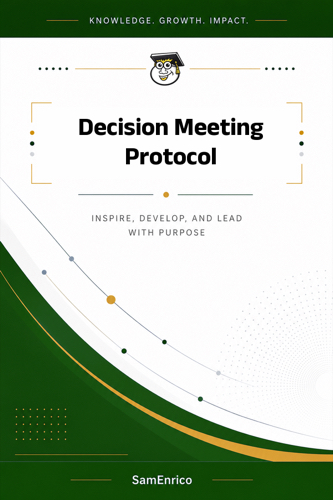
Decision Meeting Protocol eBook
Distinguish between information sharing and decisi
Distinguish between information sharing and decision making gatherings.
Formats
Free sample
Chapter 1: The $1 Trillion Blind Spot--You are about to discover something that will make you genuinely angry about your calendar.Not frustrated. Not mildly annoyed. Genuinely, viscerally angry.Because over the next ten minutes, you will calculate exactly how many hours of your life have been stolen by meetings that had no right to exist. You will put a dollar figure on the time you have spent sitting in rooms—physical or virtual—listening to status updates that could have been emails, watching Power Point slides that no one read beforehand, and leaving without any clear sense of what was actually decided.And then you will realize that the problem is not your colleagues, your boss, or your organization’s meeting culture.The problem is a single, massive, invisible confusion that has been hiding in plain sight: the conflation of information sharing with decision making.This is the $1 trillion blind spot.The Meetings Tax Let us begin with a calculation.According to research cited in John Tropman’s Making Meetings Work, the average executive spends approximately 23 hours per week in meetings. Mid-level managers spend roughly 12 hours.
Even individual contributors—people hired to write code, design products, or serve customers—spend an average of 6 to 8 hours per week in gatherings.Now consider what happens when a meeting lacks a clear “decision requirement.” Tropman’s data reveals that up to 50 percent of meeting time is wasted when participants do not know whether they are there to share information or to make a choice.Let us do the math conservatively.Assume a team of ten people, each earning an average fully-loaded cost (salary, benefits, overhead) of $100,000 per year. That is approximately $50 per hour per person. If that team spends 10 hours per week in meetings—a low estimate—and half of that time is wasted due to ambiguous purpose, the weekly loss is:10 people × 10 hours × $50 × 0.5 waste = $2,500 per week.Over 48 working weeks per year, that is $120,000 per year for a single small team.Now scale that to a medium-sized organization of 500 people. Assume the same 10 hours per week and the same 50 percent waste. The annual loss exceeds $6 million.For a Fortune 500 company with 100,000 employees, the loss exceeds $1.2 billion per year.Across the United States alone, the cumulative cost of ambiguous, conflated meetings exceeds $1 trillion annually.That is not a typo.
One trillion dollars. Every single year.And you are paying that tax.But here is the thing about a tax: you can stop paying it once you understand how it works.The Continuum of Clarity Every meeting falls somewhere on what I call the Continuum of Clarity. At one end, gatherings are purely social—team building, relationship maintenance, celebration. At the other end, they are purely operational—resource allocation, contract approval, strategic direction.For the purposes of this book, we focus on the two most problematic and commonly conflated types: Information Meetings and Decision Meetings.An Information Meeting exists to share what happened. Its purpose is context, alignment, and awareness.
Think of a weekly status update, a quarterly business review, or a project handoff. The success criterion is simple: did everyone leave with the same understanding of reality?A Decision Meeting exists to determine what to do about it. Its purpose is closure, resource allocation, and velocity. Think of a budget approval, a vendor selection, or a go/no-go call. The success criterion is equally simple: did the group produce a directive with an owner and a timestamp?The critical failure mode of modern organizations is attempting to solve decision problems with information processes.Consider this example.
A product team gathers to “discuss the roadmap.” The product manager shares fifteen slides of customer feedback and usage data. Thirty minutes in, someone asks, “So are we building Feature X or Feature Y?” The group debates for another twenty minutes. No one has authority to decide. The meeting ends with “We’ll take this offline.”That meeting was designed as an Information session (sharing data) but needed to be a Decision session (choosing a feature). Because no one recognized the mismatch, the meeting produced neither shared understanding nor a binding choice.
Everyone wasted an hour.This pattern—the wrong meeting type for the actual need—accounts for the majority of the $1 trillion blind spot.The Social Meeting Exception Before we go further, a brief note about the third category on the Continuum: Social Meetings.Team lunches, off-site retreats, holiday parties, and one-on-one coffees serve a legitimate purpose. They build trust, psychological safety, and relationships. They are essential for long-term organizational health.However, social meetings are outside the scope of this book for two reasons.First, they rarely consume the majority of calendar time. Most professionals spend far more hours in Information and Decision meetings than in purely social gatherings.Second, the protocols for effective social gatherings are fundamentally different. What works for a decision meeting—tight agendas, role cards, time limits—would destroy a team-building retreat.
Conversely, the openness and meandering conversation that works for a social lunch would be catastrophic for a budget approval.If you need guidance on running effective off-sites or building team cohesion, there are excellent books on those topics. This book is not one of them.Here, we focus exclusively on the two types that are constantly confused: Information and Decision.The Research Base This book synthesizes the core principles from the top ten best-selling works on meeting science and group dynamics. These include:Making Meetings Work by John Tropman, which established the decision-requirement framework How to Make Meetings Work by Doyle and Straus, which introduced the Interaction Method The Human Organization by Rensis Likert, which defined participative decision roles Crucial Conversations by Patterson, Grenny, Mc Millan, and Switzler, which provided the foundation for cognitive versus affective conflict The Decision Book by Krogerus and Tschäppeler, which offered models for strategic choice Each of these works identified pieces of the puzzle. None, however, fully addressed the central problem: the conflation of sharing facts with driving action.That is what this book provides—a unified protocol for distinguishing between the two and running each type with rigor.The Core Premise Stated Simply Here is the premise that drives every chapter that follows.You cannot solve a decision problem with an information process.If you need to choose a vendor, a weekly status update will not help you choose. If you need to approve a budget, a dashboard review will not produce approval.
If you need to launch a feature, a retrospective of the last launch will not authorize the next one.And yet, organizations do this every day. They fill calendars with “updates” when what is needed is “closure.” They schedule “discussions” when what is needed is “a vote.” They confuse motion with progress.The result is not just wasted time. The result is accumulated indecision—a growing pile of choices that never get made because no one ever convenes the right people in the right structure at the right time.Indecision has a cost.Every week that a decision is delayed, opportunities are lost, problems compound, and teams spin their wheels waiting for clarity. The $1 trillion figure we calculated earlier accounts only for the direct time cost of wasted meetings. The indirect cost of delayed decisions—lost revenue…
This is the end of the free sample. Get the eBook to keep going. Buy now
About this book
Details
- Author
- Gillen Magaret
- Publisher
- SamEnrico
- Language
- English
- Genre
- Non-Fiction, Business Brief, Decision Making
- Released
- 2026-06-09
- Pages (approx.)
- 131
- Available as
- eBook, Audiobook

Read better in the ZLOADR app
Your eBooks on your phone or tablet. Sign in with your SamEnrico account and start reading.
More by Gillen Magaret
 The Remote Work Meeting DietGillen Magaret$11.99
 Vegan Mental Health Nutrition GuideGillen Magaret$11.99
 The Plantar Fasciitis FixGillen Magaret$11.99
 Franchising Your Local Brand Across Borders Real EstateGillen Magaret$11.99
 Black Gold Rush: The Secret War Over Coffee's FutureGillen Magaret$11.99
 The Ghosts of the Chosin: How One Battle Redefined Modern WarfareGillen Magaret$11.99
 Understanding Cushing Syndrome, FamilialGillen Magaret$17.99
 Sales Script Ethics GuideGillen Magaret$12.99
 IP Arbitration Cost GuideGillen Magaret$12.99
 How to Become a Tree PrunerGillen Magaret$11.99
 Accounting GeneralistGillen Magaret$11.99
You may also like
 Hong Kong Handover 1997Dunn Johnnie$11.99
 Zumba For Postnatal Recovery CourseNeal Christian$11.99
 Zumba for BeginnersLadner Nikia$11.99
 YouTube Comment Mining GuideHumes Pandora$12.99
 Worry Box MeditationCarlin Rudy$11.99
 Workplace Stress MeditationNguyen Lynn$11.99
 Workplace Stress and Sleep RepairHawley Ivory$11.99
 Workplace Perfectionism CureDelaney Jeffry$11.99
 Workplace Injustice Anger GuideWallen Isabelle$11.99
 Work Addiction and Burnout LinkGreenwood Ester$11.99
 Women in Yoga and WellnessBeattie Galina$11.99
 Women in Stand Up ComedyChun Evangeline$11.99