
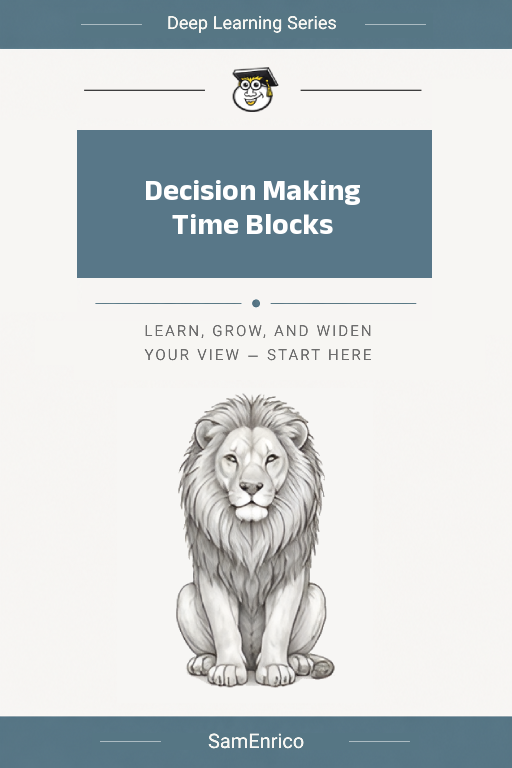
Decision Making Time Blocks eBook
Schedule high-stakes decisions for morning hours w
by Earl Coy
Schedule high-stakes decisions for morning hours when cognitive energy peaks for executives.
Formats
Free sample
Chapter 1: The 3 PM Slump--–- The boardroom was silent except for the hum of the ventilation system. Twelve executives sat around a mahogany table, each holding a twenty-page deck that no one had fully read. The CEO, a woman named Sarah who had led the company through three acquisitions and two recessions, was about to make a decision that would commit $47 million to a new market expansion. It was 3:17 PM on a Tuesday. She had been in back-to-back meetings since 8:30 AM.
She had skipped lunch to prepare for this presentation. Her last meal had been a stale granola bar at 10:45 AM, eaten while reviewing quarterly forecasts on her phone. She had approved seventeen expense reports, responded to forty-three emails, and mediated a dispute between two department heads—all before this meeting began.The presentation ended. The room looked to her. She felt the fog.
Not the creative fog of early morning brainstorming, but the heavy, wet-blanket fog of cognitive exhaustion. Her thoughts moved like wading through shallow water. She knew the numbers were good. She knew the strategy was sound. But something felt off.
She couldn't name it. Her gut, usually a reliable compass, felt like static. After a long pause, she said, "Let's table this. I need more data." The room deflated. Three weeks later, after two more meetings and another $200,000 in consultant fees, she made the exact same decision she could have made that Tuesday afternoon.
A competitor launched a similar product in the interim and captured 8% market share before Sarah's company entered.This is not a story about bad leadership. It is a story about bad timing. And it happens thousands of times every day in boardrooms, startups, and government agencies around the world. The cost is not measured merely in wasted consultant fees or delayed launches. It is measured in market share, in morale, in the gap between what an executive is capable of deciding and what they actually decide when the clock hands point to the wrong position on the dial.The Myth of Constant Decision Quality Most executives believe they are rational actors.
They believe that if given the same information at 9 AM or 3 PM or 8 PM, they would reach the same conclusion. This belief is comforting, professional, and completely false. The research is now overwhelming: human decision-making quality is not a flat line. It is a wave. And like all waves, it has peaks, troughs, and rebounds.The chapter you are about to read will fundamentally change how you understand your own mind.
It will introduce you to the hidden architecture of your daily cognitive rhythms. It will help you identify—not through guesswork but through science—the precise hours when your brain is wired for analytical brilliance and the hours when it is biologically predisposed to errors, omissions, and regrettable shortcuts. More importantly, it will begin the process of building a system that aligns your highest-stakes decisions with your highest-functioning cognitive state.But before we go any further, I need you to do something uncomfortable. I need you to stop reading for thirty seconds and look back at your calendar for the past five workdays. Count how many strategic decisions—not routine approvals, not tactical adjustments, but genuine high-stakes decisions with significant consequences—you made after 1:00 PM.
Count how many you made before 10:00 AM. Write those two numbers down. Keep them somewhere visible. By the end of this chapter, you will understand why that difference matters more than almost any other variable in your professional life.The Science of the Daily Wave Let us begin with a deceptively simple question: Are you a morning person or an evening person? Most people answer this as a matter of preference or identity.
"I'm just not a morning person" is often said with a shrug, as if it were a personality quirk like preferring cats to dogs. But the answer to this question—your chronotype, in scientific terms—is not a preference. It is a biological fact, as measurable as your height or blood type, with profound implications for how you should structure your work.Your chronotype is determined by your circadian rhythm, an internal biological clock that regulates not just sleep and wakefulness but also body temperature, hormone release, metabolism, and—critically for our purposes—cognitive performance. This clock does not care about your deadlines, your board meetings, or your aspirations. It runs on a roughly twenty-four-hour cycle, and it dictates, with surprising precision, when your brain is capable of its best work and when it is merely going through the motions.Researchers have identified three primary chronotypes.
Larks, representing approximately 25 percent of the population, wake easily, peak early (typically between 6:00 and 10:00 AM), and experience a sharp decline in cognitive performance by early afternoon. Owls, another 25 percent, struggle with mornings, reach their peak in the late afternoon or evening (often between 4:00 and 10:00 PM), and do their best analytical work while Larks are winding down for bed. Third Birds, the remaining 50 percent, fall somewhere in between, with a moderate peak in the late morning to early afternoon.Here is where most productivity advice gets it dangerously wrong. The overwhelming majority of self-help literature, executive coaching, and corporate culture implicitly assumes that everyone is a Lark. "Start your day with your most important task." "The early bird catches the worm." "Eat that frog first thing in the morning." This advice is excellent—if you are a Lark.
For an Owl, being told to do their most important work at 7 AM is like being told to run a marathon after a sleeping pill. They can do it. They will suffer. And the quality will be compromised.But—and this is crucial—the existence of different chronotypes does not mean that timing does not matter. It means the opposite.
Timing matters so much that you must calibrate it to your specific biology. A Lark making a high-stakes decision at 3 PM is operating at a severe disadvantage. An Owl making the same decision at 9 AM is equally disadvantaged. The enemy is not "afternoon." The enemy is off-peak decision-making—the gap between your biological peak and your scheduled decision time.The Three Phases: Peak, Trough, and Rebound Regardless of your chronotype, your cognitive performance follows a predictable three-phase pattern each day, measured relative to your wake-up time. Understanding these phases is the single most important concept in this book.The Peak occurs approximately three to six hours after you wake up.
During this window, your brain is operating at maximum efficiency for analytical, vigilant, and focused work. Your working memory is at its highest capacity. Your ability to filter out irrelevant information is strongest. Your executive functions—planning, inhibition, cognitive flexibility—are fully online. This is the window for high-stakes decisions, complex problem-solving, strategic analysis, and any task that requires sustained attention and logical reasoning.
For a Lark waking at 6:00 AM, the Peak is roughly 9:00 AM to 12:00 PM. For an Owl waking at 9:00 AM, the Peak is roughly 12:00 PM to 3:00 PM. For a Third Bird waking at 7:30 AM, the Peak is roughly 10:30 AM to 1:30 PM.The Trough occurs approximately seven to nine hours after you wake up. This is the cognitive valley. Your alertness drops.
Your mood deteriorates. Your ability to sustain attention fragments. You are more likely to make errors of omission (missing important…
This is the end of the free sample. Get the eBook to keep going. Buy now
About this book
Details
- Author
- Earl Coy
- Publisher
- SamEnrico
- Language
- English
- Genre
- Non-Fiction, Professional's Cheat Sheet, Decision
- Released
- 2026-05-30
- Pages (approx.)
- 154
- Available as
- eBook, Audiobook

Read better in the ZLOADR app
Your eBooks on your phone or tablet. Sign in with your SamEnrico account and start reading.
More by Earl Coy
 Senior Home Safety ConfidenceEarl Coy$11.99
 Design Thinking for Account ManagementEarl Coy$11.99
 Adaptive ThermogenesisEarl Coy$11.99
 The Step Ten Daily ReviewEarl Coy$11.99
 Cross Functional TeamsEarl Coy$11.99
 Shift Work Weight Gain GuideEarl Coy$11.99
 Mediterranean LongevityEarl Coy$11.99
 Handling Nicotine Withdrawal SymptomsEarl Coy$11.99
 The Battle of Ipsus: The End of Alexander's DreamEarl Coy$11.99
 The Shanghai Opium Vault Heist: A 19th-Century Crime Unraveled by DNAEarl Coy$11.99
 How to Produce TouchpadsEarl Coy$11.99
 How to Become a Powerhouse HelperEarl Coy$11.99