
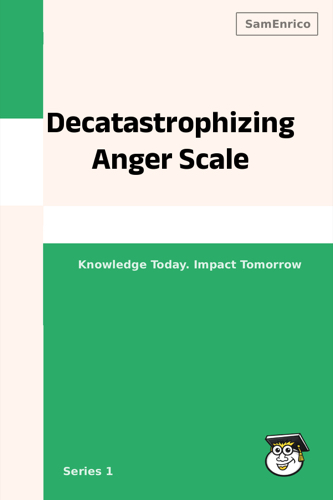
Non-FictionSelf-HelpDecatastrophizing
Decatastrophizing Anger Scale eBook
Rates feared outcomes from 0-100 to reduce perceiv
by Sanchez Jean
Rates feared outcomes from 0-100 to reduce perceived threat.
Formats
Free sample
Chapter 1: The Justification Trap--–- You are about to discover something that will fundamentally change how you experience anger, but first you need to hear a story that might make you uncomfortable. A few years ago, a man named Marcus came to my office and sat down in the chair across from me with the posture of someone who had been wronged by the entire universe. He was forty-two years old, successful in his career, married for fifteen years, and father to two teenagers. On paper, his life looked enviable. But Marcus was not enviable.
Marcus was miserable. And he was making everyone around him miserable too.The incident that finally brought him to therapy was, by his own admission, absurd. He had asked his fourteen-year-old daughter to unload the dishwasher before she went to school. She had forgotten. When Marcus came downstairs that evening and saw the dishwasher still full, he lost his mind.
He yelled at her for ten minutes. He called her lazy, irresponsible, and ungrateful. He told her that she never helped around the house and that she took him for granted. His daughter burst into tears, ran to her room, and did not speak to him for three days. His wife told him that if he ever spoke to their daughter like that again, she would leave.When Marcus recounted this to me, his face was red with remembered anger.
“She knows the rules,” he said. “I have told her a hundred times. She just doesn’t care. She thinks she can do whatever she wants.” I asked him what he was thinking in the moments between discovering the dishwasher and opening his mouth to yell. He paused.
Then he said, “I was thinking that she doesn’t respect me. That nothing I say matters. That I work my ass off for this family and no one appreciates it. That I am surrounded by people who take and take and never give.” He looked at me. “I was right to be angry.”Notice what Marcus did there.
He did not say, “I was right to yell.” He did not say, “I was right to call my daughter lazy.” He said, “I was right to be angry.” And in a narrow sense, he was correct. He had a preference. He preferred that his daughter unload the dishwasher. She had violated that preference. Anger is the emotion that arises when a preference is violated.
So yes, Marcus was right to feel some anger. But the anger he felt was not proportional to the event. He was not experiencing a 10 or a 20 on the anger scale. He was experiencing a 90. And that is the problem that this entire book exists to solve.The Hidden Mathematics of Rage Let me state the central argument of this book as simply as possible.
Every moment of anger contains a hidden mathematical equation. The equation has two variables: the objective severity of the event and your subjective rating of that event. The formula looks like this:Anger Intensity = Event Severity × Catastrophizing Multiplier The Event Severity is what actually happened. A forgotten dishwasher. A late partner.
A rude comment. A traffic jam. These events have an objective reality. They are not zero, but they are almost never catastrophic. The Catastrophizing Multiplier is the factor that your brain applies to the event based on your interpretation, your history, your mood, your stress level, and your beliefs about how the world should work.
When the multiplier is 1, your anger is proportional. When the multiplier is 10, your anger is ten times larger than the event justifies. When the multiplier is 100, you are experiencing rage at a level that belongs in a life-threatening emergency.Marcus had an event severity of maybe 15. A teenager forgetting a chore is mildly annoying. It is not dangerous.
It is not a betrayal. It is not evidence of characterological laziness. It is a teenager being a teenager. But Marcus applied a catastrophizing multiplier of 6. Fifteen times six is ninety.
He felt 90. He acted like the event was a 90. And then he destroyed his relationship with his daughter for three days because of a dishwasher.This is the Justification Trap. The trap works like this. First, something happens that violates your preferences.
Second, you notice the violation. Third, you interpret the violation as evidence of a much larger, much more threatening pattern. Fourth, you feel completely justified in your extreme response because, after all, the pattern is real. Marcus’s daughter really had forgotten the dishwasher. That was real.
But he used that small reality to build a much larger fiction: that she never helps, that she doesn’t respect him, that nothing he says matters, that his entire family takes him for granted. By the time he opened his mouth, he was no longer responding to a forgotten chore. He was responding to a fictional universe in which he was a martyr surrounded by ingrates.The most dangerous thing about the Justification Trap is that it always provides you with evidence for your rage. There is always a kernel of truth. Your partner really was late.
Your boss really did criticize you. Your friend really did cancel plans. That kernel of truth acts as a hall pass for your anger. You tell yourself, “See? I am right to be angry.
Look what they did.” And because you are right about the small thing, you assume you are right about the big thing too. But you are not. The big thing—the betrayal, the disrespect, the chronic pattern—is almost always a construction of your catastrophizing mind.Clean Fire vs. Dirty Fire Before we go any deeper into the mechanics of the Justification Trap, I need to make a distinction that will protect you from misunderstanding this entire book. I am not telling you that anger is bad.
I am not telling you that you should never feel angry. I am not telling you to become a passive doormat who smiles while being mistreated. Anger is a necessary human emotion. It signals boundary violations. It mobilizes energy for self-protection.
It tells you when something is wrong. That is what I call clean anger.Clean anger is proportional. It lasts as long as the threat lasts and no longer. It produces action that is effective, not destructive. If someone cuts in front of you in line, clean anger says, “Excuse me, I was here first.” If someone speaks disrespectfully, clean anger says, “I don’t appreciate that tone.” If someone breaks a promise, clean anger says, “I feel hurt when you don’t follow through.” Clean anger is a tool.
It is information. It is your friend. Clean anger is a campfire. It gives you warmth, light, and the ability to cook your food. It is useful and controllable.Dirty anger is something else entirely.
Dirty anger is clean anger plus catastrophizing. Dirty anger takes the same boundary violation and inflates it into a global indictment. “You always do this.” “You never listen.” “You are a terrible person.” “The world is unfair.” “I can’t stand this.” Dirty anger is not proportional. It lasts for hours or days after the event is over. It produces…
This is the end of the free sample. Get the eBook to keep going. Buy now
About this book
Details
- Author
- Sanchez Jean
- Publisher
- SamEnrico
- Language
- English
- Genre
- Non-Fiction, Self-Help, Decatastrophizing
- Released
- 2026-06-06
- Pages (approx.)
- 126
- Available as
- eBook, Audiobook

Read better in the ZLOADR app
Your eBooks on your phone or tablet. Sign in with your SamEnrico account and start reading.
More by Sanchez Jean
 The Workaholic's Hobby HandbookSanchez Jean$11.99
 Promotion Negotiation ConfidenceSanchez Jean$11.99
 NVC Role Playing Practice GuideSanchez Jean$11.99
 Apologizing After Work OutburstsSanchez Jean$11.99
 Winter Storm Emergency PlanningSanchez Jean$11.99
 Mindful Productivity GuideSanchez Jean$11.99
 Elizabeth I's Religious Compromise BlueprintSanchez Jean$11.99
 Cash Flow for Car WashesSanchez Jean$11.99
 The Burger Baron: Ray Kroc and the Rise of McDonald'sSanchez Jean$11.99
 The Great Penguin Rescue: Operation TabarinSanchez Jean$11.99
 The Last Crossing: The Prehistoric Odyssey of the Clovis PeopleSanchez Jean$11.99
 US LLC For Foreign Ecommerce SellersSanchez Jean$12.99
You may also like
 Hong Kong Handover 1997Dunn Johnnie$11.99
 Zumba For Postnatal Recovery CourseNeal Christian$11.99
 Zumba for BeginnersLadner Nikia$11.99
 YouTube Comment Mining GuideHumes Pandora$12.99
 Worry Box MeditationCarlin Rudy$11.99
 Workplace Stress MeditationNguyen Lynn$11.99
 Workplace Stress and Sleep RepairHawley Ivory$11.99
 Workplace Perfectionism CureDelaney Jeffry$11.99
 Workplace Injustice Anger GuideWallen Isabelle$11.99
 Work Addiction and Burnout LinkGreenwood Ester$11.99
 Women in Yoga and WellnessBeattie Galina$11.99
 Women in Stand Up ComedyChun Evangeline$11.99