
Non-FictionBiography / American Deserts
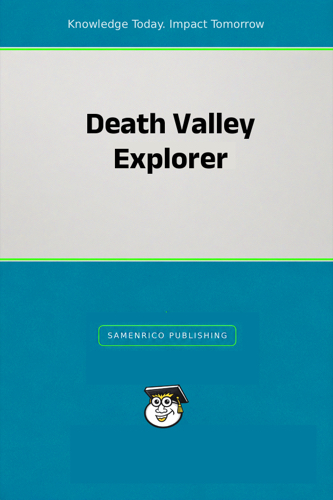
Death Valley Explorer
Crosses the hottest place on Earth on foot, ration
Crosses the hottest place on Earth on foot, rationing water to survive 120-degree days.
Formats
About this book
Free sample
Chapter 1: The Arithmetic of Dying...–- Ask a room of experienced backpackers how much water it takes to cross Death Valley on foot, and you will get a dozen different answers. Most will be wrong. Some will be deadly wrong. The correct answer is a number so absurd, so physically crushing, that the human mind instinctively rejects it. That rejection is the first step toward death.Let us begin with the math, because the math does not care about your feelings, your fitness level, or your history of overcoming adversity.
The math is a tyrant, and it demands obedience.A human being walking at a moderate pace of 2.5 miles per hour on flat ground in 120-degree heat with 10 percent humidity will sweat at a rate of approximately 1.5 quarts per hour. This is not a guess. This is a measured physiological fact, established by military research conducted in the Mojave Desert in the 1960s and confirmed by every subsequent study of exertional heat stress. The body produces sweat not to cool the skin directly but to create evaporative cooling. When that sweat evaporates, it pulls heat away from the body.
But the water must come from somewhere—specifically, from the fluid volume of your blood, your cells, and the space between them.Over the course of a ten-hour walking day, that 1.5 quarts per hour becomes 15 quarts. Fifteen quarts is 3.75 gallons. At 8.34 pounds per gallon, 3.75 gallons weighs 31.3 pounds. That is just the water you lose. To maintain fluid balance—to keep your blood thick enough to circulate, your kidneys perfused enough to filter waste, your brain floating in enough cerebrospinal fluid to function—you must replace what you lose.
The National Park Service's famous recommendation of one gallon per day is for stationary survival in the shade. Under load, in direct sun, the requirement triples.But here is where the math becomes cruel. A ten-day crossing of Death Valley from one edge to the other—say, from the Amargosa River bed near Shoshone to the Panamint Valley floor near Father Crowley Point—is approximately 100 miles. At 2.5 miles per hour, that is 40 hours…
This is the end of the free sample. Get the eBook to keep going. Buy now
Contents
- Chapter 1
- Chapter 2
- Chapter 3
- Chapter 4
- Chapter 5
- Chapter 6
- Chapter 7
- Chapter 8
- Chapter 9
- Chapter 10
- Chapter 11
- Chapter 12
Details
- Author
- Ocampo Latashia
- Publisher
- SamEnrico
- Language
- English
- Genre
- Non-Fiction, Biography / American Deserts
- Released
- 2026-06-10
- Pages (approx.)
- 112
- Available as
- eBook, Audiobook

Read better in the ZLOADR app
Your eBooks on your phone or tablet. Sign in with your SamEnrico account and start reading.
More by Ocampo Latashia
 Anki For Med SchoolOcampo Latashia$11.99
 Zumba Dance Fitness HandbookOcampo Latashia$11.99
 Analogical Thinking for BusinessOcampo Latashia$11.99
 Forgiving a NarcissistOcampo Latashia$11.99
 Managing Digital DistractionsOcampo Latashia$11.99
 Mindfulness for Cancer PatientsOcampo Latashia$11.99
 The Last Verdict of HammurabiOcampo Latashia$11.99
 The Corsair of the Cantabrian: The Pirate Who Defied Franco's FleetOcampo Latashia$11.99
 Sugar Beet (Duplicate): See Sugar Beet Harvesting GuideOcampo Latashia$11.99
 The Essential Guide to ThanksgivingOcampo Latashia$11.99
 How to Start a Artichoke Growing Business (Beginners Guide)Ocampo Latashia$11.99
 UK Business Credit Mistakes HandbookOcampo Latashia$12.99
You may also like
 Hong Kong Handover 1997Dunn Johnnie$11.99
 Zumba For Postnatal Recovery CourseNeal Christian$11.99
 Zumba for BeginnersLadner Nikia$11.99
 YouTube Comment Mining GuideHumes Pandora$12.99
 Worry Box MeditationCarlin Rudy$11.99
 Workplace Stress MeditationNguyen Lynn$11.99
 Workplace Stress and Sleep RepairHawley Ivory$11.99
 Workplace Perfectionism CureDelaney Jeffry$11.99
 Workplace Injustice Anger GuideWallen Isabelle$11.99
 Work Addiction and Burnout LinkGreenwood Ester$11.99
 Women in Yoga and WellnessBeattie Galina$11.99
 Women in Stand Up ComedyChun Evangeline$11.99