
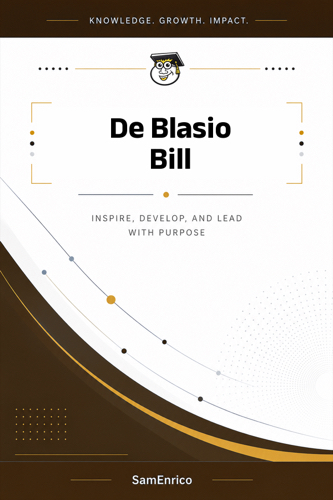
De Blasio Bill eBook
Reveals the progressive mayor's affordable housing
Reveals the progressive mayor's affordable housing.
Formats
Free sample
Chapter 1: The Brooklyn Laboratory...--The corner of Atlantic Avenue and Sheffield Street in East New York does not look like the front line of a war. On a cold Tuesday morning in March 2014, the intersection is unremarkable—a bodega with a flickering sign, a shuttered laundromat, a row of two-family homes with peeling paint and air conditioners jutting from windows like weary tongues. Across the street, a vacant lot is choked with knotweed and discarded tires. A dozen men in orange vests cluster around a temporary fence, smoking cigarettes and waiting for instructions. They are demolition crew, hired by the city to clear the lot for something new.What they do not yet know—what no one at this intersection fully understands—is that this vacant lot is about to become Ground Zero for the most ambitious affordable housing experiment in American history.
And what happens here over the next eight years will determine not just the fate of East New York, but the future of progressive urban policy nationwide.The lot at 1400 Atlantic Avenue is a paradox. It is simultaneously worthless and priceless. Worthless because nothing has grown on it but weeds and rumors for thirty years. Priceless because it sits at the crossroads of two rezoning districts, within walking distance of the Long Island Rail Road and three subway lines. In the language of city planners, it is "development-ready." In the language of the people who live around it, it is "the last open space we have."This tension—between what land is worth on paper and what it means to the people who live on it—is the central conflict of the de Blasio era.
And it is why East New York, of all the neighborhoods in New York City, became the mayor's chosen laboratory.To understand why de Blasio chose East New York, you have to understand what happened to this neighborhood in the twentieth century. The story is not unique in American cities, but it is especially brutal in its details. East New York was once a middle-class enclave of German and Italian immigrants, a place where factory workers could afford a row house with a small backyard. The 1910s and 1920s saw waves of Jewish families fleeing the Lower East Side, followed by African American families during the Great Migration. For a few decades, the neighborhood was a genuine melting pot—not wealthy, but stable.Then came the 1960s, and with them, the twin disasters of redlining and white flight.Redlining was not an accident.
It was a deliberate policy, enforced by the federal government through the Home Owners' Loan Corporation, which drew color-coded maps of every American city. Green and blue neighborhoods were deemed "low risk" and received mortgages. Yellow and red neighborhoods were deemed "hazardous" and were systematically starved of credit. East New York was colored red—hence the term "redlining." The map from 1938 still exists in the National Archives, a relic of bureaucratic cruelty. East New York is a deep, unmistakable crimson, like a wound on the page.The consequences were immediate and catastrophic.
Families who wanted to buy homes could not get loans. Landlords who wanted to repair buildings could not get financing. Property values collapsed. And as property values collapsed, landlords made a rational but morally indefensible choice: they stopped investing in their buildings. They extracted whatever rent they could and let the structures rot.
By 1975, when the city itself was on the brink of bankruptcy, East New York had become a national symbol of urban decay. In 1977, during the infamous blackout, the neighborhood burned. Hundreds of buildings were torched, some by arsonists working for landlords who wanted insurance payouts, others by residents who had simply given up.What remained was a moonscape of vacant lots and hollowed-out tenements. The city, which had foreclosed on thousands of tax-delinquent properties, became the unwilling landlord of a ruined neighborhood.This history matters because it created the conditions that de Blasio inherited. The vacant lot at Atlantic and Sheffield is not a natural phenomenon.
It is a scar. It is the physical residue of redlining, arson, disinvestment, and bureaucratic neglect. And it is one of thousands of such scars across East New York—an estimated 400 vacant lots and abandoned buildings, according to the Department of City Planning.But here is the paradox that de Blasio understood better than any of his predecessors: those scars also represented opportunity. In a city where land values had exploded under Mayor Michael Bloomberg—where a parking spot in Manhattan could sell for more than a house in Detroit—East New York remained cheap. A developer could buy a vacant lot in East New York for a fraction of what a similar lot would cost in Williamsburg or Long Island City.
And if the city rezoned that lot to allow taller buildings, the developer could build market-rate housing, set aside a percentage as "affordable," and still make a profit.This was the logic behind de Blasio's Mandatory Inclusionary Housing policy, which we will examine in detail later. But the seeds of that policy were planted in East New York, in the months before de Blasio even took office.In the summer of 2013, while de Blasio was still campaigning on a platform of ending the "Tale of Two Cities," his policy advisors were quietly studying the Bloomberg administration's rezoning of Williamsburg. That rezoning, completed in 2005, had transformed a post-industrial wasteland into a forest of luxury towers. It had also, critics argued, displaced thousands of working-class residents. The Bloomberg team had included a voluntary affordable housing component—developers could choose to include affordable units in exchange for extra height—but most chose not to.
The result was a neighborhood that had become wealthier and whiter, while the poor and the brown had been pushed deeper into Brooklyn.De Blasio's team wanted to avoid that outcome. They wanted a rezoning that would grow the housing supply without displacing the existing population. They wanted, in the slogan that would become ubiquitous in City Hall, "gentrification without displacement."East New York was the perfect test case for three reasons. First, its poverty was so deep that any economic improvement would be visible. If the rezoning succeeded, East New York would be a proof of concept that could be replicated across the city.
Second, its political landscape was fragmented. Unlike wealthy neighborhoods with powerful community boards and legal resources, East New York had few organized voices to oppose the rezoning—or to hold the city accountable if it failed. Third, and most cynically, East New York was far from Manhattan. A failed rezoning there would generate fewer headlines than a failed rezoning in a more visible neighborhood.But there was a fourth reason, one that de Blasio's aides rarely admitted in public: East New York was already gentrifying, whether the city admitted it or not. The clues were everywhere.
A new coffee shop had opened on Pennsylvania Avenue, staffed by baristas who did not live in the neighborhood. Real estate flyers appeared in mailboxes, offering cash for houses "in any condition." The median rent, which had been flat for a decade, began to inch upward. If the city did nothing, the private market…
This is the end of the free sample. Get the eBook to keep going. Buy now
About this book
Details
- Author
- Burrows Glenna
- Publisher
- SamEnrico
- Language
- English
- Genre
- Non-Fiction, Biography, Mayor
- Released
- 2026-06-05
- Pages (approx.)
- 135
- Available as
- eBook, Audiobook

Read better in the ZLOADR app
Your eBooks on your phone or tablet. Sign in with your SamEnrico account and start reading.
More by Burrows Glenna
 The Pet Loss Phone CallBurrows Glenna$11.99
 Eye Fixation Self Trance GuideBurrows Glenna$11.99
 The IBS Breathwork GuideBurrows Glenna$11.99
 Nuclear SMR CapitalBurrows Glenna$11.99
 Anger Trigger to ActionBurrows Glenna$11.99
 Sam Sheppard Co Defense LawyersBurrows Glenna$11.99
 OCD Recovery GuideBurrows Glenna$11.99
 Anger After Partner's AffairBurrows Glenna$11.99
 The Silk Road Tycoon: The Rise of the Swahili MerchantsBurrows Glenna$11.99
 Silicon Alchemist: The Untold Rise of the First Female Tech BillionaireBurrows Glenna$11.99
 Shadows of Versailles: The Secret Affair That Shook a KingdomBurrows Glenna$11.99
 How to Start a Meal of Dried Leguminous Vegetables Production Business (Beginners Guide)Burrows Glenna$11.99
You may also like
 Hong Kong Handover 1997Dunn Johnnie$11.99
 Zumba For Postnatal Recovery CourseNeal Christian$11.99
 Zumba for BeginnersLadner Nikia$11.99
 YouTube Comment Mining GuideHumes Pandora$12.99
 Worry Box MeditationCarlin Rudy$11.99
 Workplace Stress MeditationNguyen Lynn$11.99
 Workplace Stress and Sleep RepairHawley Ivory$11.99
 Workplace Perfectionism CureDelaney Jeffry$11.99
 Workplace Injustice Anger GuideWallen Isabelle$11.99
 Work Addiction and Burnout LinkGreenwood Ester$11.99
 Women in Yoga and WellnessBeattie Galina$11.99
 Women in Stand Up ComedyChun Evangeline$11.99