
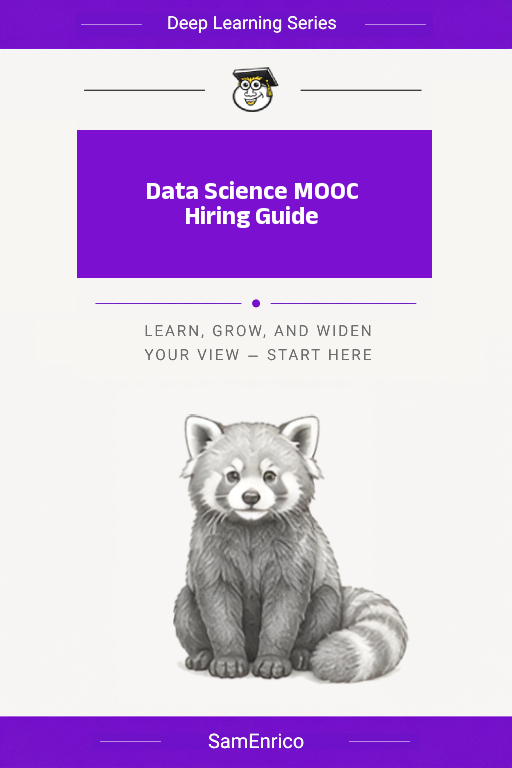
Data Science MOOC Hiring Guide eBook
Select data science certificates from IBM, Harvard
by Wills Lonny
Select data science certificates from IBM, Harvard, and DeepLearning.AI that lead to junior data scientist interviews.
Formats
Free sample
Chapter 1: The Unicorn Trap--–- The email arrived on a Tuesday afternoon. Sarah had been job hunting for eight months. She had completed fifteen data science certificates. She had spent over $10,000 on courses from Coursera, Udemy, ed X, and Data Camp. She had studied machine learning algorithms, deep learning architectures, natural language processing, computer vision, reinforcement learning, and time series analysis.
Her resume listed twelve programming languages and fourteen Python libraries. She had built projects that predicted stock prices, classified images of dogs and cats, and generated Shakespearean sonnets using LSTMs.She had applied to 537 jobs. She had received zero interview invitations.Not one.Sarah was not lazy. She was not unintelligent. She was not unlucky.
She was the victim of the Unicorn Trap — the seductive, destructive myth that companies want data scientists who can do everything. The myth that drives thousands of aspiring data scientists to spend years learning everything, only to discover that no one is hiring "everything." They are hiring SQL, Python, and statistics. That's it.This chapter is about the Unicorn Trap. It is about why most data science job seekers fail before they even get to the interview. It is about the brutal gap between what courses teach and what employers actually need.
And it is about the first, most important decision you will make on your journey: which role you are actually targeting.The Myth of the Unicorn Data Scientist Let us begin by naming the enemy. The Unicorn Data Scientist is a fantasy candidate invented by overzealous job descriptions and perpetuated by course providers who want to sell you more classes. This mythical being is simultaneously a statistician (inference, probability, experimental design), a software engineer (distributed systems, APIs, testing, version control), a machine learning expert (neural networks, transformers, LLMs, computer vision), a business strategist (ROI analysis, stakeholder management, product sense), and a data engineer (ETL pipelines, Spark, Airflow, cloud infrastructure).Job descriptions for "entry-level" positions often list twenty to thirty required skills. They ask for a Ph D in computer science, ten years of experience with Py Torch (which has only existed since 2016), and proficiency in Tableau, Power BI, AWS, Azure, GCP, Docker, Kubernetes, Tensor Flow, Scikit-learn, Pandas, Num Py, and "excellent communication skills."This is nonsense.No human being possesses all of these skills. The rare individuals who come close have fifteen years of experience and command salaries above half a million dollars.
They are not applying to junior roles. They are not reading this book. The job descriptions are wish lists, not requirements. But most candidates do not know that. They see the list, panic, and enroll in more courses.This is the Unicorn Trap.
You chase more skills, more certificates, more tools, believing that the next course will finally make you "qualified." But the trap is endless because the list is endless. You cannot finish chasing a fantasy. You can only stop chasing it.The Real Junior Data Scientist: Four Skills, Not Forty Let me tell you what companies actually need from a junior data scientist. I have spoken to hiring managers at over fifty companies, from startups to FAANG. Here is the consensus.A junior data scientist needs exactly four things.First, SQL.
You must be able to extract data from a database. This means joins (inner, left, outer), aggregations (GROUP BY, COUNT, SUM, AVG), window functions (ROW_NUMBER, RANK, LAG), and subqueries. You do not need to be a database administrator. You need to be able to write a query that answers a business question without taking down production.Second, Python. You must be able to manipulate data, clean it, and run basic analyses.
This means Pandas (merge, groupby, apply, pivot), Num Py (basic array operations), and the ability to write functions and classes. You do not need to be a software engineer. You do not need to know design patterns or metaclasses. You need to be able to take a messy CSV file and turn it into a clean dataset.Third, Statistics. You must understand the basics of inference.
This means p-values, confidence intervals, hypothesis testing (t-tests, chi-square, ANOVA), and linear regression. You do not need to derive maximum likelihood estimators from first principles. You need to know when to use a t-test versus a chi-square test and how to explain the result to a non-technical product manager.Fourth, Business Logic. You must be able to connect data analysis to business decisions. This means understanding what an A/B test is, how to measure ROI, and how to frame recommendations.
You do not need an MBA. You need to speak the language of the people who sign the checks.That is it. SQL, Python, statistics, and business logic. Four skills. Not forty.Everything else — deep learning, computer vision, natural language processing, reinforcement learning, graph databases, distributed systems — is specialization.
You will learn it on the job if you need it. Or you will learn it later, after you have a job. It is not required for entry. It is not even helpful for entry. In fact, it is often harmful.Why Extra Skills Hurt Your Resume Here is a truth that no course provider will tell you: listing too many skills makes you look unfocused.When a hiring manager sees a resume with Python, R, Java, Scala, C++, Java Script, HTML, CSS, Tensor Flow, Py Torch, Keras, Scikit-learn, XGBoost, Light GBM, Spark, Hadoop, Hive, Pig, Airflow, Tableau, Power BI, Looker, and Excel — all for a junior role — they do not think "genius." They think "this person has no idea what they want to do."Worse, they think "this person is going to be expensive to train." A candidate who claims to know fifteen tools actually knows none of them well.
The hiring manager has interviewed dozens of these resumes. They have learned that "familiar with" means "watched a video once." They have learned that "proficient in" means "completed a guided project." They have learned to filter out the generalists.The successful candidate is not the one with the longest skills list. It is the one with the most relevant skills list. SQL, Python, and statistics. That is the core.
Everything else is noise.The Trinity of Credentials If you only need three skill areas (SQL, Python, statistics), why do you need three certificates? Because no single certificate teaches all three well.This book introduces the Trinity of Credentials — a deliberate, strategic combination of three certificates, each chosen for a specific purpose.IBM Data Science Professional Certificate is the Corporate Standard. It teaches Python (Pandas, Num Py, Scikit-learn), SQL (database basics, joins, aggregations), and Jupyter notebooks. It does not teach deep statistics. That is fine.
It is not supposed to. It is supposed to teach you the tools that appear in job descriptions. IBM is the cert for keyword matching.Harvard X Data Science Professional Certificate is the Conceptual Anchor. It teaches the concepts of statistics: probability, inference, p-values, confidence intervals, hypothesis testing, linear models. It teaches these concepts using R, but this book recommends that you learn the concepts from Harvard and then implement them in Python (using libraries like Sci Py and Stats Models).
Harvard is the cert for statistical screening interviews.Deep Learning.AI provides Technical Depth. But — and this is critical — which…
This is the end of the free sample. Get the eBook to keep going. Buy now
About this book
Details
- Author
- Wills Lonny
- Publisher
- SamEnrico
- Language
- English
- Genre
- Non-Fiction, Student's Shortcut
- Released
- 2026-05-30
- Pages (approx.)
- 92
- Available as
- eBook, Audiobook

Read better in the ZLOADR app
Your eBooks on your phone or tablet. Sign in with your SamEnrico account and start reading.
More by Wills Lonny
 The Topical Pain Medication GuideWills Lonny$11.99
 The Calm Beginner GuideWills Lonny$11.99
 Coworking Virtual GuideWills Lonny$11.99
 Francis Rule of 1221Wills Lonny$11.99
 Loneliness In Marriage GuideWills Lonny$11.99
 The Fall of the Eternal City: Rome's Lost InnovationsWills Lonny$11.99
 Learn to Play the TaphonWills Lonny$11.99
 Amazon Seller App OperationsWills Lonny$11.99
 Founder Mindset for PivotWills Lonny$12.99
 How to Start a Pharmaceutical Non-medicament Products Business (Beginners Guide)Wills Lonny$11.99
You may also like
 Hong Kong Handover 1997Dunn Johnnie$11.99
 Zumba For Postnatal Recovery CourseNeal Christian$11.99
 Zumba for BeginnersLadner Nikia$11.99
 YouTube Comment Mining GuideHumes Pandora$12.99
 Worry Box MeditationCarlin Rudy$11.99
 Workplace Stress MeditationNguyen Lynn$11.99
 Workplace Stress and Sleep RepairHawley Ivory$11.99
 Workplace Perfectionism CureDelaney Jeffry$11.99
 Workplace Injustice Anger GuideWallen Isabelle$11.99
 Work Addiction and Burnout LinkGreenwood Ester$11.99
 Women in Yoga and WellnessBeattie Galina$11.99
 Women in Stand Up ComedyChun Evangeline$11.99