
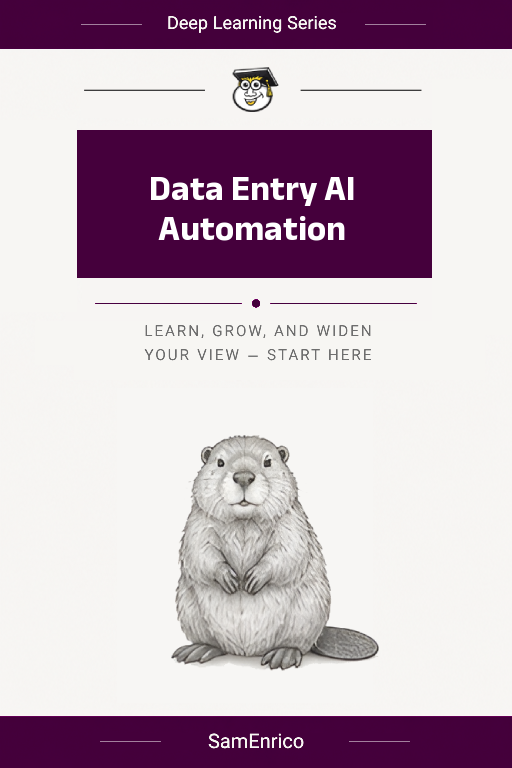
Non-FictionBusiness BriefAutomation Guide
Data Entry AI Automation eBook
Eliminate manual data entry with AI for small busi
Eliminate manual data entry with AI for small business accounting. OCR and auto-population.
Formats
Free sample
Chapter 1: The Keystroke Tax--–- At exactly 4:47 PM on a quiet Tuesday, a bakery owner named Sarah did something she would never admit to her accountant. She looked at a stack of 47 receipts spread across her kitchen table, glanced at the clock, and whispered to no one in particular, "I'll just guess." She estimated the amounts. She rounded the dates. She told herself she would "fix it later." Later never came. Three months after that, the IRS sent her a letter questioning 4,200indeductionsshecouldn′tsubstantiatebecausethethermalpaperreceiptshadfadedtoblankwhiteslips.The4,200 in deductions she couldn't substantiate because the thermal paper receipts had faded to blank white slips.
The 4,200indeductionsshecouldn′tsubstantiatebecausethethermalpaperreceiptshadfadedtoblankwhiteslips.The4,200 was gone. So were the six hours she had spent that night typing numbers into a spreadsheet—time she could have spent developing a new sourdough recipe that would have brought in $15,000 in annual revenue. The Keystroke Tax had claimed another victim.You are Sarah. Or you run a landscaping company. Or a law practice.
Or an online store selling handmade candles. Your industry doesn't matter. What matters is that right now, somewhere in your business, you are typing numbers that a machine could read for you. You are matching invoices to bank statements like a human spreadsheet. You are printing, scanning, filing, and forgetting.
And you are paying a tax that nobody tells you about—a tax measured not in dollars withheld by the government, but in hours stolen from your life and opportunities stolen from your business.This chapter is the moment you stop guessing and start counting. By the time you finish reading, you will know exactly how much money you are losing to manual data entry. You will understand why your brain fights you every time you open a spreadsheet. And you will be angry enough to never type a receipt again.The Silent Calculation You Have Never Done Let us perform a simple exercise. It will take ninety seconds.
It will change how you see your business.First, write down your hourly rate. If you are a solopreneur, use the rate you charge clients. If you are a business owner with employees, use the amount you would pay someone else to do your job. Be honest. If you bill 150perhourasaconsultant,write150 per hour as a consultant, write 150perhourasaconsultant,write150.
If you pay a bookkeeper 40perhour,write40 per hour, write 40perhour,write40. If you are not sure, use $75—the average hourly value of a small business owner's time according to the Small Business Administration.Second, estimate how many hours per week you spend on manual data entry. Not strategy. Not analysis. Not decision-making.
Pure typing: entering invoices, matching receipts, copying numbers from paper to screen, reconciling spreadsheets. Count the time you spend searching for that one missing receipt. Count the time you spend squinting at a blurry PDF. Count the time you spend fixing the typo you made last week. The average small business owner reports 4.7 hours per week.
Most are lying to themselves. Realistic number: 6 to 10 hours.Third, multiply your hourly rate by your weekly hours. Then multiply by 50 working weeks per year (allowing for two weeks of vacation, though you probably do not take them).Here is what Sarah discovered when she did the math: 85perhour×6hoursperweek×50weeks=85 per hour × 6 hours per week × 50 weeks = 85perhour×6hoursperweek×50weeks=25,500. Twenty-five thousand, five hundred dollars. That was the value of the time she burned typing receipts and invoices into Quick Books.
Add the 4,200inlostdeductionsfromthefadedreceipts.Addthe4,200 in lost deductions from the faded receipts. Add the 4,200inlostdeductionsfromthefadedreceipts.Addthe1,800 she paid her bookkeeper to clean up the mess. Her total Keystroke Tax for a single year was $31,500.She was not a large corporation. She was a baker with three employees and a single retail location. And she was losing thirty-one thousand dollars a year to manual data entry.Now do the calculation yourself.
Write the number down. Put it somewhere you can see it. That number is the cost of your current system. That number is the problem this book exists to solve.Why You Hate Data Entry (And Why That Matters)Here is something no productivity book has ever told you: your hatred of data entry is not a character flaw. It is a feature of your biology.Your brain is designed to solve problems, recognize patterns, and make decisions.
It is not designed to transfer numbers from a piece of paper into a digital field. That task—transcription—activates a completely different neural pathway than strategic thinking. When you type a receipt, your brain's prefrontal cortex (responsible for executive function) is actually suppressed. You enter a low-arousal, high-frustration state that psychologists call "tedium." Your cortisol levels rise. Your attention fragments.
Within twenty minutes of starting data entry, your cognitive performance on any other task drops by as much as 40 percent.This is not laziness. This is biology.The most successful business owners are not the ones who tolerate tedium. They are the ones who eliminate it. They understand a principle that most entrepreneurs learn too late: the work that feels like work is usually the work that should be automated. Data entry feels like work, but it is not strategic.
It is not creative. It does not grow your business. It simply maintains it. And maintaining a business by hand is a fool's errand in the age of artificial intelligence.When you avoid data entry—when you push the stack of receipts to the edge of your desk, when you mark that vendor invoice as "unread" for the sixth time—you are not being lazy. You are being rational.
Your brain is protecting you from a low-value, high-frustration activity. The problem is not your motivation. The problem is that you have not yet given your brain a better option.The Five Ugly Sources: Where Your Money Leaks Manual data entry does not arrive in a single, organized stream. It arrives through five ugly sources, each with its own hidden costs. These are the holes in your financial bucket.
Before you can plug them, you need to see them clearly.Source One: Paper Receipts The classic enemy. Paper receipts arrive from coffee shops, office supply stores, gas stations, restaurants, and hardware stores. They are printed on thermal paper that begins fading within thirty days and becomes illegible within six months. They accumulate in pockets, wallets, glove compartments, and the infamous shoebox. Their hidden cost is not just the typing time—it is the missed deductions.
The average small business loses $1,200 per year in unreimbursed expenses simply because a receipt became illegible or was lost before entry. For businesses with employee expense accounts, that number triples.Source Two: PDF Invoices Every vendor sends invoices differently. One sends a beautiful, machine-readable PDF with clearly labeled fields. Another sends a scanned image of a handwritten form that looks like it was faxed from 1995. A third sends a password-protected file that requires a login.
The hidden cost here is cognitive switching—the mental energy required to adapt to each new format. Every time you switch from a clean invoice to a messy one, you lose up to twenty seconds of processing time. Over a hundred invoices, that is thirty-three minutes of pure friction. Over a year, that is nearly…
This is the end of the free sample. Get the eBook to keep going. Buy now
About this book
Details
- Author
- Melendez Willodean
- Publisher
- SamEnrico
- Language
- English
- Genre
- Non-Fiction, Business Brief, Automation Guide
- Released
- 2026-06-01
- Pages (approx.)
- 136
- Available as
- eBook, Audiobook

Read better in the ZLOADR app
Your eBooks on your phone or tablet. Sign in with your SamEnrico account and start reading.
More by Melendez Willodean
 Mindful Pause Technique WorkbookMelendez Willodean$11.99
 The Rainbow Bridge WorkbookMelendez Willodean$11.99
 Complicated Grief After SuicideMelendez Willodean$11.99
 Operations Creative GuideMelendez Willodean$11.99
 The Cognitive Empathy GuideMelendez Willodean$11.99
 Love, Silk, and Stitches: The Secret Letters of a Wartime Fashion RevolutionMelendez Willodean$11.99
 Understanding Still's DiseaseMelendez Willodean$17.99
 Civil Engineering InternMelendez Willodean$11.99
 Source to Pay Technology StackMelendez Willodean$12.99
 How to Become a Sheller IiMelendez Willodean$11.99
You may also like
 Hong Kong Handover 1997Dunn Johnnie$11.99
 Zumba For Postnatal Recovery CourseNeal Christian$11.99
 Zumba for BeginnersLadner Nikia$11.99
 YouTube Comment Mining GuideHumes Pandora$12.99
 Worry Box MeditationCarlin Rudy$11.99
 Workplace Stress MeditationNguyen Lynn$11.99
 Workplace Stress and Sleep RepairHawley Ivory$11.99
 Workplace Perfectionism CureDelaney Jeffry$11.99
 Workplace Injustice Anger GuideWallen Isabelle$11.99
 Work Addiction and Burnout LinkGreenwood Ester$11.99
 Women in Yoga and WellnessBeattie Galina$11.99
 Women in Stand Up ComedyChun Evangeline$11.99