
Non-FictionSelf-HelpData Center
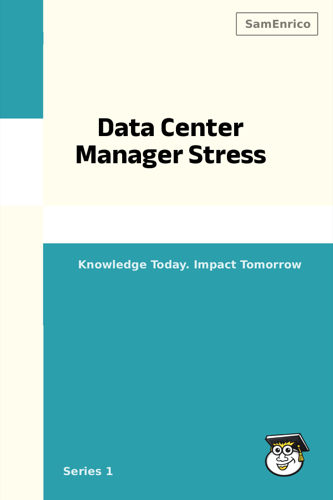
Data Center Manager Stress eBook
Handle uptime pressure, cooling failure risk, and
by Puente Micah
Handle uptime pressure, cooling failure risk, and outage response.
Formats
Free sample
Chapter 1: Your Lying Brain--–- The alarm cuts through the silence at 3:47 AM. You are awake in 0.3 seconds, your heart already pounding before your conscious mind knows why. The pager—because yes, even in the age of smartphones, data center managers still carry pagers for exactly this reason—reads: “CRITICAL: CHILLER PLANT – FLOW LOSS – RACK INLET TEMP RISING.” You have run this scenario a hundred times in training. You know the procedure cold. And yet, as you swing your legs out of bed, something strange happens.
Your mind goes blank. Not empty—chaotic. A thousand possibilities race through your head at once: Is it a sensor fault? A pump VFD failure? A construction crew cutting the wrong pipe at 2 AM?
You reach for your phone to call the NOC, but you cannot remember the night shift supervisor’s name. You have worked with him for three years. His name is Mike. Or Mark. Or maybe Matt.
You genuinely cannot retrieve it.This is not a memory problem. This is not incompetence. This is your brain lying to you.Welcome to the physiology of uptime pressure. And make no mistake: the lie your brain tells you in this moment is the single greatest threat to your facility’s Mean Time To Repair. Not the aging chiller.
Not the undersized generator. Not the budget cuts that delayed that UPS replacement. Your own neurochemistry.The Cortisol Cascade Let us start with what happens inside your body the instant that alarm sounds. The amygdala—your brain’s smoke detector—perceives a threat. Not a physical threat to your body, but a threat to a goal you have internalized as survival-critical: uptime.
Your amygdala does not distinguish between a tiger in the bush and a temperature spike in Row C. Threat is threat. Within milliseconds, it triggers your hypothalamic-pituitary-adrenal (HPA) axis. Cortisol floods your system. Adrenaline follows.Here is what that does to your cognitive performance:Working memory collapses.
The prefrontal cortex, which holds your procedures, checklists, and training, literally down-regulates under high cortisol. The technical term is “transient hypofrontality.” In plain English: your executive function goes offline. You cannot hold multiple variables in your head at once. You forget steps you have practiced fifty times.Time perception distorts. Some managers report that seconds stretch into minutes during an alarm—they feel they have forever to decide, so they overthink.
Others experience the opposite: minutes compress into seconds, leading to rushed, incomplete diagnoses. Both are wrong. Both are dangerous.Emotional regulation vanishes. The amygdala overrides the prefrontal cortex’s ability to inhibit fear and anger. You become irritable, short with your team, or paradoxically silent and withdrawn.
Either way, communication—the lifeblood of incident response—degrades immediately.This is the cortisol cascade. It is automatic. It is physiological. And it is entirely invisible to the person experiencing it. You do not feel yourself losing working memory.
You just feel panicked. And then you feel ashamed of feeling panicked. And that shame triggers another cortisol spike. A vicious cycle—if your goal is to make things worse.System One Versus System Two: The Forced Downgrade The psychologist Daniel Kahneman, in his book Thinking, Fast and Slow, popularized a useful distinction between two modes of thought. System 1 is fast, automatic, intuitive, and emotional.
It is what lets you catch a ball without calculating trajectories or recognize a friend’s face in a crowd. System 2 is slow, deliberate, analytical, and logical. It is what you use to solve a math problem or debug a complex code issue.Under normal conditions, your brain switches between these systems fluidly. You use System 2 when you need to, System 1 the rest of the time. Under acute stress—like a 3:47 AM cooling alarm—your brain forcibly downgrades to System 1.
It is not a choice. It is a survival mechanism inherited from your ancestors who needed to run from predators, not analyze them.Here is the problem for data center managers: System 1 is terrible at troubleshooting.System 1 relies on heuristics—mental shortcuts that usually work but systematically fail in novel or complex situations. When your chiller plant fails, System 1 will scream at you to do something—anything—that has worked before. Maybe last month a sensor fault triggered a false alarm, and a simple reset fixed it. System 1 will drive your hand toward that reset button before System 2 can ask: “Is this actually a sensor fault, or is this a real flow loss?”This is how cascading failures happen.
A manager bypasses a safety interlock because “it was fine last time.” A technician reseats the wrong breaker because “that is the one that tripped in the drill.” A team leader ignores a secondary alarm because “the primary one is probably the real issue.” Every one of these is System 1 overriding System 2.The most dangerous sentence in any data center is not “the generator won’t start.” It is: “I have seen this before.”Tunnel Vision: The Silent Killer Among all the stress-induced cognitive impairments, tunnel vision is the most operationally destructive. Here is what it looks like from the inside: you are staring at an alarm screen, completely focused on a single parameter—let us say, supply air temperature from CRAH unit number four. You watch it climb: 72 degrees, 74 degrees, 76 degrees. You are calculating rate of rise, cross-referencing against your thermal coast time, deciding whether to call the utility or start the backup chiller.What you do not notice is that three other alarms have appeared at the bottom of the screen. One indicates a separate issue: a pump VFD in the secondary loop is reporting high vibration.
Another shows that the BMS has lost communication with half the temperature sensors in Row D. A third—the most critical—indicates that the backup generator’s coolant temperature is already above normal, suggesting a maintenance issue that will matter profoundly if you need that generator.You do not see any of this. Your visual field has narrowed to a cone of about 30 degrees, centered on that one CRAH unit’s temperature readout. The rest of the screen might as well be blank.Auditory exclusion accompanies tunnel vision. Your team is talking to you.
The night shift technician is asking, “Should I call the facilities supervisor?” The NOC operator is reporting, “The UPS is showing a battery temperature anomaly.” The automated voice from the fire suppression system is saying something about a “pre-action valve status change.”You do not hear any of them. Not because you are ignoring them—because your auditory cortex has literally deprioritized any input that is not directly related to your current focus. The human brain can only process so much sensory information under stress. It ruthlessly discards everything it deems non-essential.The tragedy is that the brain is a terrible judge of what is essential.The Self-Assessment Checklist You Did Not Know You Needed Because stress-induced cognitive degradation is invisible to the person experiencing it, data centers need external checks—not just on equipment, but on operators. The following self-assessment checklist is designed not for retrospective reflection but for real-time use during an incident.
You should train your entire team to run through this checklist in their heads during the first 30 seconds of…
This is the end of the free sample. Get the eBook to keep going. Buy now
About this book
Details
- Author
- Puente Micah
- Publisher
- SamEnrico
- Language
- English
- Genre
- Non-Fiction, Self-Help, Data Center
- Released
- 2026-06-08
- Pages (approx.)
- 134
- Available as
- eBook, Audiobook

Read better in the ZLOADR app
Your eBooks on your phone or tablet. Sign in with your SamEnrico account and start reading.
More by Puente Micah
 The Addiction Relapse Prevention GuidePuente Micah$11.99
 The Gut Directed CBT GuidePuente Micah$11.99
 Social Comparison CurePuente Micah$11.99
 Parental Anger at Spoiled BehaviorPuente Micah$11.99
 The Forger’s Gambit: How a Journalist Uncovered the Greatest Art Scam of the CenturyPuente Micah$11.99
 Understanding Thrombocytopenia PurpuraPuente Micah$17.99
 Residential Property ManagerPuente Micah$11.99
 How to Start a Doors (wholesale) Business (Beginners Guide)Puente Micah$11.99
 Google Forms Survey GuidePuente Micah$12.99
 Payment Escrow for High RiskPuente Micah$12.99
You may also like
 Hong Kong Handover 1997Dunn Johnnie$11.99
 Zumba For Postnatal Recovery CourseNeal Christian$11.99
 Zumba for BeginnersLadner Nikia$11.99
 YouTube Comment Mining GuideHumes Pandora$12.99
 Worry Box MeditationCarlin Rudy$11.99
 Workplace Stress MeditationNguyen Lynn$11.99
 Workplace Stress and Sleep RepairHawley Ivory$11.99
 Workplace Perfectionism CureDelaney Jeffry$11.99
 Workplace Injustice Anger GuideWallen Isabelle$11.99
 Work Addiction and Burnout LinkGreenwood Ester$11.99
 Women in Yoga and WellnessBeattie Galina$11.99
 Women in Stand Up ComedyChun Evangeline$11.99