
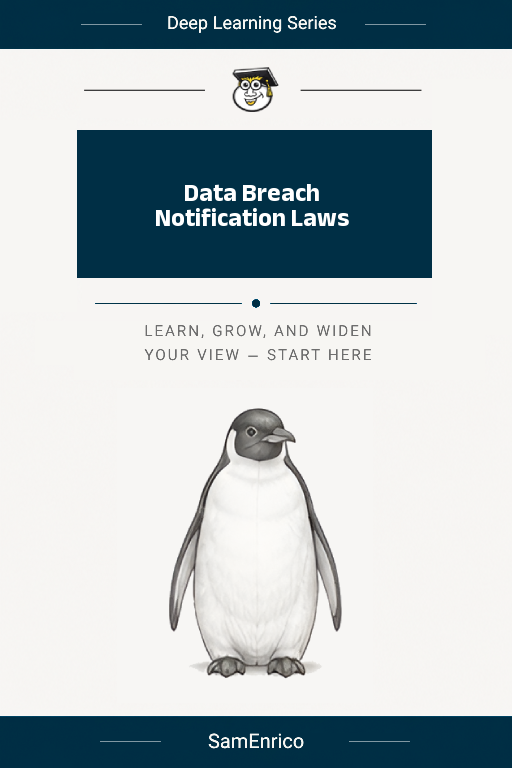
Non-FictionAnnual CheckupCross SectorBreach
Data Breach Notification Laws eBook
Comply with data breach notification requirements
Comply with data breach notification requirements across fintech, healthtech, and edtech sectors by state.
Formats
Free sample
Chapter 1: The $450,000 Lunch Code--–- The breach alert arrived at 2:14 AM on a Tuesday. Maria Chen, the Chief Privacy Officer of a rapidly growing Edtech platform called Learn Well, stared at the forensic report in disbelief. The report stated that an unauthorized actor had accessed a database containing student records from twelve different school districts across seven states. The data fields included student names, email addresses, and a column labeled “meal_eligibility_code.” Maria had reviewed the data inventory just six months earlier. She knew that student lunch codes were not considered personally identifiable information under FERPA, the federal education privacy law.
She knew that no Social Security numbers, no credit card numbers, and no health records had been accessed. She made a decision that would cost her company $450,000 and her career its upward trajectory. She decided not to notify anyone.Eight months later, Maria sat across from the New York Attorney General’s lead investigator, who slid a document across the table. The document cited New York Education Law Section 2-d, a statute Maria had never read. It defined “personally identifiable information” for students to include, among other things, “a student’s lunch account number or code when combined with a name.” The investigator explained that Learn Well had failed to notify the families of 8,900 students, had delayed notifying the school districts, and had compounded the violation by submitting a breach report that stated, falsely under New York law, that “no PII was compromised.” The proposed settlement was $450,000.
Maria’s company would also be required to hire an independent privacy monitor for three years. Her boss, the CEO, asked her one question in the hallway afterward: “How did we not know that lunch codes count?”This chapter answers that question. It reveals the dangerous illusion that “personal information” is a universal concept that means the same thing in every state and under every federal law. It explains why the breach notification trigger is not a single on-off switch but a complex matrix of definitions that change based on where your customer lives, what sector you operate in, and what data elements you store. And it provides the first practical tool you will need: a method for conducting a Data Element Inventory that tags every field in your database by its legal status across fifty states, not just its technical format.The chapter opens with a case study that will be referenced throughout this book—Learn Well’s $450,000 mistake—because it illustrates the single most common error in data breach response: assuming that if you understand federal definitions, you understand the law.
You do not. Federal laws like FERPA, GLBA, and HIPAA establish floors, not ceilings. State laws can, and frequently do, define “personal information” more broadly, include data elements that federal law ignores, and impose obligations that federal law does not contemplate. The result is a patchwork of fifty-one different definitions of what constitutes a reportable breach (fifty states plus the District of Columbia), each with its own list of triggering data elements. A breach that is not reportable in Alabama may be a mandatory notification event in California, a criminal violation in New York, and a class action feeding frenzy in Illinois.This book is organized around the Tri-Sector Framework: Fintech, Healthtech, and Edtech.
These three sectors face the most complex and overlapping regulatory requirements because they sit at the intersection of federal sectoral laws (GLBA, HIPAA, FERPA) and state breach notification laws. A Fintech company that holds health savings accounts is simultaneously subject to financial data rules and health data rules. An Edtech platform that offers student mental health surveys is simultaneously subject to education privacy laws and health privacy laws. A Healthtech wearable that integrates with a corporate wellness program may be subject to no federal law at all—but multiple state laws that treat fitness data as protected health information.Understanding the Illusion of Standard PIIThe term “personally identifiable information,” or PII, appears in countless privacy policies, data inventory spreadsheets, and breach response playbooks. It is almost always used as if it has a single, fixed meaning.
It does not. The Federal Trade Commission has issued guidance defining PII as information that can be used to distinguish or trace an individual’s identity, either alone or when combined with other information. That is a deliberately broad and flexible definition. But state breach notification laws do not use the FTC’s definition. They use their own statutory definitions, which vary in three critical dimensions: (1) which data elements are included, (2) whether the elements must be unencrypted, and (3) whether the combination of name plus one other element creates a trigger or whether multiple elements are required.Consider the humble email address.
In Alabama, a name plus an email address is not a reportable breach because Alabama’s definition of personal information includes only a name plus a Social Security number, driver’s license number, or financial account number. In California, a name plus an email address is a reportable breach—but only if the email address is combined with a password or security question answer that would permit access to the account. In New York, a name plus an email address is not sufficient on its own, but a name plus an email address plus a student lunch code is sufficient under the state’s education privacy law. In Illinois, a name plus an email address is not a breach under the general breach notification law, but if that email address is associated with a biometric identifier (like a face scan or fingerprint), the entire calculation changes.The Learn Well case illustrates the trap. The company’s data inventory correctly identified lunch codes as non-PII under FERPA, the federal law that governed its contracts with school districts.
But FERPA is not a breach notification law. It is a privacy law that sets conditions for the disclosure of education records. When a breach occurs, state law governs notification, not FERPA. New York’s Education Law Section 2-d explicitly includes “a student’s lunch account number or code, when combined with a name” in its definition of personally identifiable information. Learn Well’s privacy officer was trained to think about federal definitions.
She was not trained to think about the fifty state definitions that actually control breach notification.The Sector-Specific Definitions You Cannot Ignore To navigate the patchwork, you must understand three federal frameworks not because they define breach notification triggers but because they define data categories that states then incorporate by reference or expand upon. These frameworks are FERPA (education), GLBA (financial), and HIPAA (health). Each creates a baseline set of protected data elements. Each has its own breach notification rule that applies to covered entities. And each interacts with state laws in ways that create conflicts and overlaps.FERPA (Family Educational Rights and Privacy Act) applies to educational agencies and institutions that receive federal funding.
It defines “education records” broadly to include virtually any record directly related to a student and maintained by the school. However, FERPA does not apply directly to Edtech vendors. Vendors are typically treated as “school officials” with a “legitimate educational interest” through contract. When an Edtech vendor experiences a breach, the school—not the…
This is the end of the free sample. Get the eBook to keep going. Buy now
About this book
Details
- Author
- Oconnor Tuyet
- Publisher
- SamEnrico
- Language
- English
- Genre
- Non-Fiction, Annual Checkup, Cross Sector, Breach
- Released
- 2026-05-29
- Pages (approx.)
- 156
- Available as
- eBook, Audiobook

Read better in the ZLOADR app
Your eBooks on your phone or tablet. Sign in with your SamEnrico account and start reading.
More by Oconnor Tuyet
 Loving Kindness for Political Polarization WorkbookOconnor Tuyet$11.99
 Self Talk for Spiritual CrisisOconnor Tuyet$11.99
 Religious Difference Relationship GuideOconnor Tuyet$11.99
 Strength Band Workout SeniorsOconnor Tuyet$11.99
 Beginner Mindfulness for SurgeonsOconnor Tuyet$11.99
 The First Lady Who Defied a King: The Untold Story of Queen Elizabeth The Queen MotherOconnor Tuyet$11.99
 The Frozen Rescue: The Legend of the Pamir Ice WarriorsOconnor Tuyet$11.99
 Understanding Dementia, VascularOconnor Tuyet$17.99
 How to Become a CharterOconnor Tuyet$11.99
 Bilkent University GuideOconnor Tuyet$12.99
You may also like
 Hong Kong Handover 1997Dunn Johnnie$11.99
 Zumba For Postnatal Recovery CourseNeal Christian$11.99
 Zumba for BeginnersLadner Nikia$11.99
 YouTube Comment Mining GuideHumes Pandora$12.99
 Worry Box MeditationCarlin Rudy$11.99
 Workplace Stress MeditationNguyen Lynn$11.99
 Workplace Stress and Sleep RepairHawley Ivory$11.99
 Workplace Perfectionism CureDelaney Jeffry$11.99
 Workplace Injustice Anger GuideWallen Isabelle$11.99
 Work Addiction and Burnout LinkGreenwood Ester$11.99
 Women in Yoga and WellnessBeattie Galina$11.99
 Women in Stand Up ComedyChun Evangeline$11.99