
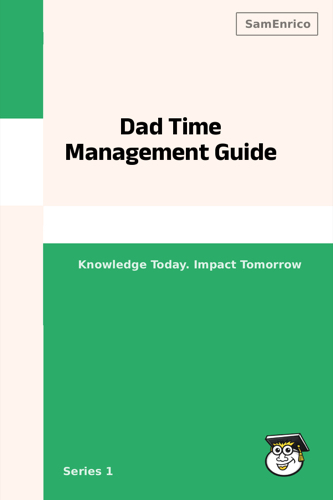
Non-FictionSelf-Help / Fatherhood
Dad Time Management Guide eBook
undefined
by Baker Penny
undefined
Formats
Free sample
Chapter 1: The Tug-of-War Lie--–- Mike’s hands were still on the steering wheel, even though the engine had been off for seven minutes. He sat in his driveway, watching the light flicker in his daughter’s bedroom window. She was supposed to be asleep by now. Instead, the light meant she was still awake, and she was still awake because she had been waiting for him. He had promised to read her a story tonight.
He had promised, and then a client had called at 4:55 PM with an “emergency” that turned out to be a formatting question, and Mike had stayed until 6:30 PM because he wanted to prove he was committed, because his colleague had been laid off last quarter, because he was afraid.He walked inside at 6:45 PM. His wife gave him a look—not angry, just tired. “She held out until 6:30,” she said. “Then she cried herself to sleep.” Mike stood in the kitchen, still wearing his work bag, still holding his phone, still vibrating with the energy of eight unread emails. He ate cold leftovers standing up.
He scrolled Twitter for twenty minutes. He went to bed at 10 PM and lay awake until midnight, replaying the day: the missed story, the unnecessary late meeting, the fact that he had been physically present for exactly ninety minutes with his daughter and had spent forty-five of those minutes checking his phone.This is not a story about a bad father. Mike is a good father. He loves his daughter. He provides for her.
He shows up to parent-teacher conferences. He remembers to pack the allergy-friendly snacks. And yet, lying in the dark, he felt like a failure. Because the dominant story of modern fatherhood told him that if he was succeeding at work, he must be failing at home—and vice versa. That story is called “work-life balance,” and it is a lie.The Myth of the Seesaw For the past forty years, the phrase “work-life balance” has been sold to working parents as the holy grail.
The metaphor is a seesaw: work on one side, life on the other. When work goes up, life goes down. When life goes up, work goes down. The goal, supposedly, is to keep them perfectly level—equal hours, equal energy, equal attention. This metaphor is everywhere.
It appears in HR seminars, in parenting articles, in the sympathetic nods of other exhausted dads at the playground.There is only one problem with the seesaw. It does not exist. Not for any working parent, and certainly not for fathers.The seesaw model assumes that work and life are locked in a zero-sum competition: every minute given to work must be stolen from family, and every minute given to family must be stolen from work. This assumption creates chronic, low-grade guilt that follows you from the office to the dinner table and back again. At work, you feel guilty for leaving at 5 PM.
At home, you feel guilty for checking email. On vacation, you feel guilty for not answering messages. On Saturday morning, you feel guilty for wanting to sleep in. The guilt becomes so constant that you stop noticing it—it becomes the weather of your life. But it is always there, eroding your presence, your patience, and your sense of being a good father.The research is clear.
A 2019 study published in the Journal of Marriage and Family found that fathers who reported high levels of work-family conflict also reported lower levels of parental satisfaction, higher rates of anxiety, and significantly less engagement with their children—not because they worked more hours, but because they believed they were supposed to feel torn. The belief itself was the problem.This chapter is going to do something radical. It is going to take the seesaw and throw it in the trash. In its place, we are going to build something that actually works for real dads with real jobs, real exhaustion, and real love for their kids. That something is called Integration.What Integration Actually Means Integration is not balance.
Balance implies equal parts. Integration implies that your roles as provider, caregiver, partner, and person can overlap, support each other, and even strengthen each other—if you stop trying to keep them separate.Think about the best day you have had as a father in the past month. Not a vacation day or a holiday—a regular Tuesday or Thursday. What made it good? Chances are, it was not a day where you worked exactly eight hours and spent exactly three hours with your kids.
More likely, it was a day where something worked: you left work a little early and caught the last twenty minutes of soccer practice, or you took a call on speakerphone while making dinner and your daughter “helped” by dumping too much salt into the pasta water, or you brought your laptop to the library on Saturday morning and worked while your kids read next to you. On that day, your roles did not compete. They coexisted. That is Integration.Integration does not mean you never work late. It means you stop pretending that working late is a sin against your family.
Integration does not mean you never miss a bedtime. It means you stop using missed bedtimes as evidence that you are failing. Integration means accepting that some weeks will tilt toward work and some weeks will tilt toward home, and neither tilt is a moral failure.The most important word in Integration is “and.” Not “work or family.” Not “work versus family.” Work and family. You are a provider and a caregiver. You are ambitious and you are loving.
You are exhausted and you are present. The “and” is where real fatherhood lives.The Three Lies Dads Believe (And Why They Keep You Stuck)Before we can build a better system, we have to clear out the wreckage of the old one. Most dads are running on three deeply embedded lies. These lies are not taught in any manual, but they are absorbed from culture, from workplace norms, and from the quiet voices of other exhausted men who have also never questioned them.Lie Number One: “Busy Equals Important.”This is the most seductive lie of all. In most workplaces, busyness has become a proxy for value.
The person who answers emails at 10 PM is seen as dedicated. The person who has back-to-back meetings is seen as in demand. The person who leaves at 4:30 PM to pick up a sick kid is seen as less serious. You have internalized this equation: if you are not busy, you are not important. So you fill your calendar.
You say yes to every request. You keep your inbox at zero. You stay late to prove you are committed. And then you wonder why you have no energy for your kids.Here is the truth that will set you free: busyness and effectiveness are not the same thing. Busyness is doing many things.
Effectiveness is doing the right things. A dad who spends three hours organizing his garage is busy. A dad who spends fifteen minutes having a real conversation with his daughter about her day is effective. One feels productive.…
This is the end of the free sample. Get the eBook to keep going. Buy now
About this book
Details
- Author
- Baker Penny
- Publisher
- SamEnrico
- Language
- English
- Genre
- Non-Fiction, Self-Help / Fatherhood
- Released
- 2026-06-06
- Pages (approx.)
- 139
- Available as
- eBook, Audiobook

Read better in the ZLOADR app
Your eBooks on your phone or tablet. Sign in with your SamEnrico account and start reading.
More by Baker Penny
 Public Speaking CalmBaker Penny$11.99
 Comparison Cure Imposter GuideBaker Penny$11.99
 The English Reformation BloodshedBaker Penny$11.99
 Neurodivergent Listening GuideBaker Penny$11.99
 Contract Abstraction Fine Tuning GuideBaker Penny$11.99
 Constipation AssessmentBaker Penny$11.99
 Ancestral Grief Leadership GuideBaker Penny$11.99
 Toussaint LouvertureBaker Penny$11.99
 The Symphony of the Sun: Black Composers Who Shaped the Classical WorldBaker Penny$11.99
 The Silent Uprising: How a Forgotten Radio Broadcast Triggered a RevolutionBaker Penny$11.99
 The Boy Who Tamed the Wind: William Kamkwamba’s Ingenious DreamBaker Penny$11.99
 How to Start a Hobby in Collecting Bottles and CansBaker Penny$11.99
You may also like
 Hong Kong Handover 1997Dunn Johnnie$11.99
 Zumba For Postnatal Recovery CourseNeal Christian$11.99
 Zumba for BeginnersLadner Nikia$11.99
 YouTube Comment Mining GuideHumes Pandora$12.99
 Worry Box MeditationCarlin Rudy$11.99
 Workplace Stress MeditationNguyen Lynn$11.99
 Workplace Stress and Sleep RepairHawley Ivory$11.99
 Workplace Perfectionism CureDelaney Jeffry$11.99
 Workplace Injustice Anger GuideWallen Isabelle$11.99
 Work Addiction and Burnout LinkGreenwood Ester$11.99
 Women in Yoga and WellnessBeattie Galina$11.99
 Women in Stand Up ComedyChun Evangeline$11.99