
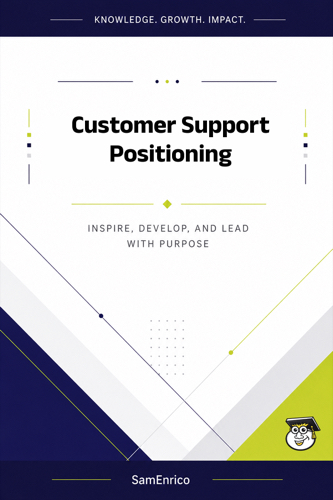
Customer Support Positioning eBook
Plot competitors on response time versus resolutio
by Holiday Riva
Plot competitors on response time versus resolution quality dimensions.
Formats
Free sample
Chapter 1: The Speed Trap--–- The CEO of a mid-sized Saa S company once told me, with genuine pride, “We reply to every customer in under sixty seconds.” He had the dashboard to prove it. His support team was fast. Blazing fast. And his churn rate was 42 percent per year. He could not understand why.
“We’re the fastest in our industry,” he said, genuinely baffled. “Shouldn’t customers love us?”He had fallen into what this book calls The Speed Trap.The Speed Trap is the seductive but false belief that faster responses equal happier customers. It is reinforced by every customer service conference, every vendor dashboard, and every well-meaning blog post that celebrates “blazing fast response times” as the ultimate badge of honor. Companies race to advertise “reply in under one minute” on their status pages. They bonus agents on Average Handle Time.
They celebrate the auto-reply as a sign of efficiency.But the data tells a very different story.The Data That Changes Everything The Aberdeen Group, a leading business research firm, analyzed hundreds of companies across multiple industries. They asked two simple questions. First: “What do companies believe is the most important driver of customer loyalty?” Eighty-seven percent of companies ranked response time as their top priority. Speed was king. Faster was better.Then they asked customers the same question.
Customers ranked “resolution quality” and “agent knowledge” at 6.9 out of 7 in importance—significantly higher than speed. The gap was enormous. Companies were obsessed with how fast they replied. Customers were obsessed with whether the reply actually solved their problem.This gap is not a minor miscalculation. It is a fundamental misalignment of priorities that costs billions of dollars in churn every year.
Companies are racing to be fast while customers are begging them to be right.Let me give you a concrete example. A telecommunications company I consulted with had a first-response time of under two minutes. They were proud of this. But their Time to Full Resolution—the total time from first contact to permanent fix—averaged eleven days. Eleven days of back-and-forth, repeated explanations, and escalating frustration.
Customers would call, get a fast auto-reply, wait three days, get a partial answer, call again, wait another two days, and eventually cancel.The company measured speed. The customer experienced a slow, painful death by a thousand cuts.The Myth of the Instant We live in an era of instant gratification. Amazon delivers packages the same day. Uber arrives in minutes. Chat GPT answers questions in seconds.
This cultural expectation has bled into customer support, creating a widespread belief that speed is the only differentiator that matters.But there is a critical distinction that most companies miss. Transactional expectations are not the same as relational expectations.When you order a pizza, you want it fast. The transaction is simple: pizza arrives, pizza is eaten, transaction ends. Speed matters.When you have a complex technical problem with your accounting software, you do not want a fast wrong answer. You want a correct answer, even if it takes time.
The relationship is ongoing. A fast wrong answer damages trust more than a slow correct answer.This distinction is the foundation of everything in this book. You cannot apply the same speed logic to every customer interaction. Yet that is precisely what most companies do. They treat a password reset the same as a production outage.
They treat a billing question the same as a data loss emergency. They measure speed uniformly across every channel, every issue, and every customer.This is a recipe for disaster.The 42 Percent Churn Example Let me return to the CEO I mentioned at the beginning of this chapter. His company sold project management software to small businesses. His support team was small—eight agents handling about two thousand tickets per month. Their average first-response time was forty-seven seconds.
They were genuinely fast.But here is what the CEO did not know until we dug into the data. Fifty-three percent of his tickets were repeat contacts from the same customers. A customer would ask a question, get a fast but incomplete answer, then ask again, then get another fast but incomplete answer, then ask a third time. Each individual response was fast. The overall resolution was agonizingly slow.The agents were measured and bonused on first-response time.
So they optimized for what got measured. They would reply quickly with a templated answer that addressed the surface question but not the underlying problem. Then they would close the ticket. The customer would reopen it. The cycle would repeat.The agents were not lazy or malicious.
They were responding rationally to the incentives they had been given. The company had built a system that rewarded speed and punished depth. And the customers—the ones who experienced this system—voted with their wallets. Forty-two percent of them left each year.When I presented this data to the CEO, he was silent for a long time. Then he said, “So we’re losing customers because we’re too fast?”“You’re losing customers because you’re fast and wrong,” I said.
“Fast and wrong is worse than slow and right.”Introducing the Support Positioning Matrix This book is built around a single, powerful framework: The Support Positioning Matrix. It is a simple 2x2 grid that plots two dimensions:Response Time (fast versus slow)Resolution Quality (low versus high)Every company, whether they know it or not, occupies one of four quadrants:Quadrant 1: The Chatbot Zone (Fast + Low Quality)This is where most companies live. They reply quickly, but the replies are shallow, incomplete, or wrong. Customers get an answer in minutes, but the answer does not solve the problem. The result is repeat contacts, frustrated customers, and high churn.
The name comes from the worst version of this quadrant—the chatbot that gives wrong answers instantly. Fast and wrong is not a strategy. It is a slow death.Quadrant 2: The Consultancy Zone (Slow + High Quality)This is where boutique consultancies and high-end B2B companies live. They take time to respond, but when they do, the answer is complete, accurate, and permanent. Customers wait longer, but they only have to wait once.
The problem is solved. The risk here is that some customers—especially those with transactional needs—will not tolerate the wait. This quadrant works for complex, high-value relationships but fails for simple, low-value transactions.Quadrant 3: The Holy Grail (Fast + High Quality)This is where every company wants to be. Fast responses that are also correct, complete, and permanent. It is extraordinarily difficult to achieve because speed and depth are naturally in tension.
Fast answers require templates, automation, and streamlined processes. High-quality answers require research, judgment, and time. The companies that achieve the Holy Grail have usually solved the tension through massive investment in AI, knowledge management, and agent training. For most companies, aiming directly for the Holy Grail is a trap—they end up in the Chatbot Zone instead.Quadrant 4: The Churn Zone (Slow + Low Quality)This is where companies go to die. Slow responses that are also wrong.
Customers wait a long time for answers that do not work. No one stays in this quadrant for long because…
This is the end of the free sample. Get the eBook to keep going. Buy now
About this book
Details
- Author
- Holiday Riva
- Publisher
- SamEnrico
- Language
- English
- Genre
- Non-Fiction, Strategic Atlas, Customer Support
- Released
- 2026-06-10
- Pages (approx.)
- 144
- Available as
- eBook, Audiobook

Read better in the ZLOADR app
Your eBooks on your phone or tablet. Sign in with your SamEnrico account and start reading.
More by Holiday Riva
 Joyful Celebration GuideHoliday Riva$11.99
 Bipolar First Episode GuideHoliday Riva$11.99
 Yoga For Stressed ParentsHoliday Riva$11.99
 The Scheduled Difficult TalkHoliday Riva$11.99
 The Metabolic Flexibility WorkoutHoliday Riva$11.99
 Public Speaking for TherapistsHoliday Riva$11.99
 Improv for PilotsHoliday Riva$11.99
 Voltaire’s Enlightenment: The Pen That Shaped a RevolutionHoliday Riva$11.99
 The Vanishing of the Silk Road Merchant: A 19th-Century Mystery in XinjiangHoliday Riva$11.99
 How to Produce Concrete CleanerHoliday Riva$11.99
 Boobies: Sula Seabirds of The TropicsHoliday Riva$11.99
 Record Retention for Micro EmployersHoliday Riva$12.99