
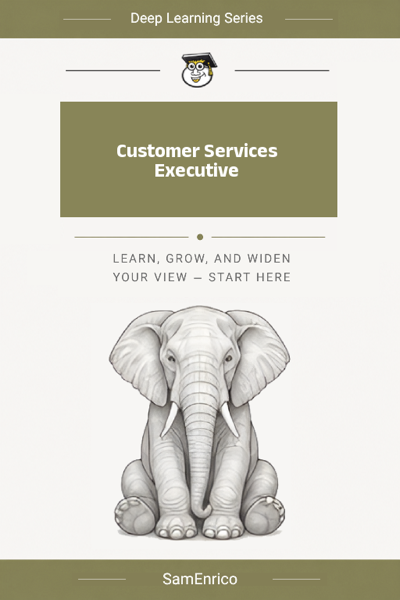
Non-FictionInformativeEducational
Customer Services Executive eBook
A Coursebook on Customer Services Executive
A Coursebook on Customer Services Executive
Formats
Free sample
Chapter 1: The Loyalty Thief--–- Every time a customer hangs up the phone, closes a chat window, or walks out of your store, a silent transaction has occurred. They have just asked themselves one question, often unconsciously: Did they make my life easier or harder? The answer determines whether they will buy from you again, recommend you to a friend, or quietly disappear—never to return. Most companies never see the loss coming. They measure satisfaction scores, celebrate resolved tickets, and assume that a quiet customer is a happy customer.
But the data tells a brutal, opposite story. According to research synthesized from the best-selling service books of the past decade—including Delivering Happiness, The Nordstrom Way, and The Effortless Experience—up to 80% of customers who defect say they were "satisfied" with their last interaction. Satisfaction, as it turns out, is a trap. It feels good but predicts almost nothing. The real metric that matters, the one that separates commodity service from brand-defining excellence, is something else entirely.
And it begins with a fundamental shift in how you see your own role. You are not a problem-solver. You are not a ticket-closer. You are not a cost center. You are, in fact, the most powerful marketing asset your company has—or the most expensive mistake it never sees coming.This chapter rewires the foundational mindset of a Customer Services Executive.
It moves you from transactional service (I solved your problem) to relational service (I made you want to stay). It introduces the three levels of proactivity that will guide every subsequent chapter. And it provides the economic logic—the brutal, unignorable math—that elevates service from a necessary evil to a competitive weapon. By the end of this chapter, you will never look at a customer complaint the same way again. You will see it not as an interruption, but as an investment opportunity.The Great Deception: Why "Satisfied" Customers Leave Let us start with a provocation.
If you asked most executives what percentage of their "satisfied" customers would repurchase, they would guess somewhere between 80 and 90 percent. The actual number, across dozens of industries, hovers around 30 to 40 percent. This gap—between feeling good about an interaction and actually changing behavior—is what one best-selling author calls the "satisfaction paradox." A customer can rate you a 4 out of 5 on a survey and still switch to a competitor the next week. Why? Because satisfaction measures the past.
Loyalty predicts the future. And they are driven by entirely different engines.Consider a typical airline experience. You board a delayed flight. The gate agent apologizes. The flight attendant offers a free snack.
You land safely. On the survey, you tick "satisfied." But six months later, when you book another trip, do you choose that airline? Probably not, if a competitor offers a direct flight or a lower fare. The satisfaction you felt did not translate into loyalty because it did not overcome the friction of the delay. The airline fixed the symptom (your anger) but not the root cause (their unreliable schedule).
This is the central insight of the best-selling book The Effortless Experience: customers do not want to be delighted. They want to be unburdened. The single strongest predictor of repeat purchase is not how happy the customer felt after the call, but how much effort they had to expend to get their problem solved.Let that land. Delight is expensive, unpredictable, and often irrelevant. Effort is cheap, measurable, and deterministic.
A customer who spends five minutes on chat and gets a straightforward answer is more loyal than a customer who spends forty-five minutes on the phone and receives a $50 credit. The credit feels good in the moment. But the memory of wasted time lingers. And time, unlike money, cannot be refunded.This changes everything about how a Customer Services Executive should prioritize their work. Your job is not to wow people with grand gestures.
Your job is to remove obstacles with surgical precision. Every time a customer has to repeat themselves, escalate to a manager, or wait on hold for a transfer, you are not providing service. You are stealing their loyalty. You are the loyalty thief. And most companies are filled with them, operating with the best intentions and the worst outcomes.The Service-Marketing Flywheel: Why Your Call Is Worth More Than an Ad Marketing departments spend billions of dollars on advertising to acquire new customers.
They buy Super Bowl spots, fund influencer campaigns, and optimize Google keywords. And yet, one of the most cited statistics in service literature—popularized by Tony Hsieh of Zappos—is that word-of-mouth referrals from exceptional service have a conversion rate two to three times higher than paid advertising. A customer who comes to you because a friend said "they solved my problem in five minutes" is already pre-sold. They trust you before they ever visit your website. That trust is not earned by a billboard.
It is earned by a service executive who listened, understood, and acted with speed and empathy.This dynamic is captured in what we call the Service-Marketing Flywheel. Unlike a traditional sales funnel, which treats service as an endpoint, the flywheel treats service as a source of energy that accelerates everything else. Here is how it works:Service → Trust. Every interaction either deposits or withdraws from a customer's trust account. A fast, accurate resolution deposits trust.
A transfer, a repeat request for information, or a "not my department" withdraws it.Trust → Repeat Purchase. Customers buy from brands they trust, even at a higher price. The Harvard Business Review has documented that increasing customer retention by just 5% increases profits by 25% to 95%. Trust is the engine of that retention.Repeat Purchase → Referrals. A customer who trusts you will tell others.
Not because you asked them to, but because humans are wired to share solutions that reduce effort. We recommend the restaurant that seated us quickly. We warn friends away from the airline that lost our bag.Referrals → Lower Customer Acquisition Cost (CAC). When new customers arrive through referrals, you spend less on marketing. That saved money can be reinvested in service, which creates more trust, which creates more referrals.
The flywheel spins faster.This is not a theoretical model. It is the operating system of every great service-driven company. Zappos built a billion-dollar business on it. Nordstrom has survived a century of retail disruption on it. And in each case, the Customer Services Executive is not a support function.
They are the flywheel's engine.Now let us put numbers on it. If your company spends $100 to acquire a new customer (CAC), and that customer spends $500 over their lifetime (LTV), your marketing is profitable. But if a single service interaction drives that customer away after one purchase, you have not just lost their future $400. You have also lost the three people they would have referred, each worth another $500. The true cost of a bad service call is not the $10 call center wage or the $20 refund.
It is the cascading loss of future revenue that you cannot see on any dashboard. This is why the most sophisticated companies calculate the Cost of Poor Service (COPS) as a line item on their P&L. And it is…
This is the end of the free sample. Get the eBook to keep going. Buy now
About this book
Details
- Author
- Mcgehee Kaylee
- Publisher
- SamEnrico
- Language
- English
- Genre
- Non-Fiction, Informative, Educational
- Released
- 2026-06-02
- Pages (approx.)
- 134
- Available as
- eBook, Audiobook

Read better in the ZLOADR app
Your eBooks on your phone or tablet. Sign in with your SamEnrico account and start reading.
More by Mcgehee Kaylee
 Shopping Budget Envelope SystemMcgehee Kaylee$11.99
 Rapid Induction ProtocolMcgehee Kaylee$11.99
 Benzo Gut Health RecoveryMcgehee Kaylee$11.99
 Literal Club Reading RaceMcgehee Kaylee$11.99
 The Tokyo Subway Sarin Attack: The Unpunished Cult LeaderMcgehee Kaylee$11.99
 Learn to Play the QuinticlaveMcgehee Kaylee$11.99
 AI for Financial Report GenerationMcgehee Kaylee$12.99
 How to Start a Neutral Spirits Production Business (Beginners Guide)Mcgehee Kaylee$11.99
You may also like
 Hong Kong Handover 1997Dunn Johnnie$11.99
 Zumba For Postnatal Recovery CourseNeal Christian$11.99
 Zumba for BeginnersLadner Nikia$11.99
 YouTube Comment Mining GuideHumes Pandora$12.99
 Worry Box MeditationCarlin Rudy$11.99
 Workplace Stress MeditationNguyen Lynn$11.99
 Workplace Stress and Sleep RepairHawley Ivory$11.99
 Workplace Perfectionism CureDelaney Jeffry$11.99
 Workplace Injustice Anger GuideWallen Isabelle$11.99
 Work Addiction and Burnout LinkGreenwood Ester$11.99
 Women in Yoga and WellnessBeattie Galina$11.99
 Women in Stand Up ComedyChun Evangeline$11.99