
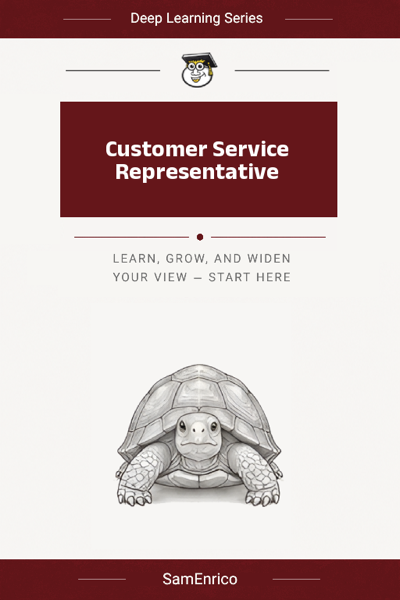
Non-FictionInformativeEducational
Customer Service Representative eBook
A Coursebook on Customer Service Representative
A Coursebook on Customer Service Representative
Formats
Free sample
Chapter 1: The Loyalty Lie--–- Every minute of every day, somewhere in the world, a customer service representative is being told to “delight the customer.” They sit through training sessions that encourage them to “go above and beyond,” to “surprise and delight,” to “make the customer’s day.” Posters on breakroom walls celebrate the representative who sent a handwritten thank-you note. Company newsletters feature the agent who stayed on the phone for forty-five minutes just to chat with a lonely elderly customer. Awards are given to the representative who upgraded a complaining customer to first class or sent a free product overnight at no charge.These are beautiful stories. They make us feel warm. They win industry awards.
And for the most part, they are wrong.Not wrong in the sense that delight is bad. Kindness is never bad. But wrong in the sense that delight is not what drives customer loyalty. Wrong in the sense that delight is not scalable. Wrong in the sense that for every representative who spends forty-five minutes building a relationship on a single phone call, there are twenty other customers waiting on hold, growing more frustrated by the minute, wondering why their simple problem is taking so long to solve.Here is the truth that the customer service industry has been slow to accept: customers do not want to be delighted.
They want their problems solved. They want to spend as little time as possible on the phone, on chat, or waiting for an email reply. They want ease. They want speed. They want to hang up and get back to their lives.This chapter is called “The Loyalty Lie” because the most persistent myth in customer service is that the path to loyalty runs through delight.
It does not. The path to loyalty runs through reducing customer effort. And understanding this distinction is the single most important shift a customer service representative can make in their career.The Experience Economy: Every Interaction Is Theater Before we can understand why effort matters more than delight, we need to understand what is at stake in every customer interaction. In their landmark book The Experience Economy, economists Joseph Pine and James Gilmore made a simple but profound argument: goods are fungible, services are personalized, but experiences are memorable. And memorable experiences are where value is created.Think about the last time you bought a cup of coffee.
The beans themselves cost pennies. The labor to brew them costs a little more. But when you buy a coffee at a café with comfortable chairs, good lighting, and a barista who remembers your name, you are not paying for coffee. You are paying for an experience. The same is true of customer service.
Every time a customer contacts your company, they are not just seeking a resolution to a technical problem. They are having an experience. That experience will either increase their loyalty, decrease it, or leave it unchanged.Pine and Gilmore argue that every business is a stage and every employee is a performer. The customer service representative is not a worker behind a desk. They are an actor in a play, and the customer is the audience.
The question is not whether you are performing. The question is what kind of performance you are giving.When a customer calls with a problem, they are already in a state of mild distress. Something has gone wrong. Their time is being consumed. They are not calling because they want to chat.
They are calling because they have no other choice. The representative’s job, therefore, is not to turn this moment of distress into a Broadway musical. The job is to acknowledge the distress, solve the problem efficiently, and return the customer to their life as quickly as possible.This is the first clue that the delight myth is misleading. A delighted customer is one who has been surprised by something positive. But a surprised customer is, by definition, one who did not expect what they received.
If a customer calls expecting frustration and instead receives a seamless, effortless resolution, they are not delighted. They are relieved. And relief, it turns out, is far more powerful than delight.The ROI of Empathy: Why Effort Drives Retention There is a number that every customer service leader should know but almost none of them do: the cost of acquiring a new customer is five to ten times higher than the cost of retaining an existing one. This is not a guess. This is not a marketing slogan.
This is a well-established finding from decades of research on customer economics. Acquiring a new customer requires advertising, sales calls, discounts, and incentives. Retaining an existing customer requires only that you not give them a reason to leave.And what makes customers leave? The answer, from research conducted by the Corporate Executive Board (CEB) and published in The Effortless Experience, is surprisingly simple. Customers do not leave because they were not delighted.
They do not leave because they did not receive a free gift or a handwritten note. They leave because the company made it too hard to do business with them.The CEB research team surveyed tens of thousands of customers across industries and asked them a simple question: what drives your loyalty? The answers were consistent. The single strongest predictor of customer loyalty was not customer satisfaction. It was not delight.
It was customer effort. Specifically, how much effort the customer had to expend to get their problem solved.Customers who experienced a high-effort service interaction were significantly more likely to defect to a competitor. They were more likely to complain. They were more likely to tell their friends not to do business with the company. Customers who experienced a low-effort interaction—meaning their problem was solved quickly, without transfers, without repeating themselves, without waiting on hold—were loyal, repeat buyers.The research went further.
It found that going above and beyond to delight customers actually had a negative return on investment for routine service interactions. When customers called with a simple problem, they did not want a surprise. They did not want a forty-five-minute conversation. They wanted a ninety-second resolution. When companies tried to delight these customers with unexpected gestures, they inadvertently increased effort.
The customer had to spend more time on the phone. They had to listen to an apology. They had to wait for a manager to approve a gift. The delight became a burden.This does not mean empathy has no role in customer service. Empathy is essential.
But empathy, in this context, does not mean performing emotional labor. It means understanding that the customer wants to get off the phone. Empathy means saying, “I know your time is valuable, so let me solve this as quickly as possible.” That is the ROI of empathy. It is not about making the customer feel loved. It is about making the customer feel respected.The Zappos Paradox: When Connection Makes Sense At this point, some readers will be thinking of Zappos.
The online shoe retailer is famous for its customer service. Zappos representatives stay on phone calls for hours. They send flowers to customers who have had a bad…
This is the end of the free sample. Get the eBook to keep going. Buy now
About this book
Details
- Author
- Horsley Elaina
- Publisher
- SamEnrico
- Language
- English
- Genre
- Non-Fiction, Informative, Educational
- Released
- 2026-06-02
- Pages (approx.)
- 134
- Available as
- eBook, Audiobook

Read better in the ZLOADR app
Your eBooks on your phone or tablet. Sign in with your SamEnrico account and start reading.
More by Horsley Elaina
 Executive Relationship BuildingHorsley Elaina$11.99
 Caregiver Isolation HandbookHorsley Elaina$11.99
 Student Stress Reset WorkbookHorsley Elaina$11.99
 Hypnotic Revivification TechniqueHorsley Elaina$11.99
 Menstrual Health at SchoolHorsley Elaina$11.99
 The Abyss of Light: Challenger’s Descent into the Indian Ocean’s DepthsHorsley Elaina$11.99
 Echoes of the Forgotten: The Lost Civilization That Whispered to the StarsHorsley Elaina$11.99
 How to Become a Automobile DetailerHorsley Elaina$11.99
 Explainer Voiceover Script TipsHorsley Elaina$12.99
 PDPA Singapore Breach GuideHorsley Elaina$12.99
 Understanding Dystonia Progressive With Diurnal VariationHorsley Elaina$17.99
You may also like
 Hong Kong Handover 1997Dunn Johnnie$11.99
 Zumba For Postnatal Recovery CourseNeal Christian$11.99
 Zumba for BeginnersLadner Nikia$11.99
 YouTube Comment Mining GuideHumes Pandora$12.99
 Worry Box MeditationCarlin Rudy$11.99
 Workplace Stress MeditationNguyen Lynn$11.99
 Workplace Stress and Sleep RepairHawley Ivory$11.99
 Workplace Perfectionism CureDelaney Jeffry$11.99
 Workplace Injustice Anger GuideWallen Isabelle$11.99
 Work Addiction and Burnout LinkGreenwood Ester$11.99
 Women in Yoga and WellnessBeattie Galina$11.99
 Women in Stand Up ComedyChun Evangeline$11.99