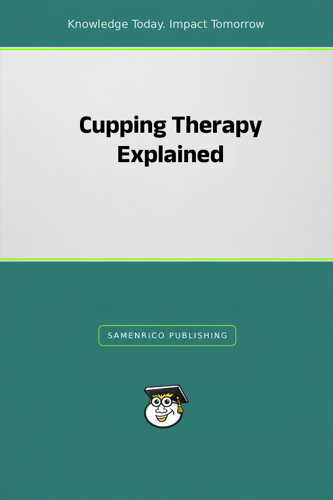
Cupping Therapy Explained eBook
Teaches fire and vacuum cupping techniques for pai
Teaches fire and vacuum cupping techniques for pain relief and respiratory conditions.
Formats
Free sample
Chapter 1: The Marks That Speak--–- The first time I saw cupping marks, I mistook them for a mistake. It was 2016, and like half the planet, I was watching the Rio Olympics. Michael Phelps walked to the starting blocks with his skin painted in perfect purple circles. The commentators stumbled. Social media erupted.
"What are those bruises?" "Did someone hurt him?" "Is that some kind of doping violation?" Within 48 hours, Google searches for "cupping therapy" increased by 11,000 percent. Millions of people had just discovered a healing art that has existed for over two thousand years, hidden in plain sight.What those Olympic viewers didn't know was that Phelps wasn't an anomaly. He was the latest chapter in a story that began when humans first looked at their own suffering and asked a radical question: What if we could pull the pain out?This chapter is not a history lesson. It is an origin story. Yours, mine, and the twenty centuries of healers, athletes, and everyday people who have used cups to rewrite their relationship with pain and breath.
Before you hold a flame to glass or pump a plastic cup against your shoulder, you need to understand where this power came from, why it nearly disappeared, and how it returned to become one of the fastest-growing wellness practices on the planet.The Birth of Suction: From Horns to Healing Long before rubber, plastic, or even glass, there were horns. Hollow animal horns, typically from cattle or water buffalo, with the tips cut off to create an open cylinder. The first cupping devices were not designed; they were discovered. Some ancient healer, perhaps in Mesopotamia or early Egypt, noticed that applying a heated horn to the skin created a pulling sensation. And when that pulling happened over a painful shoulder or a congested chest, something changed.The earliest physical evidence comes from the Ebers Papyrus, an Egyptian medical text dating to approximately 1550 BCE.
This scroll, stretching over twenty meters, contains prescriptions for everything from crocodile bites to depression. And buried among the spells and herbal formulas is a simple drawing of a cupping horn being applied to a patient's back. The hieroglyphs beside it read: "To remove the bad blood from the flesh."The Egyptians did not understand capillaries, fascia, or inflammatory response. They operated on a simpler model: disease and pain were foreign invaders that needed to be extracted. The cup was a vacuum, and the vacuum was truth.
If it left a mark, that mark was proof that something had been pulled out. This logic, while medically crude, was psychologically brilliant. Patients could see the treatment working. The evidence was right there on their skin.From Egypt, cupping traveled. It moved east along trade routes into India, where it merged with Ayurvedic medicine.
It moved north into Greece, where Hippocrates—the father of Western medicine—wrote detailed instructions for cupping in his treatise "On Affections." He recommended cups for gynecological conditions, fevers, and shoulder pain. He even designed specialized bronze cups with valves, an astonishingly advanced technology for 400 BCE.But it was in China that cupping found its permanent home.The Chinese Marriage: Cups Meet Meridians Traditional Chinese Medicine, or TCM, emerged over two thousand years ago from a fundamentally different worldview than Western medicine. Where Greeks and Egyptians looked for physical causes and mechanical solutions, the Chinese saw energy. They called it Qi (pronounced "chee"). Qi flowed through the body along invisible highways called meridians.
When Qi became stuck, stagnant, or deficient, pain and illness followed. The healer's job was not to cut or poison but to restore flow.Acupuncture was the first tool for this job. Thin needles inserted into specific points along meridians could unblock Qi like a key turning a lock. But needles had limitations. They created a small, precise channel for energy.
What if the stagnation covered a larger area? What if the problem was not a single point but an entire landscape of stuck fascia and sluggish blood?Enter cupping.Chinese physicians adapted the Egyptian and Greek techniques, but they added something new: meridian mapping. They identified specific points on the back, shoulders, and chest where cups would have the greatest effect on Qi flow. The most famous of these, BL-13 (the Lung point on the upper back) and BL-23 (the Kidney point on the lower back), remain the standard placements for respiratory and pain protocols today.The Chinese also developed the technique that would become synonymous with traditional cupping: fire cupping. A cotton ball soaked in alcohol is lit and briefly inserted into a glass cup.
The flame consumes the oxygen inside, creating a vacuum. The cup is then placed on the skin, and the negative pressure does the rest. No pumps, no valves, no plastic. Just fire, glass, and skin.For two thousand years, this was the state of the art. Chinese hospitals kept cupping sets alongside acupuncture needles and herbal dispensaries.
Mothers cupped their children's chests for colds. Martial artists cupped their legs after training. It was not alternative medicine. It was just medicine.Then the West got involved.The Rise and Fall in Western Medicine In the 17th century, European physicians began traveling to Asia with new eyes. They brought back descriptions of cupping, which they initially dismissed as primitive superstition.
But by the 18th century, Western medicine had grown desperate. The standard treatments of the era—bloodletting with lancets, purging with toxic herbs, and blistering with hot irons—were often worse than the diseases they pretended to cure.Cupping offered a less brutal alternative. It drew blood without cutting veins. It created blisters without burning. By the early 19th century, cupping had become a respectable procedure in London, Paris, and Boston.
Hospitals employed dedicated "cup-pers" who did nothing but apply glass cups to patients with pneumonia, back pain, and menstrual disorders.The most famous Western cup advocate was Sir William Osler, a Canadian physician often called the father of modern medicine. In his landmark textbook "The Principles and Practice of Medicine" (1892), Osler devoted an entire section to cupping for lower back pain. He wrote that he had seen "remarkable relief" in cases where nothing else worked. For a man of his scientific stature to endorse cupping was no small thing.But the 20th century brought two revolutions that nearly killed cupping forever.First came pharmaceutical painkillers. Aspirin became available over the counter in 1915.
By the 1950s, cortisone injections could eliminate inflammation in hours. Why spend twenty minutes with hot cups when a pill could do the job in twenty seconds?Second came the rise of evidence-based medicine. Western doctors demanded randomized controlled trials, placebo controls, and mechanistic explanations. Cupping had none of these. It had two thousand years of anecdotal success, but anecdotes are not data.
By the 1960s, cupping had largely disappeared from Western hospitals. It survived only in ethnic communities, martial arts studios, and the practices of a few aging acupuncturists.The art went underground. And that is precisely where it prepared for its comeback.The Slow Burn: How Cupping Survived While Western medicine forgot cupping, the rest of the world did not. In China, cupping remained a standard treatment in state hospitals. In Eastern Europe, particularly Russia…
This is the end of the free sample. Get the eBook to keep going. Buy now
About this book
Details
- Author
- Carrier Sachiko
- Publisher
- SamEnrico
- Language
- English
- Genre
- Non-Fiction, Health & Wellness, Cupping
- Released
- 2026-06-10
- Pages (approx.)
- 142
- Available as
- eBook, Audiobook

Read better in the ZLOADR app
Your eBooks on your phone or tablet. Sign in with your SamEnrico account and start reading.
More by Carrier Sachiko
 YouTube Binge Stopping ManualCarrier Sachiko$11.99
 Sibling Reunion GuideCarrier Sachiko$11.99
 HIIT for Martial ArtsCarrier Sachiko$11.99
 The Lost Kingdoms: Black Explorers Who Charted the UnknownCarrier Sachiko$11.99
 How to Produce ChalkCarrier Sachiko$11.99
 Private Client AdvisorCarrier Sachiko$11.99
 Factoring Lockbox Setup HandbookCarrier Sachiko$12.99
 How to Become a Batter MixerCarrier Sachiko$11.99