
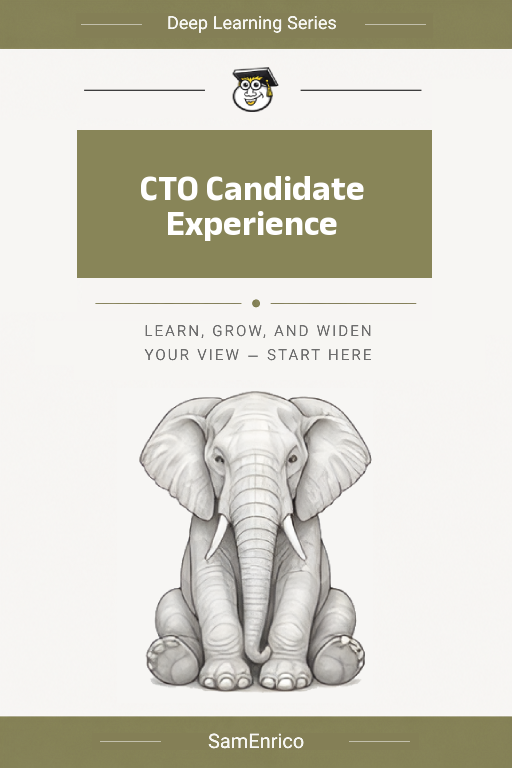
Non-FictionStartup GuideExperience
CTO Candidate Experience eBook
Create a positive candidate experience to build yo
by Khan Awilda
Create a positive candidate experience to build your brand even with rejected applicants.
Formats
Free sample
Chapter 1: The Empathy Architecture--–- The first time I watched a candidate cry after a rejection, I thought it was my fault for hiring him. Then I realized it was my fault for rejecting him badly.His name was Marcus. He was a staff engineer with fifteen years of experience, a calm demeanor, and a portfolio of open-source contributions that made my own Git Hub history look like a toddler's scribble. He had flown across the country for our final round of interviews. He had taken a red-eye to accommodate our schedule.
He had prepared a thirty-minute presentation on system design that was, honestly, better than anything I had presented in years.He did not get the job. We hired someone else—someone good, someone who worked out fine, but someone who was not clearly better than Marcus. The decision came down to a vibe in the room, a gut feeling from a senior director who said Marcus was “too quiet.” I went along with it because I was tired and because the director was loud and because it was easier to agree than to fight.The recruiter sent Marcus the template email. “After careful consideration…” The usual poison wrapped in corporate politeness.Three days later, Marcus replied to the entire thread—me, the recruiter, the senior director—with a single sentence: “I don’t need the job. I needed the respect.”I called him immediately.
He answered. And then he cried. Not sobbing. Not performative. Just a quiet, exhausted voice saying, “I canceled two other interviews for you.
I told my kids I was going to get this job. And you sent me a form letter.”That was the moment I understood that candidate experience is not a recruiting problem. It is a leadership problem. It is a design problem. It is, most of all, an architecture problem.We build systems for everything else.
We architect databases for fault tolerance. We design APIs for graceful degradation. We create monitoring dashboards for every metric that matters to our products. But when it comes to the human beings who walk through our interview process—the people who will never work for us but who will talk about us for years—we build nothing. We leave the experience to chance, to individual recruiters, to whichever template is closest at hand.This chapter is about building something instead.It is about the Empathy Architecture: a deliberate, measurable, and scalable system for designing candidate experiences that build your brand even when you have to say no.
We will cover the data that proves why this matters, the taxonomy of ghosting that explains how we fail, the tiered involvement framework that keeps CTOs from burning out, and the economic case that turns empathy from a moral preference into a competitive necessity.But before we get to any of that, I need you to understand one thing. Marcus never worked for me. But he has now told his story to more than two hundred engineers. I know this because one of them joined my company two years later and said, “My friend Marcus said you were decent. He said you called him back.
He said you listened.”That is the Empathy Architecture. It is not about the candidates you hire. It is about the candidates you reject—and what they say about you when you are not in the room.The Broken Rung: Why Technical Candidates Are Different Let me start with a number that should unsettle you: twenty-eight percent.That is the percentage of technical candidates who report feeling “actively resentful” after a recent rejection, according to a 2023 survey of over two thousand engineers conducted by the tech hiring platform Karat. Twenty-eight percent. More than one in four.
Not disappointed. Not disappointed is normal. Rejection is disappointing. Resentment is different. Resentment is active.
Resentment spreads. Resentment is the emotional state of someone who feels not just rejected but disrespected.Why are technical candidates so much more likely to feel resentment than candidates in other fields? The answer has to do with the structure of the engineering labor market.The average software engineer has a Linked In network of five hundred to one thousand other technical professionals. They participate in Slack communities, Discord servers, and local meetups. They share notes about interview processes—which companies ghost, which give thoughtful feedback, which have take-home tests that demand twenty hours of unpaid labor.
This information travels fast and persists indefinitely.When a marketing candidate has a bad experience, they might tell five people. When a senior engineer has a bad experience, they might tell five hundred—through a single post on a popular engineering forum.I call this the “Broken Rung” in tech hiring: the point in the candidate journey where a rejection, poorly handled, fractures the relationship permanently and ripples through a highly connected professional network. The rung is broken not because the candidate was rejected, but because the rejection was handled with indifference.The data on this is unambiguous. The Talent Board, which has surveyed over one million job candidates annually for more than a decade, consistently finds that approximately eighty-one percent of candidates who report a positive experience will share that experience with peers, refer other candidates, and maintain a favorable view of the company’s products or services.But here is the number that should keep every CTO awake at night: among candidates who report a negative experience, forty-five percent say they will never apply to that company again, and thirty-eight percent say they will actively discourage others from applying.A negative experience does not just cost you a candidate. It costs you a node in your talent network.
And in engineering, where the talent network is dense and well-connected, that cost multiplies.One candidate in the Karat survey wrote: “I would have respected them if they had just told me no. Instead, they told me nothing. That felt worse than any rejection.”Another wrote: “The recruiter said they would call me with feedback. They never did. Three months later, I saw the same role reposted.
I will never apply there again, and I tell everyone I know to avoid them.”These are not edge cases. Twenty-eight percent resentment is a systemic failure. And it is a failure that CTOs have the power—and the responsibility—to fix.The Taxonomy of Ghosting Before we can fix candidate experience, we must name the problem with precision. Throughout this book, I will refer to a specific taxonomy of ghosting—four distinct patterns of silence that erode trust and damage brands. Understanding these categories is essential because each requires a different intervention.Pre-Interview Ghosting occurs when a candidate submits an application and never receives any response.
Not a rejection. Not a “we’re reviewing.” Nothing. This is the most common form of ghosting, affecting an estimated sixty to seventy-five percent of all job applications in technology. The candidate is left to infer rejection from silence—a humiliating and ambiguous outcome that suggests their time and effort had no value.I have seen companies defend this practice with a shrug. “We get too many applicants,” they say.
“We can’t respond to everyone.” This is nonsense. Automated responses exist. Templates exist. The cost of acknowledging receipt and providing…
This is the end of the free sample. Get the eBook to keep going. Buy now
About this book
Details
- Author
- Khan Awilda
- Publisher
- SamEnrico
- Language
- English
- Genre
- Non-Fiction, Startup Guide, Experience
- Released
- 2026-05-30
- Pages (approx.)
- 137
- Available as
- eBook, Audiobook

Read better in the ZLOADR app
Your eBooks on your phone or tablet. Sign in with your SamEnrico account and start reading.
More by Khan Awilda
 Conversation Starters for Social AnxietyKhan Awilda$11.99
 Bipolar Exercise PrescriptionKhan Awilda$11.99
 Spin Sprint IntervalsKhan Awilda$11.99
 Napping for Military PersonnelKhan Awilda$11.99
 The Truck Stop RunawayKhan Awilda$11.99
 Google Assistant MemoryKhan Awilda$11.99
 Accidental Child DeathKhan Awilda$11.99
 Cornell Note TakingKhan Awilda$11.99
 Boundary Setting For Foster ParentsKhan Awilda$11.99
 The Last Stand of the 1975 Contract: How a Forgotten Deal Changed Music ForeverKhan Awilda$11.99
 Threads of the Unseen: The Enigmatic Life of Marco Polo’s Forgotten NavigatorKhan Awilda$11.99
 The Healers of Kadesh: Egypt's Forgotten Medics in the Battle of the DeltaKhan Awilda$11.99
You may also like
 Hong Kong Handover 1997Dunn Johnnie$11.99
 Zumba For Postnatal Recovery CourseNeal Christian$11.99
 Zumba for BeginnersLadner Nikia$11.99
 YouTube Comment Mining GuideHumes Pandora$12.99
 Worry Box MeditationCarlin Rudy$11.99
 Workplace Stress MeditationNguyen Lynn$11.99
 Workplace Stress and Sleep RepairHawley Ivory$11.99
 Workplace Perfectionism CureDelaney Jeffry$11.99
 Workplace Injustice Anger GuideWallen Isabelle$11.99
 Work Addiction and Burnout LinkGreenwood Ester$11.99
 Women in Yoga and WellnessBeattie Galina$11.99
 Women in Stand Up ComedyChun Evangeline$11.99