
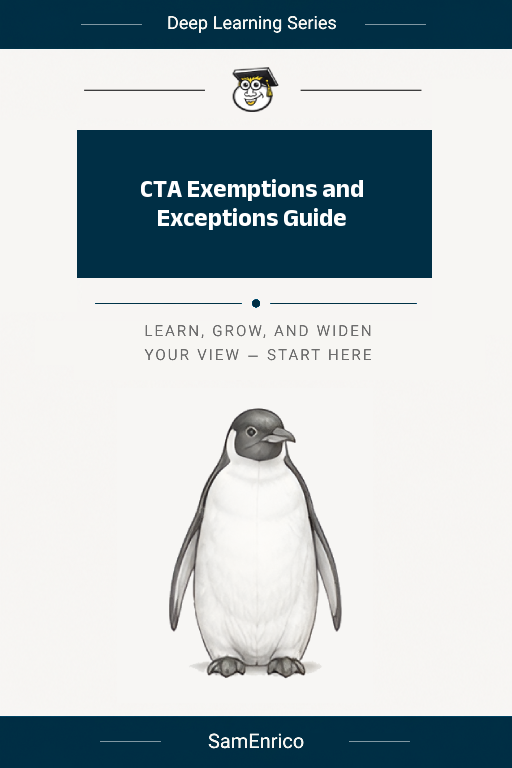
Non-FictionAnnual CheckupRegulatory Compliance
CTA Exemptions and Exceptions Guide Audiobook
Identifies 23 exemptions from Corporate Transparen
Identifies 23 exemptions from Corporate Transparency Act filing including large operating companies, banks, and public entities.
Formats
Free sample
Chapter 1: The Great Assumption--Every business owner in America wakes up today with a secret legal problem they do not know they have. The problem is not a lawsuit, a tax audit, or a regulatory investigation. It is something far more insidious: a federal law that assumes guilt first and grants innocence only to those who can prove they deserve it. This is the Corporate Transparency Act, and its most dangerous feature is not the penalties, the filing requirements, or the definition of beneficial ownership. The most dangerous feature is what this book calls the Great Assumption – the presumption that every entity is a Reporting Company unless it successfully claims one of twenty-three narrow exemptions.The Great Assumption reverses centuries of American legal tradition.
In ordinary law, the government must prove you are subject to a regulation before it can penalize you. Under the CTA, you must prove you are not subject to the regulation, or you are automatically in violation. This inversion of burden is not an accident or a drafting error. It is a deliberate design choice by Congress to close the anonymous shell company loophole that has allowed money laundering, tax evasion, and terrorist financing to flow through unregulated American entities for decades. The problem the CTA solves is real.
But the solution creates a compliance nightmare for millions of legitimate businesses that have never laundered a dollar or evaded a penny of tax.This chapter establishes the foundation for everything that follows. It explains why the CTA exists, what the Great Assumption means in practice, how the twenty-three exemptions function as affirmative defenses rather than automatic exclusions, and what happens when you get it wrong. By the end of this chapter, you will understand why the question "Do I need to file?" is the wrong question entirely, and why the correct question – "Which exemption applies to me, and how do I prove it?" – will save you from penalties that can reach nearly six hundred thousand dollars per day.The Corporate Transparency Act was signed into law on January 1, 2021, as part of the National Defense Authorization Act for Fiscal Year 2021. It was not a standalone bill that received extensive public debate. It was buried inside a must-pass defense spending bill, attached as the William M.
(Mac) Thornberry National Defense Authorization Act. This legislative maneuver meant that most business owners never heard about the CTA when it passed, and…
This is the end of the free sample. Get the Audiobook to keep going. Buy now
About this book
Details
- Author
- Alba Julianne
- Publisher
- SamEnrico
- Language
- English
- Genre
- Non-Fiction, Annual Checkup, Regulatory Compliance
- Released
- 2026-06-01
- Pages (approx.)
- 151
- Available as
- eBook, Audiobook

Listen in the VoxFlicks app
Audiobooks and audio dramas wherever you go. Sign in with your SamEnrico account and press play.
More by Alba Julianne
 Franchise Corporate Social Responsibility AbroadAlba Julianne$11.99
 The Emotional Regulation for BPDAlba Julianne$11.99
 Stress and Skin DisordersAlba Julianne$11.99
 Mammogram Callback Anxiety GuideAlba Julianne$11.99
 Customer Service Anger ControlAlba Julianne$11.99
 The Silk Road Tycoon: How a College Dropout Built a $1 Billion Empire in the ShadowsAlba Julianne$11.99
 Understanding Romberg Hemi-facial AtrophyAlba Julianne$17.99
 Multi-Channel E-Commerce BusinessAlba Julianne$11.99
 Invoice Factoring Nigeria GuideAlba Julianne$12.99
 How to Become a Stained Glass ArtistAlba Julianne$11.99
You may also like
 Hong Kong Handover 1997Dunn Johnnie$11.99
 Zumba For Postnatal Recovery CourseNeal Christian$11.99
 Zumba for BeginnersLadner Nikia$11.99
 YouTube Comment Mining GuideHumes Pandora$12.99
 Worry Box MeditationCarlin Rudy$11.99
 Workplace Stress MeditationNguyen Lynn$11.99
 Workplace Stress and Sleep RepairHawley Ivory$11.99
 Workplace Perfectionism CureDelaney Jeffry$11.99
 Workplace Injustice Anger GuideWallen Isabelle$11.99
 Work Addiction and Burnout LinkGreenwood Ester$11.99
 Women in Yoga and WellnessBeattie Galina$11.99
 Women in Stand Up ComedyChun Evangeline$11.99