
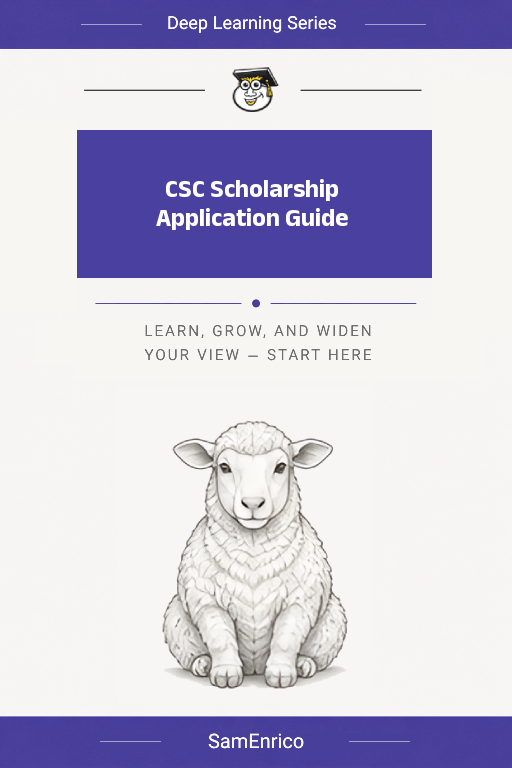
Non-FictionStudent's ShortcutCSC
CSC Scholarship Application Guide eBook
Apply for Chinese Government Scholarship covering
by Wallen Ena
Apply for Chinese Government Scholarship covering tuition, accommodation, and monthly stipend.
Formats
Free sample
Chapter 1: The Million-Dollar Misconception–- When twenty-two-year-old Amina from Nigeria first emailed me, she had already been rejected twice. Her GPA was 3.8. She had two published research papers. She spoke fluent English and basic Mandarin. On paper, she was the ideal CSC candidate.
Yet two consecutive application cycles had ended in silence – no interview, no waitlist, no explanation. "I don't understand," she wrote. "I followed every guide. I met every requirement. What am I missing?"Amina's mistake was not a lack of qualifications.
It was a failure of frame. She viewed the CSC Scholarship as a reward for academic excellence – a prize given to the smartest, hardest-working students. She spent months perfecting her grades, polishing her CV, and collecting certificates. But she never asked the one question that separates winners from the other ninety percent: What does the Chinese government actually want from this investment?The answer transforms everything. The Chinese Government Scholarship is not a charity.
It is not a diversity program. It is not a random lottery. The CSC is a strategic investment by the People's Republic of China in its own future – and in the future of the countries it seeks to influence. Each year, China allocates hundreds of millions of yuan to bring approximately 40,000 international students to its universities. This is not altruism.
This is statecraft. And once you understand this, you stop applying like a student seeking a prize and start positioning yourself like an asset offering a return.This chapter dismantles the most dangerous misconception about the CSC Scholarship and replaces it with a framework that has helped scholars from forty-seven countries win fully funded degrees. You will learn the real selection criteria that no official document ever states. You will discover why some applicants with mediocre grades win while valedictorians lose. And you will begin the transformation from passive applicant to strategic candidate – the kind of person China actively wants to fund.The Billion-Yuan Question You Were Never Asked Let us begin with raw mathematics.
The CSC budget is not public in detail, but analysts estimate that China spends between 3 and 5 billion yuan annually on international scholarships. For context, that is roughly half a billion US dollars. This money covers full tuition – which at elite Chinese universities can reach 100,000 yuan per year for international students. It covers on-campus accommodation, which at universities like Tsinghua or Peking would otherwise cost 20,000 to 40,000 yuan annually. And it provides monthly stipends that, while modest by Western standards, are quite comfortable in most Chinese cities: 2,500 yuan for undergraduates, 3,000 yuan for master's students, and 3,500 yuan for doctoral candidates.But here is the question that changes everything: why would China spend half a billion dollars on foreign students when millions of its own citizens struggle to afford university?The naive answer is "international goodwill" or "cultural exchange." These are not wrong, but they are incomplete.
The strategic answer is far more interesting. China is playing a long game. Every CSC scholar who returns to their home country carries with them not just a degree but a relationship – with Chinese professors, Chinese institutions, and Chinese ways of thinking. They become ambassadors, business partners, and sometimes political allies. When a Nigerian engineer trained in China helps build a railway using Chinese standards, that is not coincidence.
When a Brazilian agronomist who studied at a Chinese university recommends Chinese agricultural equipment, that is not accident. The CSC is a mechanism for building a global network of China-friendly elites.This is not conspiracy theory; it is standard international relations. The United States does the same thing with the Fulbright Program. Germany does it with DAAD scholarships. Japan does it with MEXT.
Every major power uses education as a tool of soft power. China simply does it at a larger scale and with more explicit strategic coordination.What this means for you is simple but profound: the CSC is not looking for the smartest person in the room. It is looking for the person who will create the most value for China over the next twenty years. Your GPA is a factor, but it is not the factor. Your research potential matters, but only insofar as it aligns with Chinese priorities.
And your personal story only resonates if it connects to China's national interests.The Five Hidden Filters Most Applicants Never See Every CSC application passes through a series of invisible gates before any human reads a word of your proposal. Understanding these filters is the difference between submitting an application that gets reviewed and submitting one that gets automatically archived.Filter One: Country Quotas. The CSC allocates scholarships by region and country. This is not公开 stated, but it is an open secret among university international offices. Students from countries with strong diplomatic ties to China – Pakistan, Russia, most of Southeast Asia, much of Africa – have larger quotas than students from countries with strained relationships or small diplomatic missions.
A mediocre applicant from Pakistan may win while an excellent applicant from the United States loses, simply because the quota for Pakistan is larger relative to its applicant pool. You cannot change your nationality, but you can research your country's historical acceptance rates. If your country sends fifty students annually and one thousand apply, your odds are five percent regardless of your qualifications. Knowing this allows you to adjust your strategy – either by applying through the university route (Type B, which bypasses embassy quotas) or by targeting universities that have not filled their country-specific slots.Filter Two: University Preferences. The CSC allows you to list up to three university preferences on your application.
Most applicants list the most famous universities – Tsinghua, Peking, Fudan, Zhejiang – in descending order of prestige. This is a catastrophic error. These universities receive thousands of CSC applications each year. Their acceptance rates for Type A applicants are often below five percent. However, many lesser-known universities – especially specialized institutes like the University of Electronic Science and Technology of China (UESTC) for engineering or Donghua University for textiles – have far fewer applicants relative to their CSC quotas.
A "safety school" in your ranking is not a consolation prize; it may be your only realistic path to a scholarship. Chapter 3 provides a complete framework for university selection based on acceptance rate data rather than prestige.Filter Three: The Discipline Match. China has national priorities. Right now, those priorities include artificial intelligence, semiconductor manufacturing, renewable energy, public health, and agricultural technology. The CSC does not openly favor these fields, but internal communications from university admissions offices suggest that applicants in priority fields receive faster processing and higher acceptance rates.
If you are a historian of medieval Europe, you are competing against a much smaller pool of applicants – but also against a much smaller pool of available slots. If you are an AI researcher, you are competing against thousands of applicants – but also against hundreds of funded positions. The key is not to chase hot fields you have no background in, but to frame your existing field in terms of Chinese priorities. A medieval historian can study the transmission of knowledge along the Silk Road, connecting European history directly to Chinese interests. A literature scholar can analyze contemporary Chinese science fiction as a window into national anxieties.
Everything connects if you know how to frame it. Chapter 4 teaches this framing in detail.Filter Four: The Supervisor Effect.…
This is the end of the free sample. Get the eBook to keep going. Buy now
About this book
Details
- Author
- Wallen Ena
- Publisher
- SamEnrico
- Language
- English
- Genre
- Non-Fiction, Student's Shortcut, CSC
- Released
- 2026-05-30
- Pages (approx.)
- 152
- Available as
- eBook, Audiobook

Read better in the ZLOADR app
Your eBooks on your phone or tablet. Sign in with your SamEnrico account and start reading.
More by Wallen Ena
 Caregiving For Parent With Mental IllnessWallen Ena$11.99
 The Couples Anger Counseling GuideWallen Ena$11.99
 Kapha Invigorating GuideWallen Ena$11.99
 Gambling Craving Recording LogWallen Ena$11.99
 Deep Cave Resilience TrainingWallen Ena$11.99
 Women s Body Image GuideWallen Ena$11.99
 Mail Order Bride TrapWallen Ena$11.99
 Catastrophic ThoughtsWallen Ena$11.99
 The Silk Road Heist: When Empires Collapsed Over a DebtWallen Ena$11.99
 A Collector's Handbook to the Ford Cortina 113eWallen Ena$11.99
 How to Produce Holiday LightingWallen Ena$11.99
 OCD Exposure Response SpecialistWallen Ena$12.99
You may also like
 Hong Kong Handover 1997Dunn Johnnie$11.99
 Zumba For Postnatal Recovery CourseNeal Christian$11.99
 Zumba for BeginnersLadner Nikia$11.99
 YouTube Comment Mining GuideHumes Pandora$12.99
 Worry Box MeditationCarlin Rudy$11.99
 Workplace Stress MeditationNguyen Lynn$11.99
 Workplace Stress and Sleep RepairHawley Ivory$11.99
 Workplace Perfectionism CureDelaney Jeffry$11.99
 Workplace Injustice Anger GuideWallen Isabelle$11.99
 Work Addiction and Burnout LinkGreenwood Ester$11.99
 Women in Yoga and WellnessBeattie Galina$11.99
 Women in Stand Up ComedyChun Evangeline$11.99