
Non-FictionTrue CrimeSocial Psychology
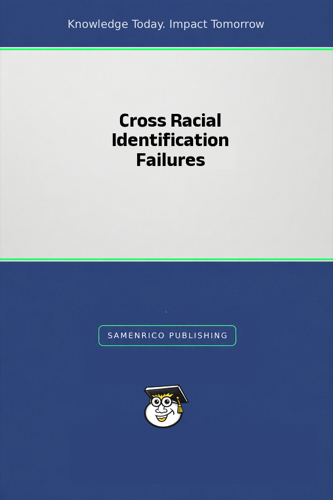
Cross Racial Identification Failures
Investigates why people struggle to recognize face
by Dill Simonne
Investigates why people struggle to recognize faces of other races and how this bias contaminates identifications.
Formats
About this book
Free sample
Chapter 1: The Memory Trap...–- On a cool September evening in 1984, a young woman was brutally assaulted in a parking lot near her apartment in Chicago. The attacker fled into the darkness. The victim, shaken but alive, gave police a detailed description: a Black man, approximately five feet nine inches tall, medium build, with a mustache and a gap between his front teeth. Based on that description, police arrested a local man named Steven. The victim viewed a photo array.
She picked Steven. At trial, she pointed to him with absolute certainty. "I'll never forget that face," she testified. Steven was convicted and sentenced to eighty years in prison. Seventeen years later, DNA evidence proved what Steven had insisted all along: he was entirely innocent.
The actual perpetrator was never found. The victim had not lied. She had not been careless. She had simply been wrong.This is not an outlier. It is not a cautionary tale from a bygone era of forensic ignorance.
As of this writing, the Innocence Project has documented over 375 wrongful convictions in the United States overturned by DNA evidence. In more than 70 percent of those cases, mistaken eyewitness identification played a role. In a staggering proportion of those mistaken identifications, the witness and the suspect were of different races. This is the central problem of this book: the systematic, predictable, and devastating failure of cross-racial identification.But before we can understand why we fail to recognize faces across racial lines, we must understand something more fundamental. We must understand that memory—all memory, for every person, in every context—is not what we think it is.
We carry a dangerous illusion: that our memories are faithful recordings of the past, stored intact in some mental archive, ready to be played back with the clarity of a video camera. This belief is not merely inaccurate. It is the single greatest obstacle to justice in the American legal system.The Science of Reconstruction The truth, established by decades of cognitive psychology research, is radically different. Human memory is not reproductive; it is reconstructive. We do not play back…
This is the end of the free sample. Get the eBook to keep going. Buy now
Contents
- Chapter 1
- Chapter 2
- Chapter 3
- Chapter 4
- Chapter 5
- Chapter 6
- Chapter 7
- Chapter 8
- Chapter 9
- Chapter 10
- Chapter 11
- Chapter 12
Details
- Author
- Dill Simonne
- Publisher
- SamEnrico
- Language
- English
- Genre
- Non-Fiction, True Crime, Social Psychology
- Released
- 2026-06-06
- Pages (approx.)
- 121
- Available as
- eBook, Audiobook

Read better in the ZLOADR app
Your eBooks on your phone or tablet. Sign in with your SamEnrico account and start reading.
More by Dill Simonne
 Ayurvedic Ear HealthDill Simonne$11.99
 Sugar Cravings and Thyroid DisordersDill Simonne$11.99Sugar Cravings and Thyroid DisordersDill Simonne$11.99
 Alcoholism Stages RecognitionDill Simonne$11.99
 Fintech Transaction Multiples GuideDill Simonne$11.99
 Music Tempo InfluenceDill Simonne$11.99
 The Refugee Camp VictimDill Simonne$11.99
 Vitamin D For SADDill Simonne$11.99
 The Magnificent Obsession: How Henrietta Tower-Richards Built a Museum from RuinDill Simonne$11.99
 The Golden Age of Supermodels: How Europe Redefined Beauty and PowerDill Simonne$11.99
 How to Produce Textile and Fabric CraftsDill Simonne$11.99
 Zoom Virtual Internship GuideDill Simonne$12.99
You may also like
 Hong Kong Handover 1997Dunn Johnnie$11.99
 Zumba For Postnatal Recovery CourseNeal Christian$11.99
 Zumba for BeginnersLadner Nikia$11.99
 YouTube Comment Mining GuideHumes Pandora$12.99
 Worry Box MeditationCarlin Rudy$11.99
 Workplace Stress MeditationNguyen Lynn$11.99
 Workplace Stress and Sleep RepairHawley Ivory$11.99
 Workplace Perfectionism CureDelaney Jeffry$11.99
 Workplace Injustice Anger GuideWallen Isabelle$11.99
 Work Addiction and Burnout LinkGreenwood Ester$11.99
 Women in Yoga and WellnessBeattie Galina$11.99
 Women in Stand Up ComedyChun Evangeline$11.99