
Non-FictionForecast & OutlookStablecoins
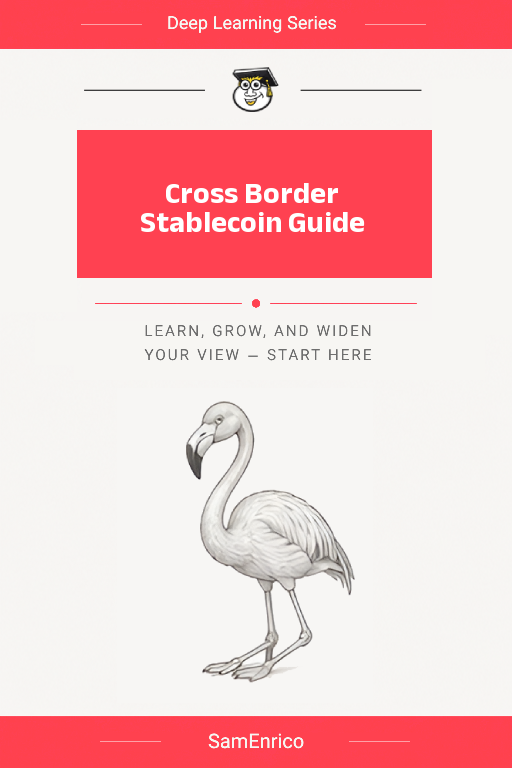
Cross Border Stablecoin Guide eBook
Discover how USD-pegged cryptocurrencies enable ne
Discover how USD-pegged cryptocurrencies enable near-instant international settlements at fractions of wire transfer costs.
Formats
Free sample
Chapter 1: The $656 Billion Toll Booth...--Every month, a nurse named Rosa who works double shifts in a London hospital sends £500 home to her mother in Manila. She has done this for eleven years. She has paid approximately £3,960 in wire transfer fees over that period – enough to buy a round-trip ticket home seven times. She does not know that a faster, cheaper way exists. The banks have never told her.Rosa’s story is not unusual.
It is the story of 200 million migrant workers worldwide who collectively send $656 billion across borders each year. That number is larger than the GDP of Sweden. It is larger than the entire economic output of Switzerland. And the global financial system extracts a toll on this river of money that would be considered robbery in any other industry.The global average cost of sending 200is6.49percent,accordingtothe World Bank.Insub−Saharan Africa,itoftenexceeds8percent.For Rosa,sending£500(200 is 6.49 percent, according to the World Bank. In sub-Saharan Africa, it often exceeds 8 percent.
For Rosa, sending £500 (200is6.49percent,accordingtothe World Bank.Insub−Saharan Africa,itoftenexceeds8percent.For Rosa,sending£500(635), the math is brutal: a visible £15 fee, a hidden 2 percent exchange rate mark-up (£10), and a £5 beneficiary fee charged by her mother’s bank in Manila. Total cost: £30 ($38). Percentage of principal: 6 percent. Her mother waits between one and three days for the money to arrive. If the transfer arrives on a Friday after 3 PM Manila time, she waits until Monday.This chapter is not a dry economic analysis of cross-border payments.
It is an investigation into a quiet heist that has been running for fifty years – and the technological revolution that is finally offering an escape.The Correspondent Banking Illusion To understand why Rosa pays so much and waits so long, you must understand how wire transfers actually work. The answer will likely make you angry.When Rosa walks into her London bank branch or opens her banking app, she believes she is sending money directly from her account to her mother’s account in Manila. This is not what happens. Her money travels through a daisy chain of intermediary banks, each one taking a cut and each one holding the funds overnight.Here is the actual journey of Rosa’s £500. First, her London bank (Bank A) sends the money to a large correspondent bank in New York (Bank B).
Bank B holds the funds overnight to earn float interest – interest on Rosa’s money that Rosa never sees. Then Bank B forwards the funds to a regional correspondent bank in Singapore (Bank C). Bank C also holds the funds overnight. Finally, Bank C sends the money to Bank D in Manila, which charges a beneficiary fee to deposit the funds into Rosa’s mother’s account.This system was designed in 1973 when SWIFT (the Society for Worldwide Interbank Financial Telecommunication) was built. At that time, every message was printed on paper and physically delivered by couriers.
A 50wirefeemadesensebecausehumansmanuallyprocessedeverytransaction.Today,computersdotheworkinmilliseconds.The50 wire fee made sense because humans manually processed every transaction. Today, computers do the work in milliseconds. The 50wirefeemadesensebecausehumansmanuallyprocessedeverytransaction.Today,computersdotheworkinmilliseconds.The50 fee remains. The overnight holds remain. The correspondent banks continue to earn interest on money that does not belong to them.The technical term for this is “float” – the value of money while it is in transit between banks.
The global float from cross-border wires is estimated at 27billionannually.Thatis27 billion annually. That is 27billionannually.Thatis27 billion of interest earned on money that belongs to senders and recipients, not banks. Rosa’s £500, during its two days in transit, earned approximately $0.14 in interest. Her bank kept it.The Ten-Minute Lie Here is a fact that will surprise most readers: A SWIFT message – the instruction to move money – takes approximately ten minutes to travel from one bank to another. The technology is not slow.
The delay is intentional.Banks hold funds for three reasons, none of which serve the customer. First, they want to earn float interest. Second, they perform manual anti-money laundering checks that could be automated but are not, because manual checks create jobs and justify fees. Third, they operate on cut-off schedules that were designed for a world of paper and couriers. If Rosa sends her transfer after 2 PM London time, it does not leave until the next business day.
If that day is a Friday, it does not leave until Monday.The “last mile” problem compounds the delay. Even after funds arrive at the destination bank in Manila, the bank may hold them for an additional 24 hours for “fraud review.” The irony is that wire transfers are irreversible – there is no fraud risk to review. The hold is purely administrative.This system is not broken. It is working exactly as designed. It was designed for banks, not for customers.The Human Cost of Slow Money Rosa’s story has a second layer that numbers cannot capture.
She works nights in a London hospital because night shifts pay a differential of £2 per hour. She saves that differential. Every month, she sends it home. Her mother uses the money for blood pressure medication and to pay the electricity bill. When the transfer is delayed – which happens approximately 15 percent of the time – her mother borrows from a local moneylender at 10 percent monthly interest.
A two-day wire delay costs Rosa’s family an additional 6ininterest.Thatis1percentoftheprincipal.Overayear,thatis6 in interest. That is 1 percent of the principal. Over a year, that is 6ininterest.Thatis1percentoftheprincipal.Overayear,thatis72. Over eleven years, that is nearly $800.Rosa does not know that a faster, cheaper way exists because her bank has no incentive to tell her. The bank earns 38onher£500transfer.Thebank’scosttoprocessthattransferisapproximately38 on her £500 transfer.
The bank’s cost to process that transfer is approximately 38onher£500transfer.Thebank’scosttoprocessthattransferisapproximately0.50 in electricity and computer time. The profit margin is 98 percent.This is not an isolated case. The World Bank estimates that the global remittance industry generates approximately 45billioninannualfeerevenue.Thecosttoprovidethosetransfers,ifthesystemwereefficient,wouldbeapproximately45 billion in annual fee revenue. The cost to provide those transfers, if the system were efficient, would be approximately 45billioninannualfeerevenue.Thecosttoprovidethosetransfers,ifthesystemwereefficient,wouldbeapproximately2 billion. The difference – $43 billion – is economic waste transferred from migrant workers to banks and their shareholders.The Regulatory Excuse Banks defend high wire fees with two arguments: compliance costs and fraud prevention.
Both arguments are misleading.Anti-money laundering compliance is expensive. Banks spend an estimated 25billionannuallyon AMLprogramsglobally.Butthemarginalcostofapplying AMLcheckstoasinglewiretransferisapproximately25 billion annually on AML programs globally. But the marginal cost of applying AML checks to a single wire transfer is approximately 25billionannuallyon AMLprogramsglobally.Butthemarginalcostofapplying AMLcheckstoasinglewiretransferisapproximately0.10 – the cost of running a database query. The $25 billion figure includes overhead, salaries, and real estate that would exist regardless of wire transfers.Fraud prevention is similarly overstated. Wire transfers are final.
Once a wire is sent, it cannot be reversed. There is no chargeback risk. The fraud prevention systems that banks cite are designed for credit cards and checks – payment methods that allow reversals. Wires do not have this risk. The fraud review holds are theater.The truth is simpler: Banks charge high wire fees because they can.
The wire transfer market has no price competition because customers do not choose their bank based on wire fees. They choose their bank based…
This is the end of the free sample. Get the eBook to keep going. Buy now
About this book
Details
- Author
- Chu Hildegard
- Publisher
- SamEnrico
- Language
- English
- Genre
- Non-Fiction, Forecast & Outlook, Stablecoins
- Released
- 2026-05-30
- Pages (approx.)
- 130
- Available as
- eBook, Audiobook

Read better in the ZLOADR app
Your eBooks on your phone or tablet. Sign in with your SamEnrico account and start reading.
More by Chu Hildegard
 Anger And Child's Friendship DramaChu Hildegard$11.99
 Anger Trigger Sensory SensitivitiesChu Hildegard$11.99
 Pain Neuroscience Support GroupChu Hildegard$11.99
 The Silent Revolution: How a Single Call Sparked a Global UprisingChu Hildegard$11.99
 Meal Prep Time Block MethodChu Hildegard$11.99
 Whispers from the Bone OrchardChu Hildegard$11.99
 How to Become a Chemical-equipment Sales EngineerChu Hildegard$11.99
 Income Streams Portfolio WorkbookChu Hildegard$12.99
 Understanding Hyperostosis Corticalis GeneralisataChu Hildegard$17.99
 Toy DesignerChu Hildegard$11.99
You may also like
 Hong Kong Handover 1997Dunn Johnnie$11.99
 Zumba For Postnatal Recovery CourseNeal Christian$11.99
 Zumba for BeginnersLadner Nikia$11.99
 YouTube Comment Mining GuideHumes Pandora$12.99
 Worry Box MeditationCarlin Rudy$11.99
 Workplace Stress MeditationNguyen Lynn$11.99
 Workplace Stress and Sleep RepairHawley Ivory$11.99
 Workplace Perfectionism CureDelaney Jeffry$11.99
 Workplace Injustice Anger GuideWallen Isabelle$11.99
 Work Addiction and Burnout LinkGreenwood Ester$11.99
 Women in Yoga and WellnessBeattie Galina$11.99
 Women in Stand Up ComedyChun Evangeline$11.99