
Non-FictionInformativeEducational
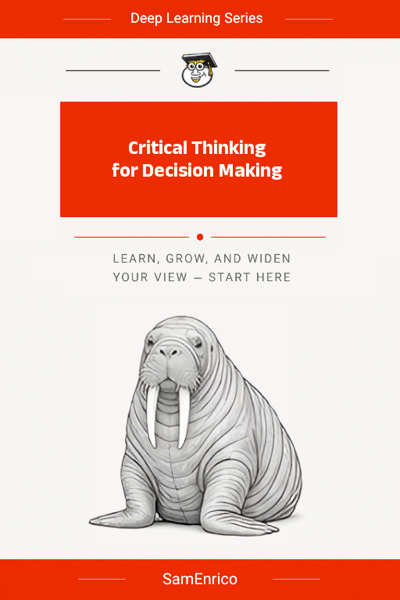
Critical Thinking for Decision Making eBook
A Coursebook on Critical Thinking for Decision Mak
by Lemke Theo
A Coursebook on Critical Thinking for Decision Making
Formats
Free sample
Chapter 1: The Two Thieves--–- Every time you make a bad decision, two thieves have robbed you. The first thief steals your time before you act. The second steals your peace after you act. You never see them coming. They wear disguises called confidence and speed.
They speak in your own voice. They feel like clarity. And they are the reason you have accepted a job you knew was wrong, stayed in a relationship past its expiration date, invested in something that felt like a sure thing, or said something in a meeting that you regretted before the sentence ended.You are not stupid. You are not lazy. You are not a bad person.
You are a human being with a brain that evolved to survive on the savanna, not to optimize 401ks, navigate office politics, or choose between five streaming services. Your brain is a miracle of biological engineering. It can recognize a leopard in tall grass in less than two hundred milliseconds. It can coordinate hundreds of muscles to throw a spear. It can learn a language without formal instruction.
But your brain cannot, on its own, make a rational decision about whether to sell a stock that is falling or to hold on. Your brain cannot, on its own, weigh probabilistic evidence about climate change. Your brain cannot, on its own, resist the emotional pull of a story about a dying child asking for donations, even when the charity has a ninety percent overhead.Your brain is not broken. It is mismatched. It is a savanna-optimized organ trying to function in a spreadsheet world.This is not a self-help book that will tell you to think positively or trust your gut.
This is a coursebook that will teach you to distrust your gut at exactly the right moments, to build external scaffolds for your fragile rationality, and to systematically outsmart the two thieves who are currently running your decision-making. The first thief is Speed. The second is Story. By the end of this chapter, you will know their real names, their disguises, and exactly how to spot them before they strike.The First Thief: Speed The psychologist Daniel Kahneman won a Nobel Prize for demonstrating that the human mind operates in two distinct modes. He called them System 1 and System 2.
I call them Speed and Accuracy because those names tell you what they do and, more importantly, what they cost.Speed is automatic, effortless, associative, and parallel. It is the part of your mind that reads the word "lemon" and immediately thinks of the color yellow, the taste of sour, and the memory of a pie your grandmother made. Speed is always on. You cannot turn it off. It scans your environment for threats and opportunities, matches patterns against a lifetime of experience, and delivers verdicts in milliseconds.
Speed is why you can catch a falling glass, recognize a friend across a crowded room, and know that a snake-shaped stick is not actually a snake. Speed is magnificent. Speed is also a liar.Speed lies by telling you that you already know the answer. It delivers conclusions without showing its work. It feels like truth because it arrives instantly and with complete confidence.
But Speed is not reasoning. Speed is pattern-matching. And patterns that worked on the savanna often fail in the boardroom.Consider this question: A bat and a ball cost one dollar and ten cents in total. The bat costs one dollar more than the ball. How much does the ball cost?Your Speed system just shouted an answer.
Most people say ten cents. That answer is wrong. If the ball cost ten cents, then the bat would cost one dollar and ten cents (one dollar more than ten cents), and the total would be one dollar and twenty cents. The correct answer is five cents. Your Speed system saw the numbers one dollar, ten cents, and the phrase "one dollar more," and it matched that pattern to a simple subtraction problem.
It did not run the algebra. It just shouted.This is called cognitive ease. Speed prefers the answer that is easiest to generate, not the answer that is most accurate. And Speed is so confident, so convincing, that most people never pause to check. They hand the wrong answer to the person who asked, or worse, they act on it.Now consider a more consequential example.
You are a hiring manager. You have interviewed three candidates for a senior position. The first candidate is polished, articulate, and attractive. The second candidate is nervous, fumbles a few answers, and wears an unfashionable suit. The third candidate is competent but unmemorable.
Your Speed system has already delivered a ranking: Candidate One is best, Candidate Two is worst, Candidate Three is in the middle. You feel this ranking as a gut instinct. It feels like wisdom.But your Speed system does not know that candidate two is nervous because she is the only person of color in the room and has been subtly dismissed by your colleague three times. Your Speed system does not know that candidate one is polished because he has been coached by a professional interview trainer. Your Speed system is matching patterns: confidence equals competence, similarity equals trust, fluency equals truth.
Every one of those patterns is statistically unreliable. Yet you will walk out of that interview room believing you have made a rational assessment.This is the first thief. Speed steals your time by giving you premature answers that you then waste hours justifying. Speed steals your peace by locking you into decisions made on bad evidence, decisions you will later regret.The solution is not to eliminate Speed. You cannot.
Speed is your brain's default operating system. The solution is to recognize when Speed is likely to be wrong and to force yourself into the second mode of thinking: Accuracy.The Second Thief: Story If Speed is the thief of time, Story is the thief of peace. Story is the part of your mind that takes scattered facts, incomplete memories, and random events and weaves them into a coherent narrative. Story cannot tolerate loose ends. Story cannot tolerate randomness.
Story cannot tolerate the possibility that you are not the hero of your own life or that bad things happen for no reason at all.Story is why you remember your life as a series of meaningful turning points rather than a chaotic sequence of accidents and reactions. Story is why you believe you knew the market would crash before it happened, even though your trading record shows you bought stocks a week before the bottom. Story is why you can tell a compelling explanation for why your ex left you, an explanation that has almost no relationship to the messy, ambiguous reality of a dying relationship.Story is not malicious. Story is adaptive. A brain that can construct narratives about cause and effect can learn from experience.
A brain that cannot tell stories cannot plan for the future. But Story has a catastrophic flaw: it prefers a bad story to no story.This is called the narrative fallacy. It was named by the essayist Nassim Taleb, and it explains why you…
This is the end of the free sample. Get the eBook to keep going. Buy now
About this book
Details
- Author
- Lemke Theo
- Publisher
- SamEnrico
- Language
- English
- Genre
- Non-Fiction, Informative, Educational
- Released
- 2026-05-11
- Pages (approx.)
- 158
- Available as
- eBook, Audiobook

Read better in the ZLOADR app
Your eBooks on your phone or tablet. Sign in with your SamEnrico account and start reading.
More by Lemke Theo
 One Tab To Rule Them AllLemke Theo$11.99
 Messner Rope Partner DeathsLemke Theo$11.99
 Meeting Anger Control SkillsLemke Theo$11.99
 Restless Leg Syndrome Sleep Positioning GuideLemke Theo$11.99
 NVC For Neighbors GuideLemke Theo$11.99
 Low Frustration Tolerance FixLemke Theo$11.99
 Teresa's Way of PerfectionLemke Theo$11.99
 Gershom Scholem Kabbalah HistorianLemke Theo$11.99
 Cash Flow for SalonsLemke Theo$11.99Cash Flow for SalonsLemke Theo$11.99
 The Last Witness: The Trial of the Sphinx’s CurseLemke Theo$11.99
 The Troll King’s Last Bargain: A Norwegian Mountain PactLemke Theo$11.99
You may also like
 Hong Kong Handover 1997Dunn Johnnie$11.99
 Zumba For Postnatal Recovery CourseNeal Christian$11.99
 Zumba for BeginnersLadner Nikia$11.99
 YouTube Comment Mining GuideHumes Pandora$12.99
 Worry Box MeditationCarlin Rudy$11.99
 Workplace Stress MeditationNguyen Lynn$11.99
 Workplace Stress and Sleep RepairHawley Ivory$11.99
 Workplace Perfectionism CureDelaney Jeffry$11.99
 Workplace Injustice Anger GuideWallen Isabelle$11.99
 Work Addiction and Burnout LinkGreenwood Ester$11.99
 Women in Yoga and WellnessBeattie Galina$11.99
 Women in Stand Up ComedyChun Evangeline$11.99