
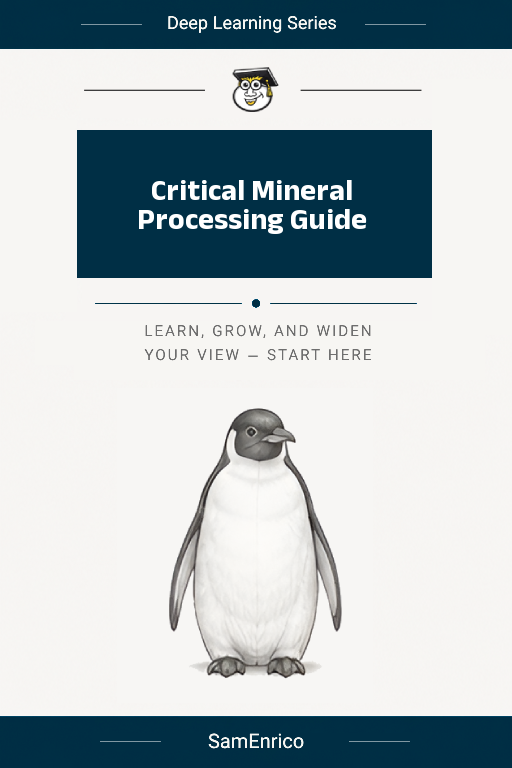
Non-FictionForecast & OutlookMinerals Finance
Critical Mineral Processing Guide eBook
Discover lithium refining, rare earth separation,
by Gillette Mee
Discover lithium refining, rare earth separation, and battery precursor plant investment.
Formats
Free sample
Chapter 1: The Stockpile Illusion--–- The core samples gleamed under the fluorescent lights of the Perth assay lab, their spodumene crystals catching the light like flecks of diamond. The geologist, a thirty-year veteran of hard-rock mining, placed his hand on the tray with theatrical reverence. “Fourteen hundred parts per million lithium oxide,” he announced to the room of investors. “One of the highest-grade discoveries in the decade. We’ve hit the motherlode.”The spreadsheets emerged.
The coffee was poured. Within seventy-two hours, a junior mining company that had been trading at eighty cents was suddenly worth four dollars. The term sheet for a hundred-million-dollar drilling program landed on the CEO’s desk before the week was out. Everyone celebrated the discovery. Everyone assumed that value had been created.Everyone was wrong.Eighteen months later, that same project sat in a state of quiet ruin.
Two hundred thousand tonnes of beautifully crushed, perfectly graded spodumene concentrate were stacked in a storage yard the size of a small town. The ore was flawless by any geological standard. It was also worthless. No refinery would take it. The toll-treating contracts that the company had assumed would materialize had been signed by competitors years earlier.
The Chinese refiners who had smiled through initial meetings stopped returning emails. The European facilities were still on drawing boards. The American plants did not exist.The company filed for bankruptcy in the second quarter of 2020. The stockpile was auctioned off for twelve cents on the production dollar. The geologist who had called it a motherlode was long gone, employed elsewhere by a different company chasing a different discovery.
The investors who had celebrated the assay results lost everything.This is the single most misunderstood dynamic in the critical minerals supply chain. It is a dynamic that has destroyed billions of dollars of shareholder value and will continue to do so until investors learn a brutal truth: a mine without a processing pathway is not a mine at all. It is a hole in the ground attached to a pile of worthless rock.The Geography of Delusion The critical minerals industry suffers from what I have come to call the Stockpile Illusion—the belief that extracted ore has inherent value regardless of what happens next. This illusion is reinforced by every stage of the mining value chain. Drilling results are celebrated.
Resource estimates are applauded. Feasibility studies are funded. And through it all, the question of what will actually be done with the rock is deferred to a vague future when “processing capacity will be available.”The Stockpile Illusion persists because mining is tangible in a way that refining is not. You can touch a core sample. You can watch a haul truck dump ore.
You can photograph a stockpile. Refining, by contrast, is invisible chemistry that happens inside sealed tanks, monitored by operators staring at computer screens. The geological heroism of discovery captures the imagination. The chemical drudgery of purification does not.Yet the economic reality is inverted. The discovery is the easy part.
The processing is where value is either created or destroyed.I have watched this pattern repeat across three continents and two commodity cycles. A lithium discovery in Australia. A rare earth deposit in Canada. A nickel laterite project in Indonesia. In every case, the pattern is identical: investors pile into the mine, congratulate themselves on the resource, and ignore the refinery until it is too late.
The yield killer for this chapter—and the theme that will recur throughout this book—is the failure to secure processing capacity before extraction begins. That failure has a name. It is called the Stockpile Illusion. And it has claimed more victims than any geological disappointment or metallurgical surprise.The 1970s Lesson That No One Learned In 1973, the world discovered that it had an oil problem. But the problem was not that crude was scarce.
The problem was that the refineries could not process what was being pumped.During the Arab oil embargo, tankers loaded with Saudi light crude sat idle off the coast of Rotterdam. The crude was there. The demand was there. What was missing was refining capacity capable of handling the specific gravity and sulfur content of that particular crude stream. The bottleneck was not the wellhead.
It was the cracking tower, the desulfurization unit, the catalytic reformer. For eighteen months, the world learned that crude oil is not gasoline. Between them lies a refinery.The same dynamic is playing out today with lithium, rare earths, nickel, and cobalt. The world is pivoting to electric vehicles, grid storage, and clean energy. That transition requires massive quantities of processed critical minerals.
But the raw ore dug from the ground is not the product. The product is 99.95% pure lithium carbonate or 99.99% pure neodymium-praseodymium oxide. Between the ore and the product lies a refinery.Consider the numbers. Between 2020 and 2025, more than two hundred lithium mining projects were announced globally. Of those, fewer than fifteen reached commercial production of battery-grade material.
The rest failed at the processing stage—or never reached it at all. Some failed because the metallurgy was more complex than anticipated. Some failed because the capital costs doubled halfway through construction. But most failed for a simpler reason: they had no place to send their ore.This is not a problem of geology. It is a problem of industrial organization.
China controls over sixty percent of global lithium refining capacity and over eighty-five percent of rare earth separation capacity. Every tonne of spodumene concentrate produced outside China must compete for a limited number of toll-treating contracts. Those contracts are scarce, they are expensive, and they come with specifications that most ore bodies cannot meet without extensive beneficiation.The Stockpile Illusion is the belief that because the ore is valuable, someone will want to process it. The reality is that refining capacity is a scarce strategic asset, controlled by players who have no obligation to process your rock.The Framework That Will Save You To understand where a project stands, and to avoid the Stockpile Illusion, I developed a simple framework that will appear throughout this book: the Geology-Processing Matrix. Every critical minerals project falls into one of four boxes.
Your investment thesis depends entirely on which box you occupy.Good Ore Bad Ore Good Processing THE PROMISED LANDTHE PROVING GROUNDBad Processing THE CEMETERYTHE DEATH VALLEYHere is what each box means.The Promised Land (Good Ore + Good Processing): This is the unicorn. The ore liberates easily at coarse grind sizes. Contaminant levels are low. The flowsheet is standard, proven, and well-understood. The processing team has built and operated this type of plant before, ideally multiple times.
Margins are thirty to forty percent or higher. These projects are rare, and when they exist, they are usually controlled by integrated majors who have no need to raise capital from public markets. Examples include the Greenbushes lithium mine in Australia, which feeds a dedicated refinery owned by the same corporate group, and the Mt. Pass rare earth mine in California after its revival by MP Materials.The Cemetery (Good Ore + Bad Processing): This is the most painful box to occupy. Your geologists did their job.
The ore is genuinely high-grade. But your engineers, or your business development team, or your board underestimated the difficulty of…
This is the end of the free sample. Get the eBook to keep going. Buy now
About this book
Details
- Author
- Gillette Mee
- Publisher
- SamEnrico
- Language
- English
- Genre
- Non-Fiction, Forecast & Outlook, Minerals Finance
- Released
- 2026-05-28
- Pages (approx.)
- 145
- Available as
- eBook, Audiobook

Read better in the ZLOADR app
Your eBooks on your phone or tablet. Sign in with your SamEnrico account and start reading.
More by Gillette Mee
 Buying for Future Self GuideGillette Mee$11.99
 Pranayama Compared To AnapanasatiGillette Mee$11.99
 The Body Language for DetectivesGillette Mee$11.99
 Scottish Canadian Return To Highlands PrimerGillette Mee$11.99
 Insurance Inventory DocumentationGillette Mee$11.99
 The Taniwha and the Telescope: A Love Story in Stars and ScienceGillette Mee$11.99
 Understanding Mixed Receptive-expressive Language DisorderGillette Mee$17.99
 How to Start a Bunkering Service Business (Beginners Guide)Gillette Mee$11.99
 Legal Document Review SecurityGillette Mee$12.99
 EDI AnalystGillette Mee$11.99
You may also like
 Hong Kong Handover 1997Dunn Johnnie$11.99
 Zumba For Postnatal Recovery CourseNeal Christian$11.99
 Zumba for BeginnersLadner Nikia$11.99
 YouTube Comment Mining GuideHumes Pandora$12.99
 Worry Box MeditationCarlin Rudy$11.99
 Workplace Stress MeditationNguyen Lynn$11.99
 Workplace Stress and Sleep RepairHawley Ivory$11.99
 Workplace Perfectionism CureDelaney Jeffry$11.99
 Workplace Injustice Anger GuideWallen Isabelle$11.99
 Work Addiction and Burnout LinkGreenwood Ester$11.99
 Women in Yoga and WellnessBeattie Galina$11.99
 Women in Stand Up ComedyChun Evangeline$11.99