
Non-FictionNon-Obvious CareerBookkeeping
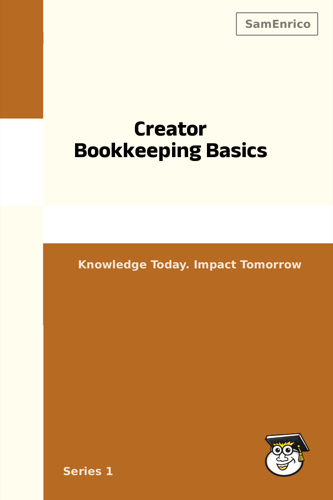
Creator Bookkeeping Basics eBook
Track expenses, invoice clients, and manage cash f
Track expenses, invoice clients, and manage cash flow as a full time creator.
Formats
Free sample
Chapter 1: The Invisible Pay Cut--–- In the spring of 2021, a comedy You Tuber named Sarah (not her real name) crossed a threshold she had dreamed about for three years. Her channel had grown to 400,000 subscribers. Between Ad Sense, a recurring Patreon pledge of $8,000 per month, and three brand deals worth $25,000 total, she was on track to earn $210,000 that year. By any standard, Sarah had made it.And yet, by December, she was borrowing $3,000 from her parents to cover her rent.This is not a story about overspending on avocado toast or a secret addiction to luxury handbags. Sarah drove a seven-year-old Honda.
She bought her clothes at Target. She cooked most of her own meals. The problem wasn't how much she spent. The problem was that she had no idea, at any given moment, how much money she actually had—or when the next real paycheck would arrive.In March, she received a $10,000 sponsorship payment and felt rich. She paid her credit card bill, bought a new camera lens she had been eyeing, and took a weekend trip to see her sister.
In April, her Ad Sense check was $700. In May, another sponsorship paid $4,000. In June, nothing. By July, she had already spent the $10,000 from March but was still waiting on $15,000 in outstanding invoices from two brands that paid on ninety-day terms. Her checking account balance said $1,200.
Her "wealth" on paper said $210,000. Her reality said she could not afford to replace her broken microphone.Sarah is not an exception. She is the rule.Welcome to the creator economy, where making a living and feeling broke are not opposites. They are identical twins.The Feast-or-Famine Lie Traditional small businesses have a predictable rhythm. A plumber knows that in an average month, she will receive roughly the same number of service calls.
A coffee shop owner knows that Tuesday mornings look different from Saturday afternoons, but the week as a whole follows a pattern. Even a freelance graphic designer with ten retainer clients can forecast her income within a few hundred dollars.A full-time creator? You might earn $8,000 in March from a brand deal, $800 in April from Ad Sense, $3,200 in May from affiliate commissions, and $0 in June from platform payouts because You Tube pays sixty days behind. This is not poor planning. This is the structural reality of the creator economy.Let me name the beast that this book exists to slay: the feast-or-famine cycle.Feast-or-famine works like this.
A brand reaches out with an exciting opportunity: $12,000 to produce three integrated videos. You say yes. The money arrives in one lump sum. For two glorious weeks, your bank account looks healthy. You pay off debt.
You upgrade your lighting. You relax. Then, because you relaxed, you didn't invoice the next brand fast enough. Or the next platform payout is delayed. Or you forgot that quarterly taxes are due in two weeks.
Suddenly, your $12,000 is gone, and you have $300 to last until the next sponsorship clears.The cruelest part of feast-or-famine is not the hunger. It is the feast itself. When a large payment lands, your brain releases dopamine and signals safety. You spend accordingly. Then, when the famine arrives, you blame yourself for being irresponsible—when in fact the problem was not your spending but your lack of a system to manage irregular income.Here is what the accounting industry does not tell you: traditional bookkeeping was designed for businesses with predictable revenue.
It assumes you know, within a reasonable margin, what next month's income will look like. It assumes you can set a budget in January and follow it through December. It assumes that "cash flow" means the money moving through a steady river, not flash floods followed by droughts.Creators do not live in that world. You need a different bookkeeping system. Not a slightly modified version of the old one.
A different one.The Multi-Platform Tax on Your Sanity Sarah's problem was not just irregular timing. It was also the sheer number of places her income came from. At the time she borrowed money from her parents, she was actively earning from:You Tube Ad Sense (paid monthly, 45–60 days behind)Patreon (paid monthly, but members could cancel at any time)Three brand sponsorships (each with different payment terms: 30 days, 60 days, and one that required her to invoice three times for the same project)Affiliate links (Amazon Associates, paid 60 days after the month ends)A digital product (a Notion template for creators, sold on Gumroad, which held 10% of every sale for potential refunds)This is not unusual. A typical full-time creator today might have income streams from Tik Tok's Creator Fund, Instagram bonuses, Twitch subscriptions, merch sales through a print-on-demand service, consulting calls, online courses, newsletter sponsorships, and coaching—all with different payout schedules, fee structures, and tax documentation requirements.Each platform adds a cognitive tax. You have to remember to check each dashboard.
You have to reconcile each payout against your bank account. You have to track which 1099 forms you should expect from which companies. You have to notice when a payment is late—and with eight platforms, at least one will be late every month.Most creators respond to this complexity by doing nothing. They log into their bank account once a week, see a number, and hope that number is enough. They pay bills when they remember.
They save for taxes by crossing their fingers and praying.This is not a moral failure. It is a design failure. The creator economy has exploded in the last decade, but the financial tools and habits available to creators are still stuck in the 1950s. This book is the patch.The Psychology of Financial Fog Let me tell you about a third creator, a podcast host named Marcus. Marcus earned $185,000 in his best year and $97,000 in his worst.
On average, he did well. But he lived in a state of constant low-grade dread.Here is how Marcus described it to me: "I feel like I'm holding my breath from the first of the month until the last day. I never know if I can say yes to dinner with friends. I never know if I should buy the good coffee. I paid my taxes late three years in a row not because I didn't have the money but because I was so afraid to look at my accounts that I just...
didn't."Marcus was experiencing what I call financial fog. Financial fog is the state of not knowing, at any given moment, your true financial position. You have money in the bank, but some of it belongs to the government. You have invoices outstanding, but you don't know when they will be paid. You have expenses coming due, but you haven't tracked them.
You are not broke. But you feel broke. And feeling broke while earning six figures is its own special kind of exhaustion.Financial fog has three predictable consequences for creators.First, paralysis. You stop making strategic decisions about your business because every decision feels risky. Should you hire an editor?
What if next month is a famine month? Should you invest in a new camera? What if the brand deal falls through? Without clear financial data…
This is the end of the free sample. Get the eBook to keep going. Buy now
About this book
Details
- Author
- Hutchison Chae
- Publisher
- SamEnrico
- Language
- English
- Genre
- Non-Fiction, Non-Obvious Career, Bookkeeping
- Released
- 2026-06-12
- Pages (approx.)
- 124
- Available as
- eBook, Audiobook

Read better in the ZLOADR app
Your eBooks on your phone or tablet. Sign in with your SamEnrico account and start reading.
More by Hutchison Chae
 Brand Adaptation For Foreign MarketsHutchison Chae$11.99
 Public Speaking Imposter SyndromeHutchison Chae$11.99
 The Teen Neurodivergent Confidence GuideHutchison Chae$11.99
 The Food Addiction Family GuideHutchison Chae$11.99
 The Star Keepers of Ethiopia: The Royal Astronomers of AksumHutchison Chae$11.99
 Concrete ForemanHutchison Chae$11.99
 Electronics Export Eco Label GuideHutchison Chae$12.99
 Search Console URL ParametersHutchison Chae$12.99
 Understanding Prieur–griscelli SyndromeHutchison Chae$17.99
 How to Become a Compound MixerHutchison Chae$11.99
You may also like
 Hong Kong Handover 1997Dunn Johnnie$11.99
 Zumba For Postnatal Recovery CourseNeal Christian$11.99
 Zumba for BeginnersLadner Nikia$11.99
 YouTube Comment Mining GuideHumes Pandora$12.99
 Worry Box MeditationCarlin Rudy$11.99
 Workplace Stress MeditationNguyen Lynn$11.99
 Workplace Stress and Sleep RepairHawley Ivory$11.99
 Workplace Perfectionism CureDelaney Jeffry$11.99
 Workplace Injustice Anger GuideWallen Isabelle$11.99
 Work Addiction and Burnout LinkGreenwood Ester$11.99
 Women in Yoga and WellnessBeattie Galina$11.99
 Women in Stand Up ComedyChun Evangeline$11.99