
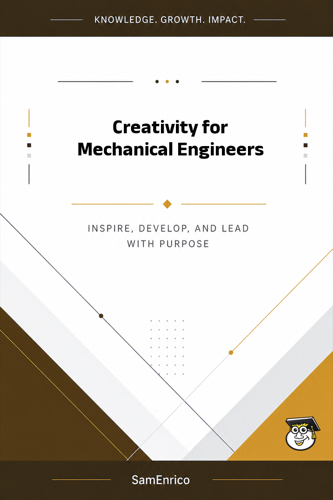
Creativity for Mechanical Engineers
Design novel mechanisms and components within phys
by Scott Minnie
Design novel mechanisms and components within physical constraints.
Formats
About this book
Free sample
Chapter 1: The Constraint Paradox--–- In 1961, a young engineer named Genrich Altshuller received a letter that would change the way we think about creativity forever. He was not a famous inventor. He was not a university professor. He was a clerk in the Soviet patent office, and his job was to read thousands of patent applications. Day after day, year after year, he read about inventions large and small.
Most were平庸 improvements—a slightly better gear, a marginally stronger spring. But a few were genuine breakthroughs. And Altshuller noticed something that no one had seen before: the breakthrough inventions followed predictable patterns.The most innovative patents were not the ones with the most freedom. They were the ones with the tightest constraints. A mechanism that had to fit in a impossibly small space.
A structure that had to support enormous loads with minimal material. A device that had to work in extreme temperatures. The constraints did not limit creativity. They fueled it.Altshuller's discovery became the foundation of TRIZ, the Theory of Inventive Problem Solving. But the deeper insight—the one that challenges everything most engineers believe about creativity—is this: constraints are not obstacles.
They are the secret ingredient.This chapter is about the Constraint Paradox. The counterintuitive truth that tight design briefs produce breakthrough solutions, while unlimited freedom produces平庸 results. It is about why the most creative mechanical engineers do not fight constraints—they embrace them as design parameters. And it is about the unified framework that will guide every chapter of this book.The Blank Page Fallacy Let us start with a story. A group of engineering students is given a design project.
Half the teams receive a brief with tight constraints: the mechanism must fit within a 10 cm cube, cost less than $50 to manufacture, and use only off-the-shelf components. The other half receives a brief with no constraints: "Design something interesting."Which group produces the most creative solutions?If you answered the group with no constraints, you are wrong. And you are in good company—most engineers believe that creativity requires freedom. This is the Blank Page…
This is the end of the free sample. Get the eBook to keep going. Buy now
Contents
- Chapter 1
- Chapter 2
- Chapter 3
- Chapter 4
- Chapter 5
- Chapter 6
- Chapter 7
- Chapter 8
- Chapter 9
- Chapter 10
- Chapter 11
- Chapter 12
Details
- Author
- Scott Minnie
- Publisher
- SamEnrico
- Language
- English
- Genre
- Non-Fiction, Self-Help
- Released
- 2026-06-08
- Pages (approx.)
- 102
- Available as
- eBook, Audiobook

Read better in the ZLOADR app
Your eBooks on your phone or tablet. Sign in with your SamEnrico account and start reading.
More by Scott Minnie
 Major Depressive Disorder Symptoms GuideScott Minnie$11.99
 Field Studies of Real LineupsScott Minnie$11.99
 Claustrophobia GuideScott Minnie$11.99
 Language Vocabulary SRSScott Minnie$11.99
 Calcium Channel BlockersScott Minnie$11.99
 Inpatient Rehab PreparationScott Minnie$11.99
 Andy North Unlikely ChampionScott Minnie$11.99
 The Unbreakable Streak: The Legend of the 1957 New York GiantsScott Minnie$11.99
 The Lion Kings of the Sahel: Sundiata’s Golden ArmyScott Minnie$11.99
 How to Start a Embroidery BusinessScott Minnie$11.99
 Penalty for Late PaymentScott Minnie$12.99
 Factoring in Philippines GuideScott Minnie$12.99
You may also like
 Hong Kong Handover 1997Dunn Johnnie$11.99
 Zumba For Postnatal Recovery CourseNeal Christian$11.99
 Zumba for BeginnersLadner Nikia$11.99
 YouTube Comment Mining GuideHumes Pandora$12.99
 Worry Box MeditationCarlin Rudy$11.99
 Workplace Stress MeditationNguyen Lynn$11.99
 Workplace Stress and Sleep RepairHawley Ivory$11.99
 Workplace Perfectionism CureDelaney Jeffry$11.99
 Workplace Injustice Anger GuideWallen Isabelle$11.99
 Work Addiction and Burnout LinkGreenwood Ester$11.99
 Women in Yoga and WellnessBeattie Galina$11.99
 Women in Stand Up ComedyChun Evangeline$11.99