
Non-FictionSelf-HelpMeeting Design
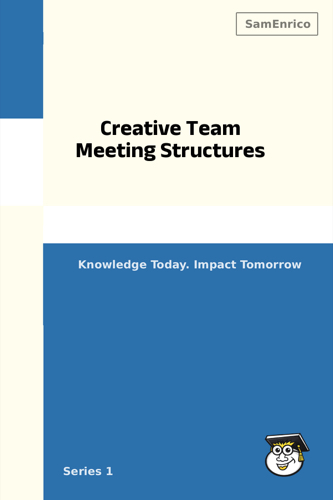
Creative Team Meeting Structures eBook
Design repeatable formats for group innovation usi
by Rowell Deann
Design repeatable formats for group innovation using this practical collaboration handbook.
Formats
Free sample
Chapter 1: The Meeting Trap---– Elena Vasquez had been staring at the same calendar invite for forty-seven seconds, which was forty-five seconds longer than it deserved. The subject line read: “Creative Brainstorm – New Feature Launch.” The attendee list: twelve people. The duration: ninety minutes. The agenda: none. The location: Conference Room B, which everyone knew meant the one with the broken air conditioning and the projector that required three reboots before it would acknowledge the existence of a laptop.She had been a product manager at Helix Financial for just under three years, long enough to recognize every sign of an impending creative disaster.
Her team was good—genuinely good—at execution. They shipped code. They hit deadlines. They resolved customer support tickets with admirable efficiency. But when it came to generating genuinely novel ideas, they were drowning.
Not because they weren’t smart. Not because they didn’t care. Because their meetings were designed to kill creativity before it had a chance to draw its first breath.She clicked “Accept” anyway. What choice did she have?Ninety minutes later, she emerged from Conference Room B with the familiar hollow ache behind her eyes. The brainstorm had produced exactly two ideas worth discussing: one from Mark, the senior engineer who spoke first and loudest, and one from Priya, the designer who had waited until minute forty-four to speak because she had been written off three times already.
The other ten people had contributed nothing of substance. The facilitator—a well-intentioned product director named David—had opened with “no bad ideas” and then proceeded to nod encouragingly at the safe ideas while gently steering away from anything that might require actual change.The kicker: David had declared the meeting a success. “Great energy in there,” he said, patting Elena on the shoulder as they walked back to their desks. “Really productive session.”Elena smiled. She said nothing.
But she made a quiet promise to herself: there had to be a better way.The Invisible Contradiction Here is the problem that Elena faced, and that you have likely faced hundreds of times: most teams operate under a hidden contradiction that they cannot see because it is baked into the very structure of their work lives.On one hand, you have meetings designed for efficiency. These are the tight, fast, goal-oriented sessions where the agenda is a bullet-point list, the decision rights are clear, and the expectation is closure. Approve the budget. Assign the tasks. Review the status report.
Resolve the blocker. These meetings thrive on speed and authority. They are the engine of execution, and when they work well, they feel productive in a tangible, measurable way. You leave with a list of action items, a sense of forward momentum, and the satisfaction of checking something off.On the other hand, you have meetings designed for creativity. These are the open, exploratory, judgment-suspended sessions where the goal is novelty, not closure.
Generate product concepts. Solve ambiguous problems. Explore possibilities. These meetings require psychological safety, permission to wander, and a tolerance for half-formed ideas. When they work well, they feel electric—the spark of collective discovery, the rush of seeing something new emerge from the chaos of discussion.The contradiction is this: the same structures that make transactional meetings effective make creative meetings fail.
And the structures that make creative meetings sing make transactional meetings a nightmare.Efficiency demands clarity, speed, and closure. Creativity demands ambiguity, patience, and openness. You cannot run the same meeting for both purposes. And yet, in most organizations, that is exactly what happens. Teams use the same default format—a group of people sitting around a table (or a Zoom grid), talking—for everything from budget approvals to product innovations.
They apply a one-size-fits-all solution to problems that require fundamentally different architectures.This is the Meeting Trap. And the first step out of it is recognizing that you are inside it.The Two Types of Meetings (And Why Confusing Them Destroys Value)Let us name the two types explicitly, because naming is the first act of mastery.Type T: Transactional Meetings The goal of a Type T meeting is closure. You are there to make a decision, assign a task, review a status, or resolve a blocker. The output is an action item, a signed document, a resolved issue, or a clear path forward. Speed is a virtue.
Authority is useful. The ideal Type T meeting ends early because you have said everything that needed to be said and no more.Examples: weekly status reviews, budget approvals, incident post-mortems, resource allocation discussions, handoff meetings between teams.Type C: Co-Creative Meetings The goal of a Type C meeting is novelty. You are there to generate options, explore possibilities, combine perspectives, or discover something that none of you could have discovered alone. The output is an idea, a prototype, an insight, a new question, or a direction to explore further. Ambiguity is a feature, not a bug.
Authority is counterproductive. The ideal Type C meeting ends with more questions than answers.Examples: product concept generation, problem framing, strategic exploration, design critiques, innovation workshops.Here is the critical insight: neither type is better than the other. They serve different purposes. The problem arises when you try to run a Type C meeting with Type T structures, or a Type T meeting with Type C structures.Run a creative meeting like a transactional meeting—tight agenda, fast decisions, clear authority—and you will kill every interesting idea before it can breathe. People will self-censor.
The loudest voice will dominate. The pressure for closure will choke off exploration. You will leave with a decision, but it will be the safest, most incremental decision possible. You will have optimized for efficiency and achieved mediocrity.Run a transactional meeting like a creative meeting—open discussion, no judgment, permission to wander—and you will never close anything. People will debate endlessly.
Decisions will be postponed. The lack of structure will produce chaos, not creativity. You will leave with lots of conversation and zero action items. You will have optimized for exploration and achieved paralysis.Elena’s team was suffering from both failures simultaneously. Their creative meetings were run like transactional meetings, so they generated no novel ideas.
Their transactional meetings were run like creative meetings, so they never made decisions. The result was a team that was simultaneously overworked and under-innovating—the worst of both worlds.The Meeting Type Matrix: A Diagnostic Tool Before you walk into any meeting, you need to know what type it is. Not what the calendar invite says. Not what the facilitator hopes. What the actual, structural, measurable type is.Here is the Meeting Type Matrix.
Use it before every meeting you schedule, every meeting you attend, and every meeting you facilitate.Ask two questions:What is the primary goal? Closure (Type T) or Novelty (Type C)?What is the required decision rights structure? Clear authority (Type T) or distributed ownership (Type C)?Plot your answers on a two-by-two grid. Most meetings will fall clearly into one quadrant. If they fall into the middle—if the goal is equally closure and novelty, or if the decision rights are ambiguous—you have a problem that no format can solve.…
This is the end of the free sample. Get the eBook to keep going. Buy now
About this book
Details
- Author
- Rowell Deann
- Publisher
- SamEnrico
- Language
- English
- Genre
- Non-Fiction, Self-Help, Meeting Design
- Released
- 2026-06-06
- Pages (approx.)
- 148
- Available as
- eBook, Audiobook

Read better in the ZLOADR app
Your eBooks on your phone or tablet. Sign in with your SamEnrico account and start reading.
More by Rowell Deann
 Green Beret Engineering TrainingRowell Deann$11.99
 Workaholism In Consulting CultureRowell Deann$11.99
 The Trigger RetrospectiveRowell Deann$11.99
 Emotional Intelligence For AccountantsRowell Deann$11.99
 The Sawbones of the Frontier: Dr. William Beaumont and the Birth of Gastric ScienceRowell Deann$11.99
 The Lost Tablets of Enki: Secrets of the AbzuRowell Deann$11.99
 Understanding G SyndromeRowell Deann$17.99
 Client Services OfficerRowell Deann$11.99
 Bridge Round PrimerRowell Deann$12.99
 Chinese Student Age LevelsRowell Deann$12.99
 How to Start a Site Location Consulting Service BusinessRowell Deann$11.99
You may also like
 Hong Kong Handover 1997Dunn Johnnie$11.99
 Zumba For Postnatal Recovery CourseNeal Christian$11.99
 Zumba for BeginnersLadner Nikia$11.99
 YouTube Comment Mining GuideHumes Pandora$12.99
 Worry Box MeditationCarlin Rudy$11.99
 Workplace Stress MeditationNguyen Lynn$11.99
 Workplace Stress and Sleep RepairHawley Ivory$11.99
 Workplace Perfectionism CureDelaney Jeffry$11.99
 Workplace Injustice Anger GuideWallen Isabelle$11.99
 Work Addiction and Burnout LinkGreenwood Ester$11.99
 Women in Yoga and WellnessBeattie Galina$11.99
 Women in Stand Up ComedyChun Evangeline$11.99