
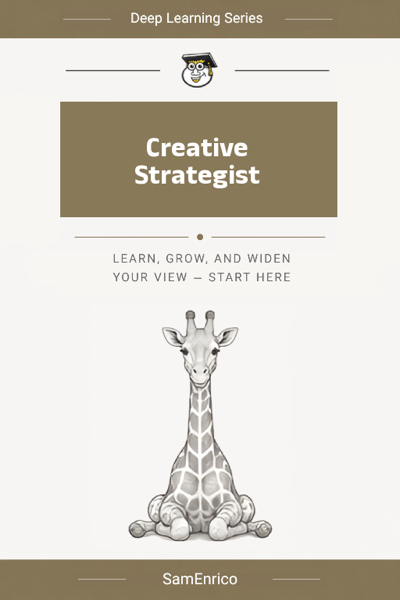
Non-FictionInformativeEducational
Creative Strategist eBook
A Coursebook on Creative Strategist
A Coursebook on Creative Strategist
Formats
Free sample
Chapter 1: The Cliché Trap...--Most strategists fail before they write a single word. They fail not because they lack intelligence, not because they lack data, and certainly not because they lack effort. They fail because they reach for the easiest answer in the room—the answer that has worked before, the answer that everyone agrees with, the answer that requires no courage to defend.This is the Cliché Trap.It is the single greatest enemy of creative strategy, and it will kill your ideas faster than any budget cut, any difficult client, or any incompetent creative team. You have seen its victims everywhere. They are the ads that make you say, "That's nice," and then forget immediately.
They are the campaigns that win awards for craft but change nothing in the market. They are the strategies that begin with the words, "Our research shows that moms are busy," or "People want authenticity," or "In today's fast-paced world..."These are not insights. These are clichés wearing a cheap disguise.The Cliché Trap works like this: You face a difficult problem. Your client wants growth. Your category is crowded.
Your budget is tight. Your brain, desperate for relief, reaches back into its memory for a solution that has worked in similar situations. That solution feels safe because it has been validated by others. You share it in a meeting. No one argues because no one can argue with something that is obviously true.
The strategy moves forward. The work gets made. The market yawns.You have just spent millions of dollars to produce silence.This book exists to pull you out of that trap. It will teach you to recognize the cliché before it catches you, to replace it with genuine insight, and to build a practice of creative strategy that produces work people actually remember. But first, you must understand the enemy.The Anatomy of a ClichéLet us name the beast.
A cliché, in the context of strategic thinking, is any statement that meets three criteria:First, it is true. This is the trap's genius. No one ever got fired for saying "Moms are busy" because it is demonstrably, obviously, painfully true. Moms are busy. Everyone knows this.
Everyone agrees with this. And because everyone agrees, no one pushes back.Second, it is true for every competitor in your category. If your insight could be used interchangeably by Nike, Adidas, Puma, and New Balance, it is not an insight. It is a category fact. Category facts do not produce competitive advantage.
They produce sameness.Third, it requires no courage to defend. A cliché is socially safe. It does not challenge the client's assumptions. It does not risk offending anyone. It does not make anyone uncomfortable.
And because it requires no courage, it produces no reward.Let us test this framework. Consider the statement: "Millennials value experiences over things." True? Broadly, yes. True for every lifestyle brand targeting Millennials? Also yes.
Does it require courage to say in a meeting? Not remotely. Cliché.Consider: "In today's digital world, consumers expect personalization." True. True for every e-commerce brand. Completely safe.
Cliché.Consider: "People are tired of being sold to; they want authentic connections." This sentence appears in approximately forty thousand marketing decks per year. It is the official cliché of the advertising industry. And it is poison.The worst part is that these statements feel like insights. They have the grammatical structure of insights. They sound smart in a pitch.
They allow you to fill a slide with words that no one will remember thirty seconds after the meeting ends.Your job as a Creative Strategist is to refuse them.The Cost of Safety You might be thinking: "What is the harm? If the cliché is true, and it makes the client comfortable, and we produce decent work, isn't that enough?"No. It is not enough. And the market will punish you for thinking it is.The cost of falling into the Cliché Trap is measured in three currencies: money, time, and trust.Money is the most obvious. Millions of dollars are spent every year on campaigns built from clichéd insights.
These campaigns produce single-digit lifts at best. They do not change market share. They do not create new categories. They do not build movements. They simply maintain the status quo at great expense.Time is more painful.
A team that spends six months developing a strategy based on a cliché has not just wasted six months. They have also lost the opportunity to develop a real strategy. The opportunity cost of a cliché is the breakthrough that never happened.Trust is the deepest wound, because it compounds. Every time you present a cliché to a client, you teach them that you have nothing original to offer. They will trust you less.
They will demand more data. They will ask for more rounds of revisions. They will treat you like a vendor rather than a partner. And they will be right to do so.I have watched agencies lose ten-year relationships because they fell into the Cliché Trap one too many times. The client did not fire them for a single bad campaign.
The client fired them for a pattern of safety. The client realized they were paying premium rates for generic thinking.Do not let this be you.The Shift: From Mad Men to Hypothesis-Driven Creativity To escape the Cliché Trap, you must first understand how the strategy profession arrived at this moment.For most of advertising history, strategy was the domain of the "Mad Men" era—a time when intuition reigned supreme. A creative director would smoke a cigarette, stare at the ceiling, and declare, "I have a feeling about this one." And sometimes that feeling produced magic. But often it produced expensive failures that no one could explain.The backlash against intuition gave rise to the data era. Suddenly, everything had to be measured.
Every decision had to be justified by a spreadsheet. Agencies hired data scientists. Clients demanded ROI projections. The pendulum swung from pure art to pure science.Both extremes miss the point.A Creative Strategist does not choose between intuition and data. They build a hierarchy between them.
And that hierarchy begins with a simple distinction: Quantitative data tells you where to look. Qualitative insight tells you what to say.Here is how the hierarchy works in practice.Quantitative data—surveys, analytics, P&L statements, market reports—answers the question "Where?" Where is the opportunity? Which customer segment has the highest churn rate? Which step in the purchase funnel loses the most people? Which product feature drives the most returns?
Quantitative data is your map. It shows you the territory.Qualitative insight—ethnography, interviews, empathy maps, house visits—answers the question "What?" What is the human truth beneath the numbers? Why do customers churn despite saying they are satisfied? What emotion drives the drop-off at that specific step? What unspoken need does that returned product reveal?
Qualitative insight is your compass. It tells you which direction to walk on the map.Neither is sufficient alone. A map without a compass leaves you wandering randomly. A compass without a map leaves you confident but lost.The Cliché…
This is the end of the free sample. Get the eBook to keep going. Buy now
About this book
Details
- Author
- Yancey Frances
- Publisher
- SamEnrico
- Language
- English
- Genre
- Non-Fiction, Informative, Educational
- Released
- 2026-05-11
- Pages (approx.)
- 157
- Available as
- eBook, Audiobook

Read better in the ZLOADR app
Your eBooks on your phone or tablet. Sign in with your SamEnrico account and start reading.
More by Yancey Frances
 The Breath Counting Group GuideYancey Frances$11.99
 Loneliness And Optimism GuideYancey Frances$11.99
 Caregiver Anger WorkbookYancey Frances$11.99
 Heavy Menstrual Bleeding GuideYancey Frances$11.99
 TikTok ASMR Comparison TrapYancey Frances$11.99
 Crown & Chaos: The Wild Reign of King Farouk of EgyptYancey Frances$11.99
 The Lost City of Z: The Real-Life Indiana Jones AdventureYancey Frances$11.99
 Understanding DyspareuniaYancey Frances$17.99
 Founder Mental Health GuideYancey Frances$12.99
 Stock Photo Batch UploadYancey Frances$12.99
 How to Start a Parcels Delivery Service (not Post office) Unlicensed Business (Beginners Guide)Yancey Frances$11.99
You may also like
 Hong Kong Handover 1997Dunn Johnnie$11.99
 Zumba For Postnatal Recovery CourseNeal Christian$11.99
 Zumba for BeginnersLadner Nikia$11.99
 YouTube Comment Mining GuideHumes Pandora$12.99
 Worry Box MeditationCarlin Rudy$11.99
 Workplace Stress MeditationNguyen Lynn$11.99
 Workplace Stress and Sleep RepairHawley Ivory$11.99
 Workplace Perfectionism CureDelaney Jeffry$11.99
 Workplace Injustice Anger GuideWallen Isabelle$11.99
 Work Addiction and Burnout LinkGreenwood Ester$11.99
 Women in Yoga and WellnessBeattie Galina$11.99
 Women in Stand Up ComedyChun Evangeline$11.99