
Non-FictionSelf-HelpFeedbackResilience
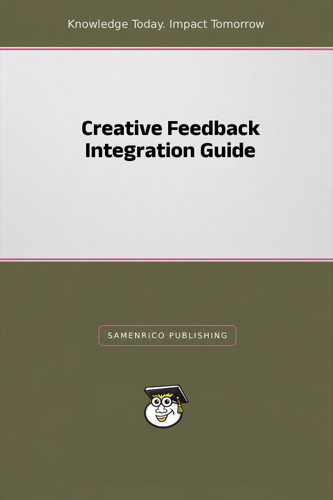
Creative Feedback Integration Guide Audiobook
Receive and use feedback on ideas without becoming
by Bates Elisa
Receive and use feedback on ideas without becoming defensive or discouraged.
Formats
Free sample
Chapter 1: The Feedback Mismatch--–- You just finished something you are proud of. A design. A pitch. A chapter. A strategy.
You took a breath. You hit send. And then you waited.The email came back three hours later. "Great start," they said—and you already knew what came after the comma. "A few thoughts." "Have you considered?" "What if we tried?" Your stomach dropped.
Your jaw clenched. Your fingers hovered over the keyboard, already typing a defense. "Actually, if you look at page four..." "That is not what I meant..." "I think you are missing the point..."Sound familiar?I spent a decade doing exactly that. Arguing. Explaining.
Defending. Burning energy I could have used to make my work better. Until I learned the single most important lesson about feedback: the receiver, not the giver, holds all the power. And the first step to claiming that power is understanding that most feedback conversations fail not because the content is wrong, but because the giver and receiver are talking about completely different kinds of feedback.You share a rough draft hoping for coaching on how to improve it, and your colleague gives you evaluation—a ranking, a grade, a judgment of where you stand. You ask for appreciation—a simple "thank you, I see your effort"—and receive coaching on everything you did wrong.
You need evaluation to understand where you stand against clear standards, and you receive only vague appreciation, leaving you confused about your actual performance. The mismatch is not your fault. But it is your problem to solve.The Three Kinds of Feedback You Are Probably Mixing Up Drawing on decades of research from Douglas Stone and Sheila Heen's Thanks for the Feedback, we can identify three distinct types of feedback. Each serves a different purpose. Each requires a different response.
And when we confuse them, conversations that should be productive become battles that leave everyone feeling hurt, defensive, or confused.Appreciation is motivational encouragement. Its purpose is to satisfy the universal human need to feel seen, valued, and appreciated. Appreciation says: "I see your effort. You matter. Thank you for what you have done." Examples include: "Thank you for your hard work on this," "I see the effort you put into that section," "Your persistence on this problem has been impressive."Appreciation is essential for relationship maintenance and creative stamina.
Without it, we burn out. We feel invisible. We stop caring. But here is what appreciation is not: it is…
This is the end of the free sample. Get the Audiobook to keep going. Buy now
About this book
Details
- Author
- Bates Elisa
- Publisher
- SamEnrico
- Language
- English
- Genre
- Non-Fiction, Self-Help, Feedback, Resilience
- Released
- 2026-06-08
- Pages (approx.)
- 117
- Available as
- eBook, Audiobook

Listen in the VoxFlicks app
Audiobooks and audio dramas wherever you go. Sign in with your SamEnrico account and press play.
More by Bates Elisa
 Rodriguez Orejuela BrothersBates Elisa$11.99
 The Safe Cookware GuideBates Elisa$11.99
 Stress and Fibromyalgia ConnectionBates Elisa$11.99
 Antwerp Heist Getaway CarsBates Elisa$11.99
 The Day the Sky Turned Green: The Great Dust Bowl of 1935Bates Elisa$11.99
 The Vanishing Archives: The CIA's Lost Cold War VaultsBates Elisa$11.99
 Sales LeaderBates Elisa$11.99
 Understanding Fanconi–bickel SyndromeBates Elisa$17.99
 Ultimate Handbook Guide to Salvador : (Brazil) Travel GuideBates Elisa$11.99
 Nigeria Free Zone VAT RulesBates Elisa$12.99
 Strategy Meeting Samples Across Seven IndustriesBates Elisa$12.99
You may also like
 Hong Kong Handover 1997Dunn Johnnie$11.99
 Zumba For Postnatal Recovery CourseNeal Christian$11.99
 Zumba for BeginnersLadner Nikia$11.99
 YouTube Comment Mining GuideHumes Pandora$12.99
 Worry Box MeditationCarlin Rudy$11.99
 Workplace Stress MeditationNguyen Lynn$11.99
 Workplace Stress and Sleep RepairHawley Ivory$11.99
 Workplace Perfectionism CureDelaney Jeffry$11.99
 Workplace Injustice Anger GuideWallen Isabelle$11.99
 Work Addiction and Burnout LinkGreenwood Ester$11.99
 Women in Yoga and WellnessBeattie Galina$11.99
 Women in Stand Up ComedyChun Evangeline$11.99