
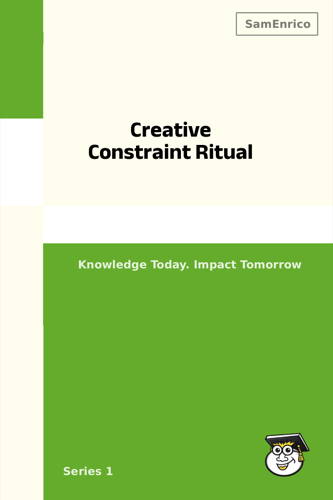
Non-FictionSelf-HelpCreative Constraints
Creative Constraint Ritual eBook
Use daily limitations to spark creative solutions
by Seal Romaine
Use daily limitations to spark creative solutions with this guide.
Formats
Free sample
Chapter 1: The Box Was Never The Problem--–- The modern creative is drowning. Not in ideas—those have never been more abundant. Not in tools—your phone alone contains more creative power than a 1990s recording studio, design house, and publishing desk combined. No, you are drowning in choice. Unlimited fonts, colors, apps, platforms, filters, templates, and possibilities do not liberate you.
They paralyze you. And the most dangerous sentence in the English language is not "I can't do this." It is "I can do anything."This book is about the counterintuitive truth that total freedom is the enemy of creativity. And the first chapter begins with a story you have almost certainly never heard—the story of a writer who was given everything, produced nothing, and then saved his masterpiece by building himself a cage.The Whale That Almost Sank In 1850, Herman Melville was a moderately successful novelist. He had written Typee and Omoo, two adventure books about his travels in the South Pacific. They sold well enough.
He had a publisher. He had an audience. He had, by any reasonable measure, total creative freedom to write whatever he wanted next.So he wrote Moby-Dick.But not the Moby-Dick you know. The first draft was a straightforward sea adventure. Whaling.
Ships. A straightforward captain chasing a straightforward whale. It was competent, conventional, and completely forgettable. Melville's publisher, Richard Bentley, read it and was unimpressed. He wanted revisions.
He wanted something more—but he could not say what.Melville sat down to revise. And here is where the story takes its strange turn.Instead of opening up his options, instead of "thinking outside the box," Melville did the opposite. He imposed a brutal constraint on himself: every chapter from that point forward had to contain three entirely incompatible elements—a Shakespearean soliloquy, a scientific lecture, and a dramatic scene—all within ten pages. A soliloquy (introspective, poetic, slow). A lecture (factual, dry, precise).
A dramatic scene (action-driven, tense, fast). Three modes that hate each other, forced into the same small container.Critics were baffled. One called the finished novel "a mass of absurdities." Another wrote that "the reader closes the book with a feeling of thankfulness that it is not longer." Melville died in 1891, his masterpiece out of print, convinced he had failed.One hundred seventy years later, we call that "absurd mass" a cornerstone of American literature. Moby-Dick is taught in every high school. It is cited as an influence by everyone from Faulkner to Pynchon.
And the reason is not despite Melville's strange constraint—it is because of it. The constraint forced him to invent a genre that did not exist: the encyclopedic novel. Part adventure, part philosophy, part textbook, part play. The box did not limit him. The box gave him walls to push against.
Without walls, there is no leverage. Without leverage, there is no art.The Jam Study and the Paradox of More You have probably heard the phrase "choice overload." But you may not know the experiment that proved it.In 2000, psychologists Sheena Iyengar and Mark Lepper set up a tasting booth at an upscale grocery store in Menlo Park, California. On some days, they offered shoppers a selection of 24 gourmet jams. On other days, they offered only 6. Both booths featured the same high-quality jams from the same brand.
The only difference was the number of options.The results were striking. The booth with 24 jams attracted more attention—people stopped, looked, sampled. But only 3% of those shoppers bought a jar. The booth with 6 jams attracted fewer people, but 30% of those shoppers bought. That is a tenfold increase in conversion.
More options led to more interest but less action. Less options led to less interest but more action.Here is what the researchers concluded: when faced with too many choices, the human brain does not feel liberated. It feels anxious. It worries about making the wrong choice. It imagines the opportunity cost of choosing jam A over jam B, C, D, E, F, G, H, I, J, K, L, M, N, O, P, Q, R, S, T, U, V, W, X.
That is 23 paths not taken. The cognitive load is exhausting. So the brain does the only thing it can: it walks away. It buys nothing. It chooses the default option—which is often to do nothing at all.Creativity works exactly the same way.When you sit down with a blank page, an empty canvas, a new project file, and say to yourself "I can do anything," your brain does not leap into inspired action.
It freezes. It runs the same opportunity-cost calculation. If I write a poem, I am not writing a story. If I paint in oils, I am not using watercolor. If I make a logo with a serif font, I am forgoing sans-serif.
Every decision feels like a loss. So you do what the shoppers did: you walk away. You check email. You scroll social media. You reorganize your desktop folders.
Anything but choose.The problem is not that you lack talent, or discipline, or inspiration. The problem is that you lack boundaries. You have been told your whole life that creativity means freedom—and that freedom means no limits. But that is a lie. The most creative people in history did not work without limits.
They worked inside limits so tight that most people would have suffocated.The Three Kinds of Limits (And One More)Before we go further, we need to be precise about what we mean by "constraint." In the chapters that follow, you will encounter four distinct types of limitations. Each serves a different creative need. Each will appear with a label so you always know which tool you are wielding.Structural Constraints are limits on time, tools, or materials. The 25-minute deadline in Chapter 4 is a Structural constraint. The single pen in Chapter 6 is a Structural constraint.
The box on your desk in Chapter 7 is a Structural constraint. These are the most straightforward: they say what you cannot use, and how long you have to use it.Behavioral Constraints are limits on actions, not materials. The No-Input Morning in Chapter 5 (no phone, no news, no reading for 90 minutes) is a Behavioral constraint. The Mid-Day Pause in Chapter 11 (15 minutes of silence before work) is a Behavioral constraint. These say what you cannot do rather than what you cannot use.Spiritual Constraints are limits on ego.
The Artist's Covenant in Chapter 3 (surrendering the need to feel inspired before you start) is a Spiritual constraint. The Worst Possible Version in Chapter 10 (deliberately making garbage) is a Spiritual constraint. These say who you are not allowed to be—namely, the perfectionist, the critic, the one who needs to be good.Negation Constraints are limits on output. The Artist Date in Chapter 8 (you are not allowed to produce anything, take notes, or "get ideas") is a Negation constraint. These say you are forbidden from making meaning right now.
They are the most counterintuitive because they ask you to be unproductive on purpose.You do not need to memorize these categories. But when you see a chapter header that says "Structural Constraint" or "Behavioral Constraint," you will know what kind of box…
This is the end of the free sample. Get the eBook to keep going. Buy now
About this book
Details
- Author
- Seal Romaine
- Publisher
- SamEnrico
- Language
- English
- Genre
- Non-Fiction, Self-Help, Creative Constraints
- Released
- 2026-06-06
- Pages (approx.)
- 129
- Available as
- eBook, Audiobook

Read better in the ZLOADR app
Your eBooks on your phone or tablet. Sign in with your SamEnrico account and start reading.
More by Seal Romaine
 Recurring Dreams of AliensSeal Romaine$11.99
 Notification Summary ModeSeal Romaine$11.99
 Chiropractic Insurance GuideSeal Romaine$11.99
 The EQ for Dentists GuideSeal Romaine$11.99
 Relapse Prevention WorkbookSeal Romaine$11.99
 Everest Hillary Tenzing AscentSeal Romaine$11.99
 Moses Mendelssohn Enlightenment FightSeal Romaine$11.99
 Trance For JealousySeal Romaine$11.99
 The Velvet Underground: How a Secret NYC Club Shaped Rock & RollSeal Romaine$11.99
 The Golden Voices: Black Opera's Triumph Over TimeSeal Romaine$11.99
 The Persian Star Catcher: Nasir al-Din Shah and the First Modern Observatory in IranSeal Romaine$11.99
 Growing Nuphar (Spatterdock)Seal Romaine$11.99
You may also like
 Hong Kong Handover 1997Dunn Johnnie$11.99
 Zumba For Postnatal Recovery CourseNeal Christian$11.99
 Zumba for BeginnersLadner Nikia$11.99
 YouTube Comment Mining GuideHumes Pandora$12.99
 Worry Box MeditationCarlin Rudy$11.99
 Workplace Stress MeditationNguyen Lynn$11.99
 Workplace Stress and Sleep RepairHawley Ivory$11.99
 Workplace Perfectionism CureDelaney Jeffry$11.99
 Workplace Injustice Anger GuideWallen Isabelle$11.99
 Work Addiction and Burnout LinkGreenwood Ester$11.99
 Women in Yoga and WellnessBeattie Galina$11.99
 Women in Stand Up ComedyChun Evangeline$11.99