
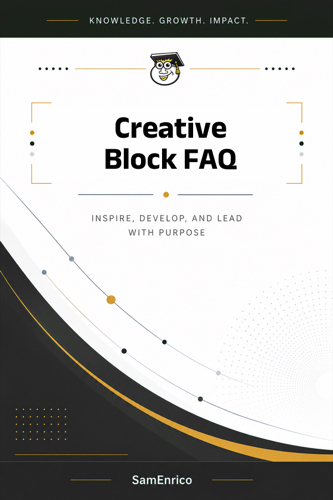
Creative Block FAQ eBook
Answers to common questions about creative struggl
by Weber Viola
Answers to common questions about creative struggles.
Formats
Free sample
Chapter 1: The Three Thieves...--–- The blank page stares back at you. The cursor blinks. The canvas remains white. You have sat down to work, perhaps for the tenth time this week, and again nothing comes. Your hands hover over the keyboard, the brush, the clay, and somewhere inside your chest, a familiar ache blooms.
You ask yourself the question that has no gentle answer: Why can't I just do the thing I want to do?This is not laziness. This is not a lack of talent. This is not evidence that you were secretly "faking it" all along. This is something far more specific, far more predictable, and far more fixable than any of those cruel stories your inner monologue is currently telling you. The problem is that creative blocks do not announce themselves with clear labels.
They do not arrive with a sign that says, "Warning: You are currently experiencing a Phase Two Middle Block caused by the Boredom and Skill Gap barrier." Instead, they feel like a monolithic wall—one solid, impenetrable thing called block.But here is the truth that the rest of this book will prove to you: there is no such thing as a single creative block. The word "block" is a suitcase into which we shove a dozen different experiences, each with its own cause, its own emotional signature, and its own cure. And because we treat all of them the same way—usually by trying harder, waiting longer, or berating ourselves more viciously—we remain stuck.This chapter introduces the first of two diagnostic lenses that will guide everything you read in this book. The first lens is the Three Phases of Creative Work. Before you can identify what is blocking you, you must identify when the block is happening.
Are you stuck before you begin? Are you trapped in the suffocating middle? Or are you sabotaging yourself at the finish line? Each of these phases feels completely different because each phase presents a completely different psychological crisis. And each phase requires a completely different kind of solution.Let me walk you through the three thieves that steal your creative momentum.Phase One: The Anxiety of Influence The first thief strikes before you have made a single mark.
You have an idea—a vague, shimmering possibility of something you might create. A novel, perhaps. A painting. A business plan. A song.
And then, before you can translate that shimmer into action, something terrible happens. You remember every masterpiece you have ever admired.This is not hyperbole. This is a documented psychological phenomenon that the critic and writer Harold Bloom called the "anxiety of influence." Bloom was writing about poets who felt crushed by the weight of their predecessors, but the same mechanism operates in every creative field. You want to write a short story, and suddenly you remember Alice Munro. You want to paint a landscape, and Turner appears in your peripheral vision.
You want to start a podcast, and you think of every polished, professionally edited show that already dominates the charts.The blank page is terrifying not because it is empty, but because it is full of ghosts. Every masterpiece you have ever loved stands behind you, whispering, "Try to be as good as me. Go ahead. We'll wait."What Happens in Your Brain During Phase One The moment you contemplate a new project, your prefrontal cortex—the part of your brain responsible for planning, evaluation, and self-control—begins to run simulations. It compares your current skill level (whatever it is) against the best examples it has stored in memory.
And because your memory is stocked with finished, polished, published, award-winning work, the comparison is almost always humiliating. Your brain concludes, "We cannot possibly succeed at this task," and shuts down the initiation signal. You do not experience this as a rational calculation. You experience it as a feeling: dread, or paralysis, or a sudden urgent need to reorganize your bookshelf.The cruel irony of Phase One is that the more you love your art form, the more you have studied it, the more you have filled your brain with examples of greatness, the harder it becomes to start. Novices often have an easier time here because they do not yet know how good "good" can be.
They are protected by what psychologists call "unconscious incompetence"—they do not know what they do not know, so they begin without fear. But you? You know too much. You have seen the mountain, and you are already exhausted by the climb.The Emotional and Behavioral Signatures The emotional signature of Phase One is a specific blend of awe and shame. You feel small.
You feel like an imposter before you have even produced a single piece of evidence that you are an imposter. You might say things to yourself like, "Who am I to try this?" or "Everything I make will be garbage compared to that." You might find yourself researching endlessly—watching tutorials, reading interviews, buying supplies—as a way to delay the terrifying moment of first contact with the blank page.The behavioral signature of Phase One is procrastination that looks like preparation. You reorganize your desk. You buy a new notebook. You read one more book on craft.
You tell yourself you are "getting ready" to start. But getting ready is not starting, and somewhere underneath the busywork, you know it.The Solution for Phase One The solution for Phase One is not more preparation. It is not more confidence. It is not a magical elimination of your anxiety. The solution is courage—but not the kind of courage that requires you to feel brave.
The kind of courage that requires you to act before you feel ready. In later chapters, we will give you specific tools for this: the 15-Minute Rule (Chapter 5), the Play Ethic (also Chapter 5), and the gentle art of lowering your standards (Chapter 10). But for now, the only thing you need to understand is that Phase One blocks cannot be solved by thinking. They can only be solved by moving. The fear will not go away before you start.
It will go away after you start, usually about three to five minutes in, when your brain realizes that the sky has not fallen and that making something imperfect is actually survivable.If you recognize yourself in this description—if your blocks always happen at the very beginning, if you have dozens of abandoned ideas that never became anything because you could not bring yourself to take the first step—then you are a Phase One sufferer. The good news is that Phase One is the most common and the most easily treated. You do not need therapy. You do not need a sabbatical. You need a ritual that forces you to make the first mark before your inner critic can finish its opening argument.Phase Two: The Muddy Middle The second thief is more patient than the first.
It does not strike at the blank page. It waits until you have begun, until you have invested days or weeks or months, until the novelty has worn off and the end is still nowhere in…
This is the end of the free sample. Get the eBook to keep going. Buy now
About this book
Details
- Author
- Weber Viola
- Publisher
- SamEnrico
- Language
- English
- Genre
- Non-Fiction, Self-Help, Reference
- Released
- 2026-06-10
- Pages (approx.)
- 132
- Available as
- eBook, Audiobook

Read better in the ZLOADR app
Your eBooks on your phone or tablet. Sign in with your SamEnrico account and start reading.
More by Weber Viola
 Mentorship for Family Business SuccessionWeber Viola$11.99
 The MBSR for Dental AnxietyWeber Viola$11.99
 Spin Class Survival ManualWeber Viola$11.99
 Active Listening For DementiaWeber Viola$11.99
 Dance Injury Prevention GuideWeber Viola$11.99
 Assertiveness For TravelWeber Viola$11.99
 Snow Driving Anger GuideWeber Viola$11.99
 Sukha Tranquil Breath StateWeber Viola$11.99
 The Phantom Fleet: How a Secret Navy Changed the Course of WWIIWeber Viola$11.99
 The Old Trafford Divorce: How Manchester United and City's Feud Split a Football FamilyWeber Viola$11.99
 The House That Rothschild Built: A Financial Empire Across ContinentsWeber Viola$11.99
 The Mineral Guide to SchoepiteWeber Viola$11.99
You may also like
 NVC Quick Reference GuideHines Alfredo$11.99
 Loneliness FAQ GuideAmato Marva$11.99
 Flow FAQ GuideHughey Tristan$11.99
 Children's Dream FAQColburn Corrin$11.99
 Improv FAQ GuideGreiner Akiko$11.99
 Emotion Regulation HandoutsFerrer John$11.99
 Priority Cheat Sheet GuideBeasley Lou$11.99
 Drug Dependency FAQHawley Ara$11.99
 Envy FAQ GuideMeeker Marya$11.99
 Divorce FAQ GuideBurchfield Allie$11.99
 Walking Meditation FAQ GuideUtley Elna$11.99
 The Conversation Starter BibleBobo Jeanice$11.99