
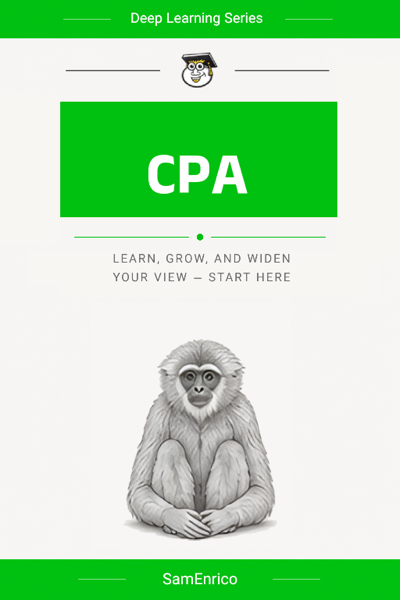
Non-FictionInformativeEducational
CPA eBook
A Coursebook on CPA
by Coon Sherise
A Coursebook on CPA
Formats
Free sample
Chapter 1: The Million-Dollar Decision--–- You are about to make a decision that will affect every paycheck, every promotion, and every opportunity you will see for the next forty years. Most people stumble into this choice without realizing its weight. They hear “CPA” and think of tax season, green visors, and calculator tape. They have no idea that three letters can be the difference between a career spent grinding out journal entries and a career spent sitting in the boardroom, shaping strategy, and earning a seven-figure ending salary. This chapter exists to make sure you are not one of those people.
By the time you finish these pages, you will understand exactly what the CPA license is worth, exactly how to get it, and exactly why the journey — painful as it can be — is the single best investment you will ever make in yourself.The CPA license is not a trophy. It is not a certificate to hang on a wall and dust once a year. It is a legal monopoly, granted by each state board of accountancy, that gives you the exclusive right to perform certain work — auditing financial statements, attesting to the accuracy of public company reports, representing taxpayers before the IRS, and signing off on complex financial transactions. No other credential in the accounting world carries this statutory authority. Not the CMA.
Not the CIA. Not the CFA. Those are valuable, respected, even lucrative. But they do not give you the law behind your signature. When a CPA signs an audit opinion, that signature carries professional liability, regulatory oversight, and a level of trust that banks, investors, and regulators have decided cannot be entrusted to anyone else.That trust translates directly into money.
The numbers are not subtle. According to the AICPA’s most recent compensation studies, the median salary for a CPA in the United States is roughly twenty to thirty percent higher than for a non-CPA accountant at the same experience level. At entry level, the gap might be ten or fifteen thousand dollars. By mid-career, the gap widens to forty or fifty thousand. By senior leadership — controller, CFO, partner — CPAs consistently out-earn their non-certified peers by six figures.
Over a thirty-year career, the lifetime earnings premium for a CPA is estimated between one million and one point five million dollars. That is not a typo. The CPA license is a million-dollar decision.But the money is only half the story. The other half is access. Non-certified accountants are often locked out of the most interesting, highest-impact roles.
You cannot become an audit partner at a public accounting firm without a CPA license — it is a firm requirement. You cannot become a controller or CFO of a publicly traded company without a CPA in most organizations. You cannot sign a tax return for a client before the IRS as a paid representative without active CPA credentials. You cannot lead a forensic accounting team investigating fraud for a government agency or a law firm without that license opening the door. The CPA credential is not just a salary booster; it is a key that unlocks entire career paths that otherwise remain closed.This chapter will give you a complete, accurate, and actionable roadmap to earning that key.
You will learn the three requirements that every candidate must satisfy. You will understand how the 2024 CPA Evolution changed the exam forever. You will discover the single biggest mistake candidates make when planning their timeline — and how to avoid it. You will walk away with a clear answer to the question that paralyzes so many potential candidates: where do I start?The Three Pillars of Licensure Becoming a CPA requires satisfying exactly three requirements. Think of them as three doors.
You must walk through every door. You cannot skip one, and you cannot trade one for another. But the order can vary depending on your state, your job, and your patience.Door number one is the education requirement. Every state board requires candidates to complete 150 semester hours of college education. That is thirty hours more than a typical four-year bachelor’s degree, which usually stops at 120 hours.
Those extra thirty hours can come from a master’s degree (most commonly a Master of Accountancy, MAcc, or an MBA with a concentration in accounting), from a dual-degree program, from community college courses taken after graduation, or even from online classes. The only rules are that the courses must be from an accredited institution and that a minimum number of hours must be in accounting-specific subjects (usually twenty-four to thirty hours) and business-related subjects (usually another twenty-four hours). State boards vary slightly in exactly how many accounting hours they require, so you must check your specific state’s rules — but the national trend is toward twenty-four to thirty accounting hours and twenty-four business hours.Here is where many candidates stumble. Some states allow you to take the CPA exam with only 120 hours — the so-called “120-hour path to sit.” But even if your state lets you sit early, you still cannot be licensed until you have completed all 150 hours. That means you can pass all four sections of the exam with 120 hours, but you will not receive your license until you finish the additional thirty hours.
For some candidates, this is a strategic advantage — they take the exam while still in school or while working on their master’s, spreading the workload. For others, it creates a false sense of progress. They pass the exam, celebrate, and then realize they still have a year of coursework ahead of them. Either approach is fine, as long as you know which path you are on.Door number two is the examination requirement. You must pass the Uniform CPA Examination.
That exam is the subject of most of this book, but for now, you need to understand its structure. The exam is divided into four sections. Three are core sections that every candidate takes regardless of career path. The fourth is a discipline section that you choose based on your professional interests.The three core sections are:Financial Accounting and Reporting, abbreviated FAR. This is the largest section in terms of content volume.
It covers GAAP, financial statements, revenue recognition, leases, bonds, consolidations, government accounting, and nonprofit accounting. Most candidates consider FAR the most difficult because it contains the most material to memorize.Auditing and Attestation, abbreviated AUD. This section covers the entire audit process — planning, risk assessment, internal controls, evidence gathering, sampling, and audit reports. It also covers professional responsibilities and ethics under the AICPA Code of Professional Conduct.Regulation, abbreviated REG. This section covers federal taxation for individuals and entities, business law (contracts, agency, UCC, bankruptcy), and ethics for tax practitioners under Circular 230.The fourth section is where the 2024 CPA Evolution changed everything.
Previously, all candidates took a fourth section called Business Environment and Concepts, or BEC. That section no longer exists. In its place, candidates must choose one of three discipline sections:Business Analysis and Reporting, abbreviated BAR. This discipline focuses on financial analysis, technical accounting, and consulting skills. It is most appropriate for candidates planning to work in financial reporting, technical accounting roles, or advisory services.Information Systems and Controls, abbreviated ISC.…
This is the end of the free sample. Get the eBook to keep going. Buy now
About this book
Details
- Author
- Coon Sherise
- Publisher
- SamEnrico
- Language
- English
- Genre
- Non-Fiction, Informative, Educational
- Released
- 2026-05-04
- Pages (approx.)
- 156
- Available as
- eBook, Audiobook

Read better in the ZLOADR app
Your eBooks on your phone or tablet. Sign in with your SamEnrico account and start reading.
More by Coon Sherise
 Deadline Pressure Coping SkillsCoon Sherise$11.99
 Migraine Postdrome GuideCoon Sherise$11.99
 Active Listening For CoachesCoon Sherise$11.99
 Cocaine Anhedonia RecoveryCoon Sherise$11.99
 The Opium Kingpin: The Fall of Ah Sui and the Shanghai UnderworldCoon Sherise$11.99
 Knowledge Base Article GenerationCoon Sherise$12.99
 Learn to Play the Pan FluteCoon Sherise$11.99
 How to Start a Drilling Jars for Mining Business (Beginners Guide)Coon Sherise$11.99
You may also like
 Hong Kong Handover 1997Dunn Johnnie$11.99
 Zumba For Postnatal Recovery CourseNeal Christian$11.99
 Zumba for BeginnersLadner Nikia$11.99
 YouTube Comment Mining GuideHumes Pandora$12.99
 Worry Box MeditationCarlin Rudy$11.99
 Workplace Stress MeditationNguyen Lynn$11.99
 Workplace Stress and Sleep RepairHawley Ivory$11.99
 Workplace Perfectionism CureDelaney Jeffry$11.99
 Workplace Injustice Anger GuideWallen Isabelle$11.99
 Work Addiction and Burnout LinkGreenwood Ester$11.99
 Women in Yoga and WellnessBeattie Galina$11.99
 Women in Stand Up ComedyChun Evangeline$11.99