
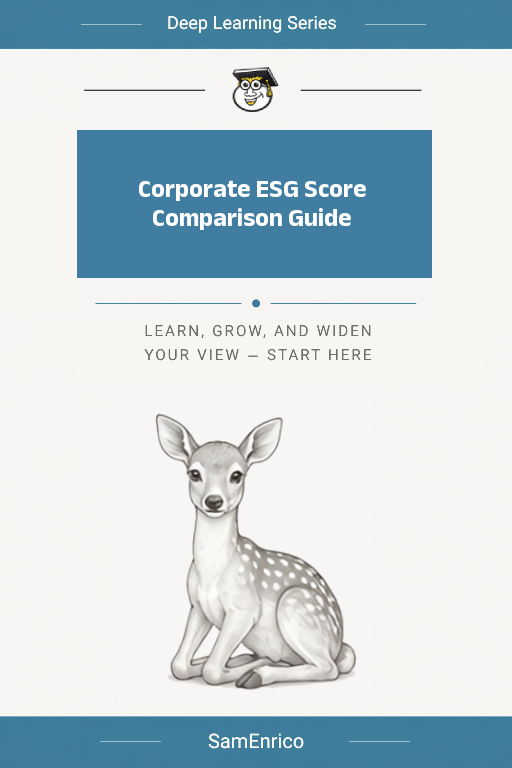
Non-FictionStrategic AtlasSustainability Analysis
Corporate ESG Score Comparison Guide
Analyzes how public companies stack up on carbon e
Analyzes how public companies stack up on carbon emissions, diversity metrics, board independence, and supply chain labor standards.
Formats
About this book
Free sample
Chapter 1: The Tower of Babel--–- In 2025, a curious thing happened in the world of sustainable finance. Tesla, the electric vehicle manufacturer that had built its entire brand around saving the planet, received an "AAA" rating from one major ESG agency while simultaneously earning a "CCC" rating from another. The same company. The same year. The same data publicly available to both raters.
One agency praised Tesla for its industry-leading electric vehicle fleet and carbon avoidance. The other penalized it for governance controversies involving Elon Musk's tweets, labor disputes at its German factory, and a lack of diversity in its boardroom. The spread between these two ratings was not a minor disagreement. It was a chasm wide enough to drive a semi-truck through—or, in Tesla's case, a Cybertruck.This is not an isolated anomaly. In 2024, a major oil company was rated "A" for climate management by one agency and "D-" by another.
A global bank received top marks for its diversity policies from one rater while being flagged for "high risk" on labor standards by a third. A pharmaceutical company with impeccable governance was ranked in the bottom quartile for supply chain ethics. These contradictions are not bugs in the system; they are features. ESG ratings are not objective measurements like the temperature of a room or the weight of an object. They are opinions dressed in quantitative clothing, produced by proprietary algorithms that reflect the values, priorities, and commercial interests of the agencies that create them.This chapter is called "The Tower of Babel" for a reason.
In the biblical story, humanity spoke a single language until God confused their speech, scattering them across the earth unable to understand one another. The world of ESG scores today is a modern Tower of Babel. MSCI speaks one dialect, Sustainalytics another, Eco Vadis a third, Bloomberg a fourth, and CSRHub attempts to translate them all into a shaky consensus. Without a methodology to navigate these contradictions, direct comparison of public companies on carbon emissions, diversity metrics, board independence, and supply chain labor standards is not just difficult—it is impossible.The goal…
This is the end of the free sample. Get the eBook to keep going. Buy now
Contents
- Chapter 1
- Chapter 2
- Chapter 3
- Chapter 4
- Chapter 5
- Chapter 6
- Chapter 7
- Chapter 8
- Chapter 9
- Chapter 10
- Chapter 11
- Chapter 12
Details
- Author
- Callaway Janine
- Publisher
- SamEnrico
- Language
- English
- Genre
- Non-Fiction, Strategic Atlas, Sustainability Analysis
- Released
- 2026-06-01
- Pages (approx.)
- 143
- Available as
- eBook, Audiobook

Read better in the ZLOADR app
Your eBooks on your phone or tablet. Sign in with your SamEnrico account and start reading.
More by Callaway Janine
 The DBT Willingness vs WillfulnessCallaway Janine$11.99
 Remote Self Review TemplateCallaway Janine$11.99
 Affirmations For People Pleasing HandbookCallaway Janine$11.99
 Autophobia Alone FearCallaway Janine$11.99
 EMDR Trigger Preparation GuideCallaway Janine$11.99
 Silent Shadows of the Silk RoadCallaway Janine$11.99
 Director of SecurityCallaway Janine$11.99
 LinkedIn Group Mentoring GuideCallaway Janine$12.99
 Understanding PapillitisCallaway Janine$17.99
 How to Start a Paint Removers Business (Beginners Guide)Callaway Janine$11.99
You may also like
 Hong Kong Handover 1997Dunn Johnnie$11.99
 Zumba For Postnatal Recovery CourseNeal Christian$11.99
 Zumba for BeginnersLadner Nikia$11.99
 YouTube Comment Mining GuideHumes Pandora$12.99
 Worry Box MeditationCarlin Rudy$11.99
 Workplace Stress MeditationNguyen Lynn$11.99
 Workplace Stress and Sleep RepairHawley Ivory$11.99
 Workplace Perfectionism CureDelaney Jeffry$11.99
 Workplace Injustice Anger GuideWallen Isabelle$11.99
 Work Addiction and Burnout LinkGreenwood Ester$11.99
 Women in Yoga and WellnessBeattie Galina$11.99
 Women in Stand Up ComedyChun Evangeline$11.99