
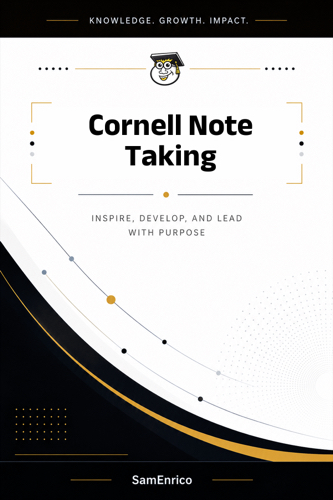
Free sample
Chapter 1: The Forgetting Curve...--–- The first time I watched a student fail an exam they had studied for, I was less surprised than they were. They sat in my office, a blue book filled with partial answers and blank spaces, and said the words I have heard a thousand times since: "I read the chapter three times. I highlighted everything. I don't understand how I forgot."That student was not lazy. They were not unintelligent.
They were the victim of a biological process that every human brain experiences, yet almost no one is taught to counteract. The name of that process is forgetting, and it begins the moment learning ends.This book is not about taking notes. It is about stopping the leak in your memory before it drains everything you have worked to understand. The Cornell Note-Taking System, developed by Walter Pauk at Cornell University in the 1950s, is not a layout or a template. It is a weapon against the natural decay of knowledge.
But to understand why Cornell works, you must first understand the enemy it was designed to defeat.The Anatomy of Forgetting In the late 19th century, a German psychologist named Hermann Ebbinghaus conducted a series of experiments on himself that would forever change how we understand memory. He memorized lists of nonsense syllables—meaningless combinations like "ZOF" and "KAP"—and then tested himself at varying intervals to measure how much he retained. What he discovered became known as the Ebbinghaus Forgetting Curve, and its implications for students are devastating.Ebbinghaus found that within one hour of learning new information, the average person forgets approximately 50 percent of it. Within 24 hours, that number climbs to 70 percent. Within one week, without any review, nearly 90 percent of the information is gone.
The curve is exponential, not linear. The most rapid forgetting happens immediately after learning, not days later.Consider what this means for a typical college student. On Monday morning, they attend a 75-minute lecture on the causes of World War I. They take notes diligently. By Monday afternoon, they have already forgotten half of what they heard.
By Tuesday morning—before they have even had a chance to open their notebook again—they have forgotten 70 percent. When they sit down to study on Wednesday for Friday's exam, they are not reviewing. They are re-learning.This is not a failure of effort. This is a failure of understanding…
This is the end of the free sample. Get the Audiobook to keep going. Buy now
About this book
Details
- Author
- Khan Awilda
- Publisher
- SamEnrico
- Language
- English
- Genre
- Non-Fiction, Self-Help
- Released
- 2026-06-06
- Pages (approx.)
- 127
- Available as
- eBook, Audiobook

Listen in the VoxFlicks app
Audiobooks and audio dramas wherever you go. Sign in with your SamEnrico account and press play.
More by Khan Awilda
 Conversation Starters for Social AnxietyKhan Awilda$11.99
 Bipolar Exercise PrescriptionKhan Awilda$11.99
 Spin Sprint IntervalsKhan Awilda$11.99
 Napping for Military PersonnelKhan Awilda$11.99
 The Truck Stop RunawayKhan Awilda$11.99
 Google Assistant MemoryKhan Awilda$11.99
 Accidental Child DeathKhan Awilda$11.99
 Boundary Setting For Foster ParentsKhan Awilda$11.99
 The Last Stand of the 1975 Contract: How a Forgotten Deal Changed Music ForeverKhan Awilda$11.99
 Threads of the Unseen: The Enigmatic Life of Marco Polo’s Forgotten NavigatorKhan Awilda$11.99
 The Healers of Kadesh: Egypt's Forgotten Medics in the Battle of the DeltaKhan Awilda$11.99
 The Mineral Guide to JadariteKhan Awilda$11.99
You may also like
 Workplace Stress MeditationNguyen Lynn$11.99
 Volcano Monitoring ScientistCox Alexis$11.99
 The Tech Professional NetAguiar Nevada$11.99
 The Morning Metta RitualCanales Anya$11.99
 The Chunking Memory TechniqueClanton Hyacinth$11.99
 The Beginner Mistake FixAmmons Cassondra$11.99
 Surrendering to What IsGrimm Reatha$11.99
 Self Hypnosis for Fear of FireBillups Eli$11.99
 Road Rage for Professional DriversBrackett Janise$11.99
 Psychiatric Ward Nurse StressDunning Wyatt$11.99
 Observation vs Evaluation NVCTimmons Alda$11.99
 Networking for Nonprofit ProfessionalsPoole Jesse$11.99