
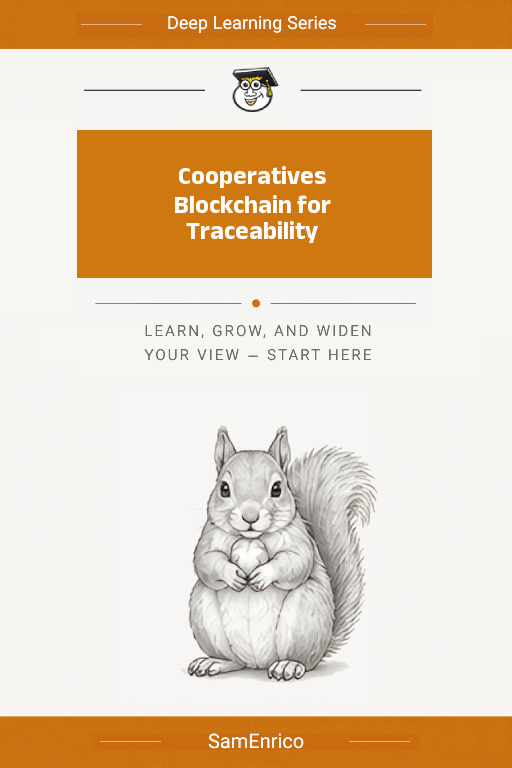
Cooperatives Blockchain for Traceability eBook
Use blockchain to track cooperative produce from E
Use blockchain to track cooperative produce from East African farm to international buyer, proving origin and sustainability.
Formats
Free sample
Chapter 1: The Broken Bond...–- The morning mist still clung to the slopes of Mount Rungwe when Grace Mbowe tied her kangaroo cloth tight around her waist and walked into her coffee plot. She was fifty-two years old, a widow, a mother of four, and the secretary of the Mbeya Organic Cooperative Union. For thirty-seven years, she had tended the same two hectares of shade-grown arabica, her fingers learning every contour of the land, her nose reading the ripeness of each cherry by its faint wine scent. Her father had planted the oldest trees. Her grandfather had cleared the original plot from the mountain forest in 1952, carefully leaving every other canopy tree to shelter the coffee below.
This was not a farm to Grace. It was a covenant.She knelt and touched the soil—dark, crumbly, alive with earthworms. Organic matter at nearly eight percent. She knew this because a visiting agronomist had tested it last year and called it "exceptional." He had said she could command a premium price, perhaps double the local market rate, if only she could prove what she already knew: that her coffee was grown under shade, without synthetic chemicals, on land her family had stewarded for generations. The agronomist had handed her a certificate, a piece of paper with a gold seal and a signature.
Grace had paid 35forit,afortuneinaseasonwhenabagofhercoffeesoldforbarely35 for it, a fortune in a season when a bag of her coffee sold for barely 35forit,afortuneinaseasonwhenabagofhercoffeesoldforbarely50.She harvested that season's best cherries by hand, selecting only the reddest, heaviest ones. She pulped them the same afternoon, fermented them for exactly eighteen hours, washed them in the cold mountain stream, and dried them on raised beds until the moisture content hit eleven percent—measured with a cheap hygrometer she had bought second-hand from a retiring farmer. She bagged the parchment coffee in new grain-pro sacks, labeled each bag with her name, her plot number, and the harvest date, and delivered the lot to the cooperative collection center on the back of a borrowed bicycle.The cooperative manager weighed her bags: 487 kilograms of fully washed arabica, screen size seventeen, zero defects on the hand-sorted sample. He smiled and told her it was the best lot he had seen all season. He gave her a receipt, another piece of paper, and promised that the coffee would be sold to an exporter who claimed to source "direct trade" from "sustainable women-led cooperatives" in East Africa.Three months later, Grace learned the truth.
A friend in the nearest town showed her a website on a cracked smartphone screen. There, on a sleek page with drone photography and mission statements, was a photograph of Grace—taken without her knowledge at the collection center—beside a bag of coffee labeled "Single-Origin: Tanzania, Mbeya Region. Direct trade. Organic. Women-empowered." The price to the end consumer in Berlin: €18 for 250 grams.
That worked out to roughly 85perkilogram.Gracehadbeenpaid85 per kilogram. Grace had been paid 85perkilogram.Gracehadbeenpaid3.50 per kilogram. The retailer was making a twenty-four hundred percent markup on her labor.She was not angry about the markup. She understood that logistics, roasting, packaging, marketing, and retail all cost money. What broke her was what she discovered next.
A German consumer watchdog group had tested thirty bags of "single-origin" coffee sold in European supermarkets. Twenty-two of them—seventy-three percent—contained beans from multiple countries. The "Tanzanian" coffee was blended with beans from Brazil, Vietnam, and Uganda. The "organic" certification was a forgery. The "women-empowered" cooperative had never received a penny of the promised premium.
The consumer group called it "pencil washing"—the practice of using a trace amount of legitimate premium coffee to certify an entire shipment of ordinary beans, named after the old trick of rubbing a pencil across a low-grade diamond to make it appear more valuable.Grace's coffee had been used as the pencil. The few bags of her exceptional harvest had been mixed with thousands of kilograms of cheaper beans, and the entire shipment had been sold under her name, her photograph, her story. The retailer had profited. The exporter had profited. The consumer had been deceived.
And Grace had received exactly $3.50 per kilogram, the same price as every other farmer in her district.This is the broken bond.The Paradox of Ethical Consumption There is perhaps no more troubling paradox in modern commerce than the chasm between consumer intention and farmer reality. A 2023 survey by Nielsen IQ found that seventy-eight percent of European consumers say they are willing to pay a premium for sustainably sourced products. Sixty-two percent say they actively seek out fair trade or organic certifications. Forty-one percent say they have switched brands specifically because of ethical sourcing claims. And yet, despite this apparent demand, the typical smallholder farmer in East Africa—the person who grows the coffee, the cocoa, the tea, the avocados, the cashews, and the flowers that stock the shelves of Whole Foods, Carrefour, and Aldi—earns less than 2.50perday.Morethansixtypercentofthepopulationof Tanzania,Uganda,and Burundilivesonlessthan2.50 per day.
More than sixty percent of the population of Tanzania, Uganda, and Burundi lives on less than 2.50perday.Morethansixtypercentofthepopulationof Tanzania,Uganda,and Burundilivesonlessthan3.20 per day.The problem is not a lack of consumer willingness. The problem is not a lack of farmer quality. The problem is a catastrophic failure of information. The supply chain that connects Grace's coffee tree to a Berlin café is long, fragmented, and profoundly opaque. Between the farm and the cup, a bag of coffee will change hands between six and twelve times.
Each transfer is an opportunity for fraud. Each intermediary adds a layer of anonymity. Each paper certificate can be forged, doctored, or simply ignored.The result is a system in which the most ethical, sustainable, carefully grown product in the world is indistinguishable from the cheapest, most destructive monocrop—unless a buyer is willing to spend thousands of dollars on forensic testing, on-site audits, and legal verification. Most buyers are not. Most consumers, however well-intentioned, cannot afford to DNA-test their morning latte.
So the system optimizes for the lowest common denominator: cheap beans, vague claims, and plausible deniability.The Trust Deficit, Quantified Let us put numbers to this tragedy. The Food and Agriculture Organization of the United Nations (FAO), in collaboration with the Organisation for Economic Co-operation and Development (OECD), estimates that food fraud—defined as the deliberate substitution, addition, tampering, or misrepresentation of food products for economic gain—costs the global economy between 30billionand30 billion and 30billionand50 billion annually. This figure includes mislabeled origin (Brazilian coffee sold as Colombian), counterfeit certifications (fake organic, fake fair trade, fake Rainforest Alliance), adulteration (adding cheaper fillers to spices, honey, or olive oil), and outright substitution (replacing premium fish with cheaper species).For East African cooperatives, the cost is disproportionately severe. According to a 2022 study by the International Institute for Environment and Development (IIED), coffee farmers in Tanzania who achieve organic and shade-grown certifications could command a premium of 0.80to0.80 to 0.80to1.20 per kilogram if their claims were verifiable. Instead, because buyers cannot trust paper certificates, the average realized premium is just 0.12perkilogram—aninetypercentlossofpotentialincome.Foracooperativeoffivehundredfarmersproducingtwohundredtonsperyear,thatisalossofnearly0.12 per kilogram—a ninety percent loss of potential income.
For a cooperative of five hundred farmers producing two hundred tons per year, that is a loss of nearly 0.12perkilogram—aninetypercentlossofpotentialincome.Foracooperativeoffivehundredfarmersproducingtwohundredtonsperyear,thatisalossofnearly200,000…
This is the end of the free sample. Get the eBook to keep going. Buy now
About this book
Details
- Author
- Hirsch Maybell
- Publisher
- SamEnrico
- Language
- English
- Genre
- Non-Fiction, Business Brief
- Released
- 2026-06-01
- Pages (approx.)
- 157
- Available as
- eBook, Audiobook

Read better in the ZLOADR app
Your eBooks on your phone or tablet. Sign in with your SamEnrico account and start reading.
More by Hirsch Maybell
 The Startup Insurance AccountingHirsch Maybell$11.99
 Artist Studio Time GuideHirsch Maybell$11.99
 Imposter At Work GuideHirsch Maybell$11.99
 Iggy Pop Stooge IdolHirsch Maybell$11.99
 Political Refugee Talent FlowsHirsch Maybell$11.99
 Morning Block Scheduling GuideHirsch Maybell$11.99
 Listening Protocols for HypnosisHirsch Maybell$11.99
 Deep Work RitualsHirsch Maybell$11.99
 The Clockmakers of Geneva: A Love Story in TimeHirsch Maybell$11.99
 The Black Sun’s Oath: A Slavic Knight’s Forgotten QuestHirsch Maybell$11.99
 Exploring Poster Art: Lithography & AdvertisingHirsch Maybell$11.99
 South African Stock Option TaxationHirsch Maybell$12.99
You may also like
 Hong Kong Handover 1997Dunn Johnnie$11.99
 Zumba For Postnatal Recovery CourseNeal Christian$11.99
 Zumba for BeginnersLadner Nikia$11.99
 YouTube Comment Mining GuideHumes Pandora$12.99
 Worry Box MeditationCarlin Rudy$11.99
 Workplace Stress MeditationNguyen Lynn$11.99
 Workplace Stress and Sleep RepairHawley Ivory$11.99
 Workplace Perfectionism CureDelaney Jeffry$11.99
 Workplace Injustice Anger GuideWallen Isabelle$11.99
 Work Addiction and Burnout LinkGreenwood Ester$11.99
 Women in Yoga and WellnessBeattie Galina$11.99
 Women in Stand Up ComedyChun Evangeline$11.99