
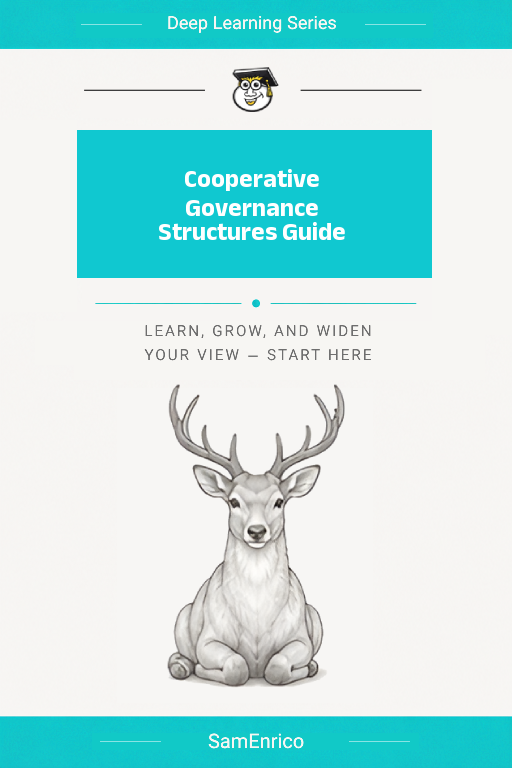
Cooperative Governance Structures Guide eBook
Design democratic governance with member elections
Design democratic governance with member elections bylaws and board responsibilities.
Formats
Free sample
Chapter 1: The Silent Crisis--Governance is not the reason most people join a cooperative. They join for the affordable housing, the ethically sourced food, the democratic workplace, or the shared access to capital. Governance is the infrastructure they hope they will never have to think about—like the foundation of a house or the operating system of a computer. It only becomes visible when it fails.And it is failing, quietly and systematically, across thousands of cooperatives worldwide.I have watched this failure unfold in housing cooperatives where members stopped attending meetings not because they were lazy, but because the meetings had become pointless rituals where nothing real was decided. I have seen it in worker cooperatives where the board—elected by fellow workers—began making decisions in private and presenting them as faits accomplis.
I have witnessed it in agricultural cooperatives where the founding generation refused to relinquish control, treating elected positions as lifetime entitlements while younger members drifted away. And I have studied it in consumer cooperatives where the general manager, hired to serve the members, quietly accumulated so much power that the board became a rubber stamp.Every one of these cooperatives had legally compliant bylaws. Every one held annual meetings. Every one elected directors according to proper procedures. And yet, something essential had broken.
The cooperative was legally democratic but practically autocratic. The members were owners on paper but subjects in reality.This gap between legal compliance and lived democracy is the silent crisis of cooperative governance. It is silent because it rarely announces itself with a dramatic scandal. It creeps in gradually, year by year, meeting by meeting, until one day a member stands up and asks, "When did we stop being in charge of our own cooperative?" And no one can answer.This book is written for everyone who has ever asked that question—and for everyone who wants to make sure they never have to.The Invisible Architecture Every cooperative is built on two documents: the articles of incorporation, which create the legal entity, and the bylaws, which govern how that entity operates. Most cooperatives treat these documents as legal chores to be completed once and then forgotten.
They are filed with the state, printed in a binder, and placed on a shelf where they gather dust until some conflict forces someone to consult them.This is a catastrophic misunderstanding of what bylaws are and what they can do.Bylaws are not merely legal requirements. They are the operating system of democratic ownership. They determine how power flows, who decides what, and what happens when people disagree. They are the code that translates the abstract principle of "member control" into the concrete practice of meetings, elections, and accountability.When bylaws are drafted carefully, they create a self-reinforcing system of democratic participation. When they are copied from templates designed for condominiums or investor-owned corporations, they create a slow poison that kills member engagement.Consider the difference between two housing cooperatives, both created in the same city in the same year.
Cooperative A copied its bylaws from a condominium association. The documents were legally sufficient—they satisfied the state's requirements for incorporation. But they reflected a fundamentally different understanding of ownership. The condominium model assumes that owners are primarily consumers of services, not participants in governance. Voting was structured by unit size.
Meetings were treated as information sessions, not decision-making forums. The board was given broad discretion with minimal accountability.Within five years, Cooperative A had become a battlefield. Members accused the board of being unaccountable. The board accused members of being apathetic. Annual meeting attendance had dropped below ten percent.
Several members had hired lawyers to challenge board decisions. The cooperative was legally compliant but practically dysfunctional.Cooperative B, by contrast, had drafted its bylaws specifically for a housing cooperative, drawing on resources from the cooperative development community. Voting was one member, one unit—reflecting the cooperative principle that ownership is democratic, not proportional to investment. Meetings were structured to include real decision-making authority. The board was required to report its decisions to the membership and to face re-election annually.
Member responsibilities were spelled out as clearly as member rights.Fifteen years later, Cooperative B still had annual meeting attendance above sixty percent. Members rotated through board service. Conflicts were resolved through the mediation procedures written into the bylaws rather than through lawyers. The cooperative was not merely legally compliant—it was democratically alive.The difference between these two cooperatives was not market conditions, member quality, or managerial competence. It was governance design.The Democratic Drift There is a predictable pattern that affects cooperatives of every type and size.
I call it the democratic drift, and it unfolds in four phases.Phase one is founding. In this phase, member engagement is high. The people who create the cooperative are deeply invested in its success. They attend meetings, serve on committees, and debate decisions passionately. The board is accountable to the membership because the membership is present, paying attention, and willing to hold the board accountable.
This phase feels democratic because it is democratic.Phase two is stabilization. The cooperative has survived its early challenges. Basic systems are in place. Members begin to trust the board to handle routine matters. This trust is not misplaced—the board is generally making good decisions.
But a subtle shift occurs. Members start to disengage, not out of frustration, but out of confidence. "The board has everything under control," they say. "I don't need to attend every meeting."Phase three is consolidation. The board, accustomed to making decisions without member input on routine matters, begins to extend its reach.
Major decisions are made without member consultation. The annual meeting becomes a presentation of decisions already made rather than a forum for making decisions. The board tells itself that members are too busy to be involved, that the decisions are too complex for the full membership to understand, that efficiency requires centralizing authority.Phase four is oligarchy. The board treats the cooperative as its own. Members have become passive.
The few who remain engaged are dismissed as troublemakers. The cooperative is legally democratic—it still holds annual meetings and elections—but practically autocratic. The board chooses its own successors. Decisions are made in private. Members who ask questions are told to trust the board.This drift is not inevitable.
It is a design flaw that can be engineered against. But engineering against it requires understanding why it happens.The Iron Law and Its Limits The political sociologist Robert Michels formulated what he called the "iron law of oligarchy" in 1911. His argument was simple and devastating: all organizations, even those committed to democracy, inevitably become oligarchies. The reasons, he claimed, were structural. Leaders develop expertise that ordinary members lack.
They control information. They build alliances. They have time and resources that ordinary members do not. Over time, the organizational apparatus becomes an end in itself, and the members become passive spectators.Michels studied socialist parties and labor unions—organizations explicitly committed to democratic principles. His conclusion was that democracy in large organizations is impossible.
The best you can hope for is a competitive oligarchy where different elites compete for power.Michels was wrong—not about the…
This is the end of the free sample. Get the eBook to keep going. Buy now
About this book
Details
- Author
- Delatorre Kaitlin
- Publisher
- SamEnrico
- Language
- English
- Genre
- Non-Fiction, Business Brief
- Released
- 2026-06-01
- Pages (approx.)
- 158
- Available as
- eBook, Audiobook

Read better in the ZLOADR app
Your eBooks on your phone or tablet. Sign in with your SamEnrico account and start reading.
More by Delatorre Kaitlin
 The Micro Stress Couples RecoveryDelatorre Kaitlin$11.99
 Performance Breath MasteryDelatorre Kaitlin$11.99
 The Mistake AdmissionDelatorre Kaitlin$11.99
 Listening In Mining GuideDelatorre Kaitlin$11.99
 Sailing Around the World AloneDelatorre Kaitlin$11.99
 Gratitude for Technology GuideDelatorre Kaitlin$11.99
 Breathing Techniques for StressDelatorre Kaitlin$11.99
 Power Nine Lifestyle GuideDelatorre Kaitlin$11.99
 Johnny Carson CouchDelatorre Kaitlin$11.99
 The Secret Codebreaker: How a Teenage Girl Cracked the Nazi’s Enigma MachineDelatorre Kaitlin$11.99
 Silk and Shadows: The Opium Wars' Forgotten ConspiratorsDelatorre Kaitlin$11.99
 The Great British Bake-Off: Political Pastry WarsDelatorre Kaitlin$11.99
You may also like
 Hong Kong Handover 1997Dunn Johnnie$11.99
 Zumba For Postnatal Recovery CourseNeal Christian$11.99
 Zumba for BeginnersLadner Nikia$11.99
 YouTube Comment Mining GuideHumes Pandora$12.99
 Worry Box MeditationCarlin Rudy$11.99
 Workplace Stress MeditationNguyen Lynn$11.99
 Workplace Stress and Sleep RepairHawley Ivory$11.99
 Workplace Perfectionism CureDelaney Jeffry$11.99
 Workplace Injustice Anger GuideWallen Isabelle$11.99
 Work Addiction and Burnout LinkGreenwood Ester$11.99
 Women in Yoga and WellnessBeattie Galina$11.99
 Women in Stand Up ComedyChun Evangeline$11.99