
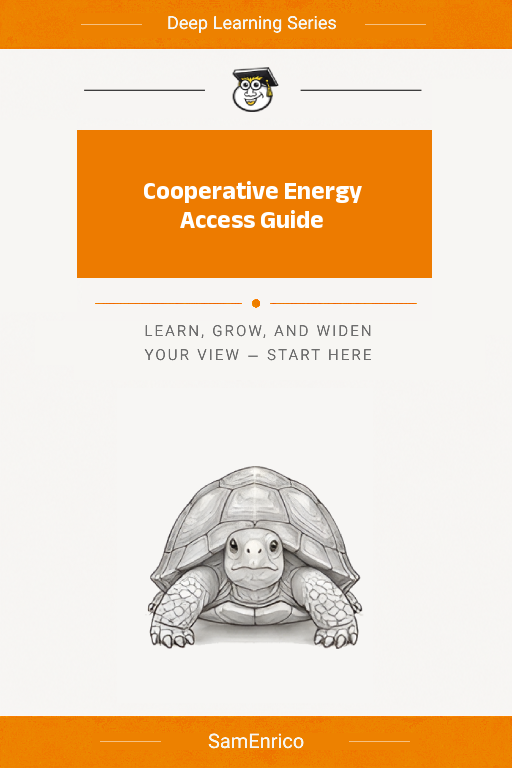
Cooperative Energy Access Guide
Install solar mini-grids through member-owned ener
by Horn Felecia
Install solar mini-grids through member-owned energy cooperatives in rural East Africa, accessing development funding.
Formats
About this book
Free sample
Chapter 1: The Mango Tree Revolution...–- The night the kerosene ran out, something shifted in Grace Achieng’s chest that she would later recognize as the beginning of a revolution. Her youngest daughter, Akinyi, was burning with malaria. The nearest clinic was eight kilometers down a dirt road that turned to glue in the rain. Grace had no flashlight. Her phone had been dead for two days.
The donkey cart’s lantern held maybe thirty minutes of kerosene—enough to reach the main road, not enough to return. She walked. In darkness. Carrying her daughter. Arriving at dawn, too late for the worst of the fever but not too late to make a promise she would spend the next three years keeping: Never again.
Not for my children. Not for any child in this village.That promise became a solar mini-grid. That mini-grid became a cooperative. That cooperative became a movement. And that movement began under a mango tree, with forty-seven skeptical farmers, one widow who refused to accept darkness as her destiny, and a question that would challenge everything outsiders had assumed about rural Africa: What if the people who need electricity the most are the ones best equipped to own it?This book is the answer to that question.
It is not a theoretical treatise. It is not a donor report. It is a field guide, a blueprint, and a provocation—written for the community organizer, the cooperative manager, the development officer, and the rural entrepreneur who is tired of waiting for someone else to flip the switch. It is built on the stories of people like Grace, who discovered that the two dominant models of rural electrification—the state-led approach and the private-sector model—had both failed her community, and that a third way was not only possible but已经在 her own tradition of cooperation.The Two Failures That Created the Space for a Third Way Before we build something new, we must understand what has broken. Rural electrification in East Africa has been dominated for decades by two competing models, each with its own champions, its own funding streams, and its…
This is the end of the free sample. Get the eBook to keep going. Buy now
Contents
- Chapter 1
- Chapter 2
- Chapter 3
- Chapter 4
- Chapter 5
- Chapter 6
- Chapter 7
- Chapter 8
- Chapter 9
- Chapter 10
- Chapter 11
- Chapter 12
Details
- Author
- Horn Felecia
- Publisher
- SamEnrico
- Language
- English
- Genre
- Non-Fiction, Business Brief
- Released
- 2026-06-01
- Pages (approx.)
- 151
- Available as
- eBook, Audiobook

Read better in the ZLOADR app
Your eBooks on your phone or tablet. Sign in with your SamEnrico account and start reading.
More by Horn Felecia
 Sector for IntrovertsHorn Felecia$11.99
 Number Thirteen Fear TriskaidekaphobiaHorn Felecia$11.99
 Research Proposal Sampling Strategy GuideHorn Felecia$11.99
 Deadweight Loss ExplainedHorn Felecia$11.99
 Self Hypnosis Script TemplateHorn Felecia$11.99
 Divorce Childhood Self BlameHorn Felecia$11.99
 Baseball Batting TranceHorn Felecia$11.99
 The Soul Stirrers: Touch the Hem of His Garment, Touch HistoryHorn Felecia$11.99
 The Edison Heist: Stealing the FutureHorn Felecia$11.99
 The Phantom of the Grand Place: The Haunting of Brussels' Architectural MasterpieceHorn Felecia$11.99
 The Mineral Guide to BromelliteHorn Felecia$11.99
 US Business Credit Starter VendorsHorn Felecia$12.99
You may also like
 Hong Kong Handover 1997Dunn Johnnie$11.99
 Zumba For Postnatal Recovery CourseNeal Christian$11.99
 Zumba for BeginnersLadner Nikia$11.99
 YouTube Comment Mining GuideHumes Pandora$12.99
 Worry Box MeditationCarlin Rudy$11.99
 Workplace Stress MeditationNguyen Lynn$11.99
 Workplace Stress and Sleep RepairHawley Ivory$11.99
 Workplace Perfectionism CureDelaney Jeffry$11.99
 Workplace Injustice Anger GuideWallen Isabelle$11.99
 Work Addiction and Burnout LinkGreenwood Ester$11.99
 Women in Yoga and WellnessBeattie Galina$11.99
 Women in Stand Up ComedyChun Evangeline$11.99