
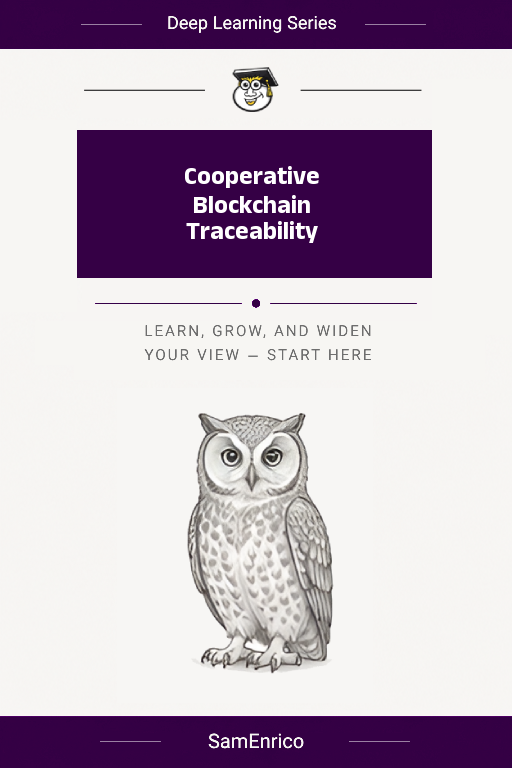
Cooperative Blockchain Traceability eBook
Use blockchain to track cooperative produce from f
by Lanham Junie
Use blockchain to track cooperative produce from farm to buyer, proving origin and sustainability for premium markets.
Formats
Free sample
Chapter 1: The Honey Trap--The email arrived at 4:47 AM Lusaka time, and Grace Mwamba read it three times before she believed it.Her cooperative's entire year's harvest—thirty thousand beehives' worth of organic honey—had been rejected. The buyer, a European food conglomerate she had spent eighteen months courting, claimed "quality inconsistencies" in the final laboratory reports. But Grace knew the truth. She had watched the honey being harvested, processed, and sealed. She had the paper certificates, the batch numbers, the signatures of three independent inspectors.
The honey was perfect.The buyer had found cheaper honey elsewhere and used a paperwork loophole to escape their contract.The honey would rot in a Mombasa warehouse. Her 1,200 farmers would not be paid. And Grace's phone was already buzzing with messages from families who had spent their advance payments on school fees, medical bills, and seeds for the next season."I am sorry," the buyer's email concluded, "but without verifiable proof of origin from farm to factory, we cannot proceed."Verifiable proof. Grace had given them paper. She had given them certificates.
She had given them everything her father and grandfather had used to sell honey for three generations. But paper, she now understood, was not proof. Paper was a promise. And promises, she had just learned, could be broken with a single email.What Grace did not know, as she stared at her phone in the pale Zambian dawn, was that four thousand miles away in Ghana, a different story was unfolding. There, a blockchain pilot project funded by the United Nations Industrial Development Organization was doing what her paper contract could not: proving, second by second, that cocoa came from the farms it claimed.
That pilot would eventually save 800,000 farm families from Grace's fate. But Grace had never heard of blockchain. She had never heard of UNIDO. She only knew that her honey was trapped in a warehouse, her farmers were trapped in debt, and she had seventy-two hours to find a buyer before the honey spoiled.She called her nephew in Lusaka, who knew someone who knew someone—"some tech person in Brooklyn." She did not know it yet, but that phone call would start a revolution.The Crisis of Trust in Global Supply Chains Grace's story is not unique. It is the story of millions of smallholder farmers around the world who grow the finest produce on earth—coffee that wins international tastings, cocoa that commands premium prices, honey that is purer than any industrial substitute—and yet are systematically cheated by a global supply chain built on paper promises.The problem is simple but devastating: the systems that certify organic, fair trade, and sustainable products are fundamentally unverifiable.Consider the journey of a typical coffee bean from a cooperative in Ethiopia to a coffee shop in London.
The farmer harvests the cherry and delivers it to a cooperative collection point. The cooperative issues a paper receipt. The coffee is transported to a dry mill, where it is hulled, graded, and bagged. Another paper certificate is issued. The coffee is sold to an exporter, who consolidates it with coffee from dozens of other cooperatives—sometimes hundreds—in a single shipping container.
The exporter issues a certificate of origin. The coffee arrives in Europe, where an importer buys the container and sells the coffee to a roaster. The roaster sells it to a coffee shop. The coffee shop sells it to a consumer who pays a 300 percent markup for "single-origin, organic, fair trade Ethiopian coffee."At every step, paper changes hands. At no step can anyone definitively prove that the coffee in the consumer's cup came from the farm on the label.This is not a hypothetical problem.
In 2023, a major European chocolate manufacturer was found selling "single-origin" bars containing cocoa from four different countries. The fraud was discovered not by auditors—who had signed off on the supply chain for years—but by a blockchain pilot project in Ghana that allowed investigators to trace individual batches from farm to factory. The blockchain did not lie. The paper had.The Collapse of Certification Trust For decades, consumers have relied on certification labels to make ethical purchasing decisions. Organic.
Fair Trade. Rainforest Alliance. UTZ. Each label promises that the product meets certain standards: no synthetic pesticides, fair wages for farmers, protection of biodiversity, safe working conditions. And for decades, consumers have paid premiums—often 20 to 50 percent higher prices—for products carrying these labels.But the trust is collapsing.Studies across multiple countries show that more than 60 percent of consumers now doubt sustainability claims on product packaging.
They have been burned too many times. They have read too many exposés about "organic" products contaminated with pesticides, "fair trade" farmers paid below poverty wages, "single-origin" products blended with cheaper commodities. The labels that once signaled virtue now signal potential fraud.This cynicism is not irrational. It is the logical response to a system that rewards certification without verification. A paper certificate can be forged.
A batch can be diluted. An auditor can be deceived—or simply never show up. In one investigation, undercover journalists found that they could obtain an "organic" certification for a conventional farm by paying a fee and submitting falsified documents. No inspection was conducted. No soil was tested.
No records were verified.The premium that consumers pay for certified products is supposed to reach the farmers who earned it. Instead, it often disappears into a system of middlemen, fraudulent certificates, and unenforceable promises. The cooperatives that need those premiums most—the smallholder farmers who lack bargaining power, market access, and legal resources—are the ones most frequently cheated.The Regulatory Tsunami But change is coming. And it is not coming from consumer activism alone—it is coming from government regulation.The European Union, which represents the world's largest market for premium agricultural products, has unleashed a wave of regulations that will fundamentally reshape global supply chains. Three regulations, in particular, are forcing the issue.The EU Deforestation Regulation (EUDR) is the most significant.
Enacted in 2023 and taking full effect in 2025, EUDR requires any company selling cocoa, coffee, soy, palm oil, beef, rubber, or derived products into the EU to prove that those products did not come from land deforested after December 31, 2020. The proof must be geo-located: GPS polygons of every farm plot, satellite imagery showing forest cover in 2020, and a due diligence statement connecting the product to the land. Non-compliance means exclusion from the EU market—a market worth hundreds of billions of dollars annually.For cooperatives like Grace's, EUDR represents both a threat and an opportunity. The threat is obvious: without the ability to prove deforestation-free origin, they lose access to their most valuable customers. The opportunity is equally clear: cooperatives that can provide verifiable, immutable proof of origin will command premium prices from buyers desperate to comply with the regulation.The EU Corporate Sustainability Due Diligence Directive (CSDDD) adds another layer of requirement.
It mandates that large companies identify, prevent, and address human rights and environmental violations in their supply chains. This is not voluntary. Companies that fail to conduct due diligence face fines of up to 5 percent of their global revenue and civil liability for…
This is the end of the free sample. Get the eBook to keep going. Buy now
About this book
Details
- Author
- Lanham Junie
- Publisher
- SamEnrico
- Language
- English
- Genre
- Non-Fiction, Business Brief
- Released
- 2026-06-01
- Pages (approx.)
- 137
- Available as
- eBook, Audiobook

Read better in the ZLOADR app
Your eBooks on your phone or tablet. Sign in with your SamEnrico account and start reading.
More by Lanham Junie
 Ethiopian Family Reunited AbroadLanham Junie$11.99
 Research Proposal Dissemination Plan GuideLanham Junie$11.99
 Exercise Academic Stress ReliefLanham Junie$11.99
 Casino Dealer Stress ManagementLanham Junie$11.99
 Scripting for SleepLanham Junie$11.99
 Market Disequilibrium DynamicsLanham Junie$11.99
 Praise Dependent Self WorthLanham Junie$11.99
 Marathon Wall HypnosisLanham Junie$11.99
 The Alchemists of Rome: Forging the Foundations of ScienceLanham Junie$11.99
 The Crusade of the Black Eagle: The Mongols at Acre (1291 AD)Lanham Junie$11.99
 Docker and ContainerizationLanham Junie$11.99
 Growing DiploglottisLanham Junie$11.99
You may also like
 Hong Kong Handover 1997Dunn Johnnie$11.99
 Zumba For Postnatal Recovery CourseNeal Christian$11.99
 Zumba for BeginnersLadner Nikia$11.99
 YouTube Comment Mining GuideHumes Pandora$12.99
 Worry Box MeditationCarlin Rudy$11.99
 Workplace Stress MeditationNguyen Lynn$11.99
 Workplace Stress and Sleep RepairHawley Ivory$11.99
 Workplace Perfectionism CureDelaney Jeffry$11.99
 Workplace Injustice Anger GuideWallen Isabelle$11.99
 Work Addiction and Burnout LinkGreenwood Ester$11.99
 Women in Yoga and WellnessBeattie Galina$11.99
 Women in Stand Up ComedyChun Evangeline$11.99