
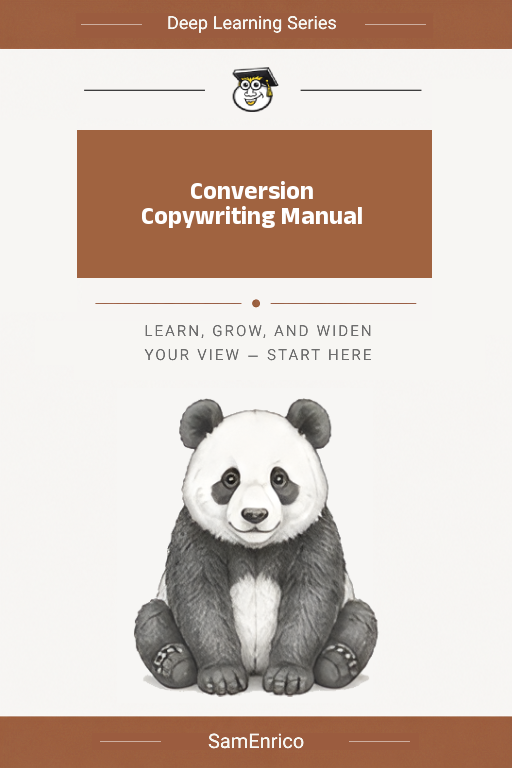
Non-FictionNon-Obvious CareerDirect Response
Conversion Copywriting Manual eBook
Write email sequences, landing pages, and sales pa
Write email sequences, landing pages, and sales pages that convert using proven frameworks, swipe files, and before after portfolios without any degree.
Formats
Free sample
Chapter 1: The 5-Step Sequence--–- I wrote an email once that got a 0.2% open rate. That’s not a typo. Zero point two percent. Out of 10,000 people, exactly twenty opened it. Twenty.
I had spent three hours on that email. I had rewritten the subject line seven times. I had shown it to my wife, who said it was “clever.” It was clever. It was also worthless.That was the moment I realized that copywriting—real copywriting that prints money—has almost nothing to do with cleverness and almost everything to do with psychology. Specifically, it has to do with the invisible ladder that every buyer climbs before they say “yes.” Most copy fails not because it’s poorly written, but because it asks the reader to jump from “scrolling” to “buying” without building the intermediate rungs.
You wouldn’t ask someone to climb a ten-foot wall without a ladder. But that’s exactly what most copy does.This chapter is about that ladder. It’s called the 5-Step Motivating Sequence, and it’s been the hidden engine behind every profitable sales page, landing page, and email sequence for nearly a century. It was refined by copywriting legends like Robert Bly, Claude Hopkins, and Eugene Schwartz. And it works whether you’re selling a 7ebookora7 ebook or a 7ebookora7,000 coaching program.By the end of this chapter, you will never look at a “Buy Now” button the same way again.The One Question That Changes Everything Let’s start with a brutal truth: Your reader does not care about your product.
They care about their problem. They care about their pain. They care about the gap between where they are and where they want to be. Your product is just a potential bridge across that gap—but they won’t cross until you’ve convinced them the bridge is safe, stable, and worth the toll.The 5-Step Motivating Sequence is that bridge. Here are the five rungs:Attention – You stop the scroll.
You interrupt the pattern. You make them look up from their phone.Interest – You connect your opening to something they already want. You make them lean in.Desire – You show them what life looks like on the other side. You make them want it.Conviction – You prove it’s possible. You overcome the “yeah, but” in their head.Action – You tell them exactly what to do next.
You remove the friction.That’s it. Five rungs. But here’s what almost everyone gets wrong: You cannot skip a rung. You cannot jump from Attention to Action. You cannot go from “Hey, look at this” to “Buy now” without building Desire and Conviction along the way.
That’s like asking someone to marry you on the first date. It might work once in a million tries, but it’s not a strategy. It’s a lottery ticket.Let me show you what skipping rungs looks like in the wild. I see this every single day.The “So What?” Test: Your New Best Friend Before we dive into each rung, you need a tool. It’s called the “So What?” Test, and it’s the single most effective way to turn boring features into emotional convictions.Here’s how it works: Take any feature of your product.
Write it down. Then ask “So what?” Keep asking until you hit an answer that makes you feel something. Stop when you reach the identity level—when the answer describes who the reader becomes, not just what the product does.Let me walk you through an example. Imagine you’re selling cloud storage. A feature might be “10GB of storage.” That’s boring.
Nobody wakes up wanting 10GB of storage. So ask:Feature: 10GB of storage.So what? So you can store more photos.So what? So you never have to delete a photo to make space.So what? So you never lose a memory of your child’s first steps.So what?
So you are a parent who protects what matters most.See what happened there? We started with a technical feature (10GB) and ended with an identity statement (“You are a parent who protects what matters most”). That’s conviction. That’s the emotional fuel that drives action.Here’s another example, this time for a productivity app:Feature: Task reminders with smart scheduling.So what? So you don’t forget important deadlines.So what?
So you stop missing client calls and embarrassing yourself.So what? So you are the reliable person on your team that everyone trusts.So what? So you are a professional who delivers on their promises.Same pattern. Feature → functional benefit → emotional benefit → identity. The “So What?” Test is the ladder you climb to reach the top rung of the 5-Step Sequence.
You’ll use it constantly. In fact, let’s use it right now.Quick exercise: Take a feature from your own product or service. Write it down. Then ask “So what?” four times. Write each answer.
If you don’t reach an identity statement by the fourth “So what?”, keep going. I’ll wait.Done? Good. That identity statement you just wrote? That’s the emotional core of your copy.
That’s what you’re actually selling. Not the feature. The identity.Rung 1: Attention – The 3-Second Hijack You have between one and three seconds to stop the scroll. That’s it. In that time, your reader’s brain makes a binary decision: “This is for me” or “This is not for me.” There is no middle ground.
There is no “I’ll come back to this later.” Later never comes.So how do you win those three seconds? You hijack their attention with one of these four proven patterns:Pattern A: The Unexpected Statement Say something that violates expectations. The brain is wired to notice anomalies. If you’re walking through a forest and see a couch in a tree, you stop. Same principle applies to copy.Before (weak): “How to save time with email templates”After (attention-grabbing): “I wrote this email at 3 AM so you don’t have to”The second version stops the scroll because it’s unexpected.
It creates a micro-mystery. Who wrote an email at 3 AM? Why? What happened? The reader doesn’t know, but they want to.Pattern B: The Pain Point Punch Name a specific, visceral pain that your reader feels every day.
Don’t be polite. Don’t be vague. Be specific.Before (weak): “Struggling with productivity?”After (pain point punch): “You’ve started eleven projects this year and finished exactly two.”The second version hurts because it’s true. Your reader feels seen. And when someone feels seen, they stop scrolling.Pattern C: The Curiosity Gap Open a loop that the reader has to close by reading further.
This is the most powerful attention pattern in direct response copywriting. But—and this is important—the curiosity gap only works if the payoff delivers. If you open a loop and the content is boring, you lose trust forever.Before (weak): “Tips for better sleep”After (curiosity gap): “The 9 PM habit that ruined my sleep for a decade”What’s the habit? The reader doesn’t know. They have to read to find out.Pattern D…
This is the end of the free sample. Get the eBook to keep going. Buy now
About this book
Details
- Author
- Reardon Ofelia
- Publisher
- SamEnrico
- Language
- English
- Genre
- Non-Fiction, Non-Obvious Career, Direct Response
- Released
- 2026-06-01
- Pages (approx.)
- 118
- Available as
- eBook, Audiobook

Read better in the ZLOADR app
Your eBooks on your phone or tablet. Sign in with your SamEnrico account and start reading.
More by Reardon Ofelia
 Mats Wilander Surprising ChampionReardon Ofelia$11.99
 EQ Creative Collaboration GuideReardon Ofelia$11.99
 Equifax Identity Theft VictimsReardon Ofelia$11.99
 Perfectionism at WorkReardon Ofelia$11.99
 SAS 22 Regiment HistoryReardon Ofelia$11.99
 The Asura’s Gambit: A Spy Among GodsReardon Ofelia$11.99
 The Vanishing Doctors: The Dark Truth Behind the 1975 DisappearancesReardon Ofelia$11.99
 Cryptocurrency TracingReardon Ofelia$11.99
 Domestic Travel Recovery PatternsReardon Ofelia$12.99
 How to Become a Jinrikisha DriverReardon Ofelia$11.99
 Understanding Gastrocutaneous SyndromeReardon Ofelia$17.99
You may also like
 Hong Kong Handover 1997Dunn Johnnie$11.99
 Zumba For Postnatal Recovery CourseNeal Christian$11.99
 Zumba for BeginnersLadner Nikia$11.99
 YouTube Comment Mining GuideHumes Pandora$12.99
 Worry Box MeditationCarlin Rudy$11.99
 Workplace Stress MeditationNguyen Lynn$11.99
 Workplace Stress and Sleep RepairHawley Ivory$11.99
 Workplace Perfectionism CureDelaney Jeffry$11.99
 Workplace Injustice Anger GuideWallen Isabelle$11.99
 Work Addiction and Burnout LinkGreenwood Ester$11.99
 Women in Yoga and WellnessBeattie Galina$11.99
 Women in Stand Up ComedyChun Evangeline$11.99