
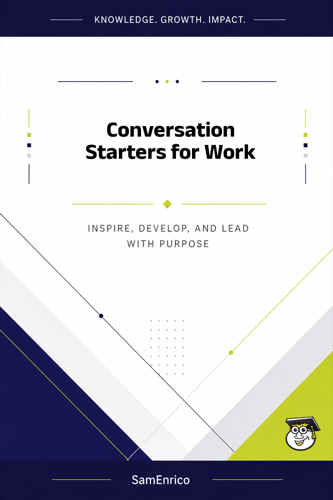
Conversation Starters for Work eBook
Office and team meeting openers for colleagues.
by Gass Viviana
Office and team meeting openers for colleagues.
Formats
Free sample
Chapter 1: The Primacy Trap...–- You have just called a meeting. The agenda is polished. The slides are ready. The right people are on the call or in the room. You take a breath, look at the clock, and say the seven words that doom more meetings than any other phrase in the English language: “Alright, let’s go ahead and get started.”Those seven words feel efficient.
They feel professional. They feel like respect for everyone’s time. And they are almost always a catastrophic mistake.What you do in the next three hundred seconds will determine whether this meeting produces decisions, alignment, and energy—or whether it becomes another entry in the long, sad archive of wasted hours that your colleagues will quietly resent. The first five minutes are not a warm-up. They are not an icebreaker to be tolerated before the “real work” begins.
They are the single most leveraged intervention you will ever make as a meeting facilitator. And most leaders are getting them profoundly wrong.This book exists because of a simple, uncomfortable truth: the difference between a high-performing team and a chronically frustrated one often comes down to what happens in the space between “hello” and the first agenda item. After synthesizing the best practices from dozens of leading books on team dynamics, psychological safety, and facilitation—including Quick Meeting Openers for Busy Managers, Perfect Phrases for Icebreakers, The Five Dysfunctions of a Team, and Crucial Conversations—the evidence is overwhelming. The openers that feel safe and familiar are usually useless. The openers that feel slightly uncomfortable are usually transformative.
And skipping the opener entirely is not a time-saver; it is a time-waster dressed in business casual.This chapter establishes the scientific and practical foundation for everything that follows. You will learn why the first five minutes matter more than the next fifty, how the psychology of first impressions hijacks your team’s brain, and why the most common meeting start—“Let’s dive in”—is actually a form of facilitation negligence. By the end of this chapter, you will never start another meeting the same way again.The Primacy Effect: How Your First Five Minutes Become Your Only Five Minutes In 1946, the Polish-born psychologist Solomon Asch conducted a now-famous experiment. He gave two groups of people a list of adjectives describing a hypothetical person. Group A received the list: “intelligent, industrious, impulsive, critical, stubborn, envious.” Group B received the identical list—but in reverse order: “envious, stubborn, critical, impulsive, industrious, intelligent.” The participants then rated their impression of the person.
Group A described someone who was capable but slightly flawed. Group B described someone who had serious problems but some redeeming qualities. The only difference was the order of the information.This is the primacy effect: the human brain disproportionately weights the first information it receives in a sequence. First impressions are not just memorable; they are sticky. They act as a cognitive frame through which all subsequent information is filtered.
If you meet someone and the first thing they do is interrupt you, you will interpret everything else they do through the lens of “this person is rude.” If the first five minutes of a meeting are tense, confusing, or boring, your team’s collective brain will remain in that defensive or disengaged state for the remaining fifty-five minutes—even if the agenda is brilliant.Here is what the primacy effect looks like in a meeting. The facilitator starts with: “Alright, let’s get started. Susan, can you give us the numbers?” Susan fumbles with her laptop for thirty seconds. Someone’s phone buzzes. Two people start a side conversation about parking.
The facilitator says “shh” with their eyes but not their mouth. By the time the first agenda item is announced, the emotional tone is already set: slightly anxious, slightly bored, slightly performative. That tone will persist. No amount of brilliant analysis in minute forty-two will fully recover what was lost in minute one.The primacy effect is not a bug in human cognition. It is a feature.
Our brains evolved to make rapid judgments about safety and threat. In a meeting context, the brain is asking a continuous, subconscious question: “Is this a place where I can speak honestly, take risks, and focus—or do I need to protect myself?” The first five minutes answer that question. If the answer is “protect myself,” your team will spend the rest of the meeting nodding, checking email, and saying “that’s a good point” while mentally composing their lunch order.The Myth of “Getting Straight to Business”The most common objection to deliberate meeting openers is also the most seductive: “We don’t have time for that. We need to get straight to business.” On its surface, this sounds like respect for everyone’s time. In practice, it is the exact opposite.Consider the research from a multi-year study of meeting effectiveness conducted across manufacturing, technology, and healthcare organizations.
Teams that skipped any form of opener—jumping directly into the first agenda item within thirty seconds of the scheduled start—had meetings that ran, on average, 22 percent longer than scheduled. They had 37 percent more side conversations. They rated their own meeting effectiveness 41 percent lower than teams that used a deliberate, three-to-five-minute opener. The teams that used openers did not just feel more effective. They finished earlier.
They made clearer decisions. They had fewer follow-up meetings.Why? Because “getting straight to business” assumes that everyone arrived already oriented, aligned, and psychologically present. That assumption is almost always false. Your colleagues arrived from different contexts: a stressful call with a client, a fight with their teenager about homework, a deadline that just moved up, a notification that their 401(k) dropped again.
They are physically present but cognitively scattered. When you say “let’s dive in,” you are asking them to perform focus without giving them any tool to achieve it. It is like telling someone to “just be creative” and then staring at them.The teams that used openers did not waste time. They invested time. A three-minute opener that acknowledges the cognitive clutter, builds a shared emotional state, or pre-activates thinking about the agenda reduces the “spin-up time” that would otherwise leak into the first fifteen minutes of the meeting.
The opener is a catalyst. The meeting without an opener is a cold engine turning over and over, wasting fuel, going nowhere.Check-In Culture vs. Launch Pad Strategy Not all openers are created equal. In fact, most openers are worse than no opener at all because they create the illusion of connection while delivering nothing but awkwardness. We call this Check-In Culture, and it is epidemic.Check-In Culture looks like this: The facilitator says, “Let’s go around the room and say how we’re doing.” Pause.
Someone says “Good.” Someone says “Busy.” Someone says “Happy to be here” with visible insincerity. Two people say the same thing. One person shares a long, uncomfortable story about their sick pet. The facilitator nods, says “great,” and then pivots to the agenda. Nothing was accomplished.
No one feels more connected. The meeting is now late, and everyone is slightly annoyed.Check-In Culture fails for three reasons.…
This is the end of the free sample. Get the eBook to keep going. Buy now
About this book
Details
- Author
- Gass Viviana
- Publisher
- SamEnrico
- Language
- English
- Genre
- Non-Fiction, Self-Help, Workplace
- Released
- 2026-06-10
- Pages (approx.)
- 142
- Available as
- eBook, Audiobook

Read better in the ZLOADR app
Your eBooks on your phone or tablet. Sign in with your SamEnrico account and start reading.
More by Gass Viviana
 Men's Master GuideGass Viviana$11.99
 War Zone ChildhoodGass Viviana$11.99
 Immigrant AI Startup FounderGass Viviana$11.99
 UAE Wasta Influence UnderstandingGass Viviana$11.99
 Teen Breakup Self EsteemGass Viviana$11.99
 School Picture Day OutfitsGass Viviana$11.99
 Dream Menagerie LogGass Viviana$11.99
 Eleanor of Aquitaine: Queen of Courts and CrusadesGass Viviana$11.99
 The Tsuchigumo's Shadow: A Yokai's Path to RedemptionGass Viviana$11.99
 Virtual IBAN for African ExportersGass Viviana$12.99
 Citation for Data Sets GuideGass Viviana$12.99
 How to Produce Office Rubber StampsGass Viviana$11.99
You may also like
 Hong Kong Handover 1997Dunn Johnnie$11.99
 Zumba For Postnatal Recovery CourseNeal Christian$11.99
 Zumba for BeginnersLadner Nikia$11.99
 YouTube Comment Mining GuideHumes Pandora$12.99
 Worry Box MeditationCarlin Rudy$11.99
 Workplace Stress MeditationNguyen Lynn$11.99
 Workplace Stress and Sleep RepairHawley Ivory$11.99
 Workplace Perfectionism CureDelaney Jeffry$11.99
 Workplace Injustice Anger GuideWallen Isabelle$11.99
 Work Addiction and Burnout LinkGreenwood Ester$11.99
 Women in Yoga and WellnessBeattie Galina$11.99
 Women in Stand Up ComedyChun Evangeline$11.99