
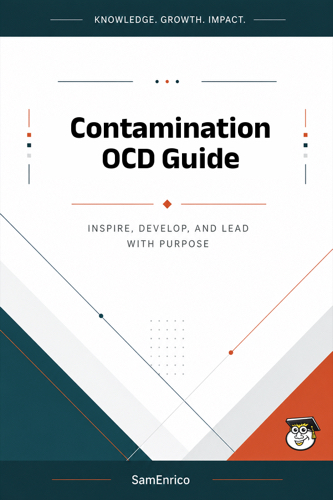
Free sample
Chapter 1: The Bleeding Point--–- The first time my hands split open, I was in a public restroom at a shopping mall. I had touched the door handle—that was the crime—and for the next forty-five minutes, I stood at the sink, scrubbing with scalding water and cheap pink soap, watching the skin on my knuckles crack and begin to weep a thin, clear fluid that I knew was not blood but that I also knew, with absolute certainty, meant I had finally done it. I had finally washed myself raw. I had finally become the person I had always feared I was: someone who could not stop, someone whose need for cleanliness had become dirtier than any germ, someone whose hands now looked like ground meat because a door handle might have had something on it.–- I was twenty-three years old. I had a college degree.
I had friends who did not know I spent two hours a day in the bathroom. I had a therapist who had told me, kindly but uselessly, to "just challenge my thoughts." And I had a secret that felt heavier than any secret should be: I was losing the war against my own brain, and I was absolutely certain that no one else in the world could possibly understand what it felt like to be this exhausted, this ashamed, and this unable to stop.–- I was wrong about the no one else part. That is why I am writing this book. That is why you are reading it. And that is why the first and most important thing I need to tell you is not a technique or a strategy or a clinical insight.
It is simply this: you are not alone, you are not broken, and the fact that you are still fighting—still washing, still avoiding, still searching for answers even when you feel like giving up—means you are far stronger than your OCD wants you to believe.The Trap You Did Not Build–- Let me describe a scene that will feel familiar to you. You are walking down a sidewalk. You see a discarded napkin on the ground. You are not near it. You do not touch it.
But your brain, in a fraction of a second, has already generated the thought: What if something from that napkin floated through the air and landed on my shoe? What if I track it into my home? What if my family touches the floor and then touches their faces? Your heart rate spikes. Your palms sweat.
Your throat tightens. You cross the street to avoid the napkin entirely, and for a moment, you feel relief. But then the relief curdles into a new worry: What if the contamination was already on my shoe from earlier? What if I am carrying it with me right now without knowing? You spend the next twenty minutes mentally replaying every step you have taken, trying to remember if you saw anything on the ground, checking the bottom of your shoe for invisible residue.
By the time you get home, you are exhausted. You have not done anything productive. You have not enjoyed your walk. You have simply survived it.–- This is the trap. You did not build it.
You did not choose it. You did not wake up one day and decide to be terrified of napkins on the sidewalk. The trap was built by a combination of genetic vulnerability, life experiences, and the normal learning mechanisms of a brain that is trying—badly, incorrectly, but genuinely trying—to keep you safe. Your brain has learned that uncertainty is danger, that possibility is probability, and that the only way to feel better is to wash, avoid, or ask for reassurance. And every time you do those things, you are not solving the problem.
You are digging the trap deeper.–- This is the central paradox of contamination OCD: the behaviors that make you feel better in the moment are the very behaviors that keep you sick. Washing your hands provides temporary relief, but it teaches your brain that the washing was necessary—which means the danger must have been real. Avoiding the napkin feels smart, but it teaches your brain that the napkin was worth avoiding—which means it must have been dangerous. Asking your partner "Is this clean?" soothes you for a few seconds, but it teaches your brain that you cannot trust your own judgment—which means you will need to ask again next time, and the time after that, and forever.–- The chapters ahead will give you the tools to stop digging and start climbing. But before we get to the tools, we need to name the problem clearly.
We need to look at the trap from every angle, understand how it works, and recognize that millions of people are trapped in the exact same way—even though almost all of them are hiding it, just like you are.The Dirty Secret of Contamination OCD–- There is a secret that people with contamination OCD keep, and it is not the secret you think. It is not that they wash their hands too much or that they are afraid of germs. The real secret is this: they know, on some level, that their fears are irrational, and that knowledge makes everything worse.–- Think about that for a moment. If you believed with 100 percent certainty that every doorknob was coated with a deadly poison, your behavior would make perfect sense. You would wear gloves.
You would use paper towels. You would avoid public places entirely. You would be rational, given your belief. The problem with OCD is not that you have irrational beliefs. The problem is that you have partially irrational beliefs.
You know that the risk from a doorknob is tiny. You have read the statistics. You understand germ theory well enough to know that most bacteria are harmless and that your immune system is remarkably effective. And yet, in the moment, standing in front of that doorknob, the tiny risk feels enormous. The statistics vanish.
The knowledge evaporates. All that remains is the feeling: this is dirty, this is dangerous, and I cannot touch it.–- This gap between what you know and what you feel is the source of the shame. You tell yourself that you should be able to think your way out of this. You should be able to remember the statistics. You should be able to act like a normal person.
And because you cannot, you conclude that you are weak, or crazy, or fundamentally broken. You are none of those things. You are experiencing the normal result of a brain that has learned to prioritize feeling over knowledge. Your amygdala—the brain's rapid-threat-detection system—is overriding your prefrontal cortex—the brain's careful-thinking system. It is not a character flaw.
It is a neurological pattern. And neurological patterns can be changed.–- The first step to changing the pattern is to stop punishing yourself for having it. The shame is not helping you wash less. The shame is not making you braver. The shame is just another weight on your back…
This is the end of the free sample. Get the eBook to keep going. Buy now
About this book
Details
- Author
- Gunther Dotty
- Publisher
- SamEnrico
- Language
- English
- Genre
- Non-Fiction, Health & Wellness / OCD
- Released
- 2026-06-08
- Pages (approx.)
- 140
- Available as
- eBook, Audiobook

Read better in the ZLOADR app
Your eBooks on your phone or tablet. Sign in with your SamEnrico account and start reading.
More by Gunther Dotty
 The Ignite Talk MethodGunther Dotty$11.99
 Numbness Trigger ActivationGunther Dotty$11.99
 Sustainable Aviation FuelGunther Dotty$11.99
 Sheppard Case Ohio Supreme CourtGunther Dotty$11.99
 Iron Deficiency Recovery GuideGunther Dotty$11.99
 Future Pacing Script TemplatesGunther Dotty$11.99
 Forgiveness After AngerGunther Dotty$11.99
 Lightfoot LoriGunther Dotty$11.99
 The Last Patient of Dr. Libby Zion: A Medical System in CrisisGunther Dotty$11.99
 The Hollow Hill's Last Bargain: A Fairy's Cruel PactGunther Dotty$11.99
 The Hollow Ones: The Forgotten Plague of the Black DeathGunther Dotty$11.99
 Prescriptive Analytics and OptimizationGunther Dotty$11.99
You may also like
 Hong Kong Handover 1997Dunn Johnnie$11.99
 Zumba For Postnatal Recovery CourseNeal Christian$11.99
 Zumba for BeginnersLadner Nikia$11.99
 YouTube Comment Mining GuideHumes Pandora$12.99
 Worry Box MeditationCarlin Rudy$11.99
 Workplace Stress MeditationNguyen Lynn$11.99
 Workplace Stress and Sleep RepairHawley Ivory$11.99
 Workplace Perfectionism CureDelaney Jeffry$11.99
 Workplace Injustice Anger GuideWallen Isabelle$11.99
 Work Addiction and Burnout LinkGreenwood Ester$11.99
 Women in Yoga and WellnessBeattie Galina$11.99
 Women in Stand Up ComedyChun Evangeline$11.99