
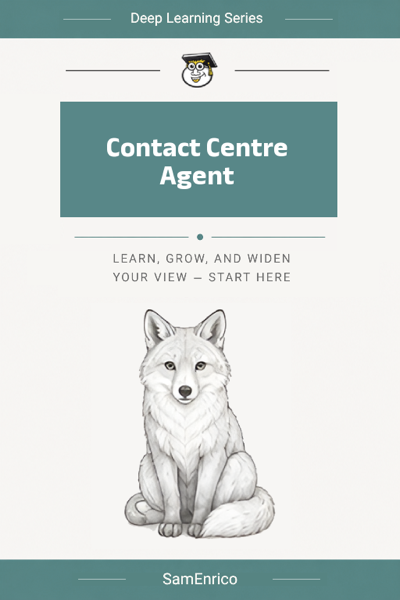
Non-FictionInformativeEducational
Contact Centre Agent eBook
A Coursebook on Contact Centre Agent
A Coursebook on Contact Centre Agent
Formats
Free sample
Chapter 1: The Loyalty Lie...--You were told that your job is to answer calls, solve problems, and move on to the next person in the queue. You were told that speed matters most, that customers want quick resolutions, and that your value is measured in seconds per call and satisfaction scores on a five-point scale. You were told a version of the truth that left out the most important part.That version is wrong.Not slightly inaccurate. Not missing a few details. Fundamentally, strategically, and dangerously wrong for you, for your career, and for every customer who ever waits on hold.Here is what nobody told you on your first day of training: the contact centre is not a cost centre.
It is not a necessary evil. It is not a place where problems go to die slowly on hold music. The contact centre is the single most valuable asset your company owns—and you, the person sitting in that headset, are the most powerful employee in the entire organization.This chapter is going to show you why. More importantly, it is going to show you how to start thinking like the asset you actually are.The Million-Dollar Call You Already Take for Granted Let us start with a number that will change how you hear every single ring.The average company spends between five and twenty-five times more money to acquire a new customer than to keep an existing one. Depending on the industry, acquiring a new customer costs anywhere from $50 to more than $500.
Keeping one? Often less than $10 per year in service costs—and most of that is your salary.Yet most companies spend ninety percent of their marketing budget chasing new customers while investing almost nothing in the ones they already have.Here is where you come in.Every time you answer a call from an existing customer, you are not handling a problem. You are managing an asset worth anywhere from hundreds to thousands of dollars in future revenue. That customer on the line has already proven they will pay you. They have already chosen your company over competitors.
They have already gone through the hassle of setting up an account, learning your products, and trusting you with their money.And in that moment, they are vulnerable. They have a problem. They are frustrated. They are wondering, silently, whether they made a mistake choosing you.Your next few minutes will determine the answer.A customer who hangs up feeling heard, respected, and genuinely helped will stay for years. They will forgive mistakes.
They will recommend you to friends. They will defend you on social media when someone else complains. These customers are called Superfans, and they are the difference between a company that grows and a company that dies.A customer who hangs up feeling rushed, dismissed, or processed like a piece of meat will start looking for alternatives. They may not leave today. They may not leave next week.
But a door has opened in their mind, and eventually, they will walk through it.And here is the part that should keep every CEO awake at night: most customers who leave do not bother to complain first. They just leave. You never get a chance to fix it because you never knew it was broken.That call you just took? The one that felt routine? It was either a brick in the wall of loyalty or the first crack in the foundation.
There is no neutral.The Nordstrom Lesson: Culture Flows Downhill To understand what is possible, let us look at a company that has turned ordinary retail into a case study in loyalty. Nordstrom is a department store. They sell shoes, clothes, and handbags. Nothing magical. Nothing that cannot be bought cheaper somewhere else.Yet Nordstrom has a legendary reputation for customer service that has lasted for decades.
Why?Because Nordstrom teaches its employees something radical: use your best judgment.The company has a famously short employee handbook. It is printed on a single five-by-eight-inch card. The entire policy section reads: "Use your good judgment in all situations. There will be no additional rules."Now consider the opposite. Imagine a retailer with a two-hundred-page policy manual covering every possible scenario.
What happens when a customer walks in with a return that falls into a gray area? The employee checks the manual, finds no clear answer, and calls a manager. The manager checks a different manual, finds no answer, and calls corporate. The customer waits. The customer gets angry.
The customer leaves and never comes back.The difference is not about the product. It is about whether the company trusts its people to think.In the contact centre, the same dynamic plays out on every call. If you are forced to follow a rigid script, forbidden from making exceptions, and measured only on how fast you hang up, you become a robot. And customers can tell. They can hear the script in your voice.
They can feel that you are not allowed to care.But if your company gives you guidelines instead of scripts, authority instead of handcuffs, and trust instead of surveillance, something shifts. You become a human helping another human. That is when loyalty happens.Here is the hard truth that this chapter asks you to accept: you may work for a company that has not yet figured this out. You may be surrounded by metrics that punish empathy and reward speed. That does not change the fact that you, personally, can choose to operate differently.
You can be the Nordstrom agent in a call centre that still thinks it is 1995.From Problem-Solver to Loyalty-Builder: The Mindset Shift Let us name the transformation that this entire book is designed to create. You are going to move from being a problem-solver to being a loyalty-builder.A problem-solver asks: "What is the issue? How do I fix it? How fast can I close this ticket?"A loyalty-builder asks: "Who is this person? What do they actually need?
How can I make them feel glad they called?"The difference may sound subtle, but it changes everything about how you listen, how you speak, and how you feel at the end of your shift.Problem-solvers burn out because they see an endless line of broken things to fix. Loyalty-builders gain energy because they see an endless line of relationships to deepen.Problem-solvers get defensive when a customer is angry because they take it personally. Loyalty-builders understand that anger is almost never about them—it is about fear, inconvenience, or the feeling of being powerless—and they respond to the fear, not the volume.Problem-solvers celebrate when a call ends quickly. Loyalty-builders celebrate when a customer says "thank you" in a voice that sounds relieved.This shift is not about being nicer. It is about being smarter.
It is about recognizing that your time is most valuable when you are building assets (loyal customers) rather than extinguishing fires (angry people who will leave anyway).The Economic Case You Can Take to Your Manager You may be thinking: "This sounds great, but my manager only cares about my Average Handling Time and my Customer Satisfaction Score. I cannot just decide…
This is the end of the free sample. Get the eBook to keep going. Buy now
About this book
Details
- Author
- Maloney Starla
- Publisher
- SamEnrico
- Language
- English
- Genre
- Non-Fiction, Informative, Educational
- Released
- 2026-06-02
- Pages (approx.)
- 147
- Available as
- eBook, Audiobook

Read better in the ZLOADR app
Your eBooks on your phone or tablet. Sign in with your SamEnrico account and start reading.
More by Maloney Starla
 The Relationship First Sales ApproachMaloney Starla$11.99
 Non College Mobile Entertainment TrendsMaloney Starla$11.99
 Forgiveness Ho'oponopono GuideMaloney Starla$11.99
 Non Hormonal Future PrimerMaloney Starla$11.99
 The Silk Road of Wheels: How BMX and Freestyle Motocross Revolutionized Medieval Travel and TradeMaloney Starla$11.99
 How to Produce BaseballsMaloney Starla$11.99
 Chinese Exam Prep Tutoring GuideMaloney Starla$12.99
 How to Become a Lubrication ServicerMaloney Starla$11.99
You may also like
 Hong Kong Handover 1997Dunn Johnnie$11.99
 Zumba For Postnatal Recovery CourseNeal Christian$11.99
 Zumba for BeginnersLadner Nikia$11.99
 YouTube Comment Mining GuideHumes Pandora$12.99
 Worry Box MeditationCarlin Rudy$11.99
 Workplace Stress MeditationNguyen Lynn$11.99
 Workplace Stress and Sleep RepairHawley Ivory$11.99
 Workplace Perfectionism CureDelaney Jeffry$11.99
 Workplace Injustice Anger GuideWallen Isabelle$11.99
 Work Addiction and Burnout LinkGreenwood Ester$11.99
 Women in Yoga and WellnessBeattie Galina$11.99
 Women in Stand Up ComedyChun Evangeline$11.99