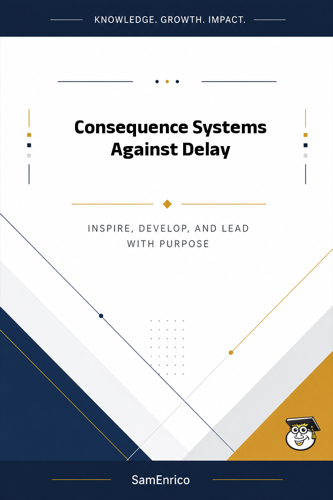
Consequence Systems Against Delay eBook
Create disincentives for procrastination to increa
Create disincentives for procrastination to increase follow through.
Formats
Free sample
Chapter 1: The Motivation Lie--–- If motivation worked, you would have finished already.That sentence is not meant to shame you. It is meant to save you years of chasing the wrong solution.Think about every productivity book you have read, every TED talk you have watched, every vision board you have created, every morning routine you have tried and abandoned. They all promised the same thing: find your why, tap into your passion, discover your intrinsic drive, and the work will do itself.And yet, here you are. Still delaying. Still negotiating with yourself at 11:00 PM about whether tomorrow will finally be the day.
Still feeling that familiar mixture of guilt, confusion, and quiet desperation as another deadline passes and another promise to yourself remains unkept.The problem is not that you lack motivation. The problem is that you have been taught to rely on the wrong psychological lever.This book is built on a provocative but evidence-backed claim: For most people, most of the time, reward-based motivation systems collapse precisely when they are needed most. In contrast, well-designed consequence systems—rooted in the science of loss aversion and pre-commitment—create reliable follow-through even when your energy is zero and your desire to work has evaporated.What you are about to read is not a collection of gentle suggestions or affirmations. It is a practical, step-by-step framework for building external accountability structures that make procrastination more painful than action. You will learn how to harness your brain's ancient wiring—not fight against it.
You will discover why the fear of losing one hundred dollars is twice as powerful as the hope of gaining one hundred dollars, and how to use that asymmetry to your advantage.But first, we need to dismantle the single most destructive myth in productivity culture.The Myth of the Motivated Self Every self-help book ever written contains an implicit promise: if you can just find the right mindset, the right mantra, the right source of inspiration, you will never struggle with procrastination again. This is the Motivation Myth—the belief that action follows feeling, that you must first feel motivated before you can act.Here is the truth that the productivity industry does not want you to hear: motivation is an emotion, and emotions are fleeting, unreliable, and biologically designed to avoid discomfort.Consider the last time you had an important project due. In the days leading up to the deadline, did you feel increasingly motivated? Probably not. You likely felt anxious, overwhelmed, and resistant.
The pressure did not generate pleasant motivation; it generated avoidance. And yet, when the final hour arrived, you somehow completed the work. Not because you felt motivated, but because the consequence of failure (a bad grade, a lost client, public embarrassment) finally outweighed the discomfort of working.That is the dirty secret of productivity. Action rarely follows motivation. Action follows the removal of alternatives.
When the cost of not doing something becomes high enough, you do it. No inspiration required.This is not cynicism. This is behavioral economics.Loss Aversion: The Brain's Asymmetric Wiring In the 1970s, psychologists Daniel Kahneman and Amos Tversky revolutionized our understanding of human decision-making. Their work on prospect theory—for which Kahneman later won a Nobel Prize—revealed a fundamental asymmetry in how humans evaluate gains and losses.The finding is simple and devastating: the pain of losing one hundred dollars is approximately twice as intense as the pleasure of gaining one hundred dollars.This is not a cultural quirk or a matter of willpower. It is a hardwired feature of the mammalian brain.
Evolution shaped us to be more sensitive to threats than to opportunities because missing a reward is survivable; missing a predator is not. Your brain is a loss-avoidance machine disguised as a goal-seeking machine.Here is what this means for procrastination. When you try to motivate yourself with the promise of a reward—I will buy myself a nice dinner if I finish this project—your brain registers that potential gain as mildly pleasant but not urgent. The reward is in the future, uncertain, and optional. Your limbic system yawns and returns to scrolling social media.But when you create a meaningful consequence for failure—I will lose five hundred dollars if I do not finish this project by Friday—your brain registers that potential loss as an immediate threat.
The pain is vivid, certain, and looming. Your limbic system snaps to attention.This is why consequence systems work. They speak the brain's native language: loss aversion.The Anti-Procrastination Equation (Retired)Earlier drafts of this book included a mathematical formula intended to capture the dynamics of procrastination. After testing it with readers, we discovered that formulas create distance rather than clarity. So we are retiring the equation in favor of something simpler.Here is the core principle that will guide everything in this book:Your likelihood of taking action equals the perceived cost of inaction divided by your brain's desire for immediate comfort.Increase the cost of inaction enough, and action becomes inevitable.
This is not motivation. It is physics.The High-Stakes Proof: Industries That Cannot Afford Delay If consequence systems sound extreme or unnatural, consider the industries where human life depends on flawless follow-through.Aviation. Before every flight, pilots complete a pre-flight checklist. They do not do this because they feel motivated. They do it because the consequence of skipping a step is a plane crash.
The Federal Aviation Administration mandates these checklists, airlines enforce them, and pilots who fail to comply lose their licenses. No one asks, "Do you feel like checking the fuel valves today?" The consequence system removes the question.Surgery. Operating rooms use time-outs—brief pauses before incision where the entire team verifies the patient, the procedure, and the site. Surgeons do not perform these time-outs because they enjoy them. They do them because the consequence of wrong-site surgery is a lawsuit, a lost medical license, and a harmed patient.
The system demands compliance regardless of mood.Military. Basic training is famously structured around consequences. Show up late, and you do pushups. Fail a inspection, and your entire unit pays the price. The military does not care if you feel motivated at 5:00 AM.
It has built an environment where the cost of non-compliance is immediately, palpably painful.Notice what these industries do not do. They do not hand out inspirational posters. They do not ask employees to find their why. They do not suggest vision boards or gratitude journals. They build consequence systems so that the path of least resistance is also the path of compliance.You are not a pilot, a surgeon, or a soldier.
But your brain operates by the same rules. When the consequence of delay is vague or distant, you will delay. When the consequence is specific, immediate, and painful, you will act.Why Rewards Fail Under Pressure Let us be specific about why reward-based systems collapse when you need them most.Imagine you are facing a difficult, ambiguous, or anxiety-provoking task. Perhaps it is a creative project, a difficult conversation, or a complex report. Your brain, ever protective, generates resistance.
This resistance is not laziness; it is threat detection. Your amygdala is asking, "Will this task hurt? Will I fail?…
This is the end of the free sample. Get the eBook to keep going. Buy now
About this book
Details
- Author
- Ballard Ronald
- Publisher
- SamEnrico
- Language
- English
- Genre
- Non-Fiction, Self-Help, Consequences
- Released
- 2026-06-06
- Pages (approx.)
- 154
- Available as
- eBook, Audiobook

Read better in the ZLOADR app
Your eBooks on your phone or tablet. Sign in with your SamEnrico account and start reading.
More by Ballard Ronald
 Addiction Recovery Self TalkBallard Ronald$11.99
 Insurance Dividend StocksBallard Ronald$11.99
 Distraction Proof Coding WorkflowBallard Ronald$11.99
 Public Commitment StrategyBallard Ronald$11.99
 Polish Zygmunt SzendzielarzBallard Ronald$11.99
 Grief and Music After Child LossBallard Ronald$11.99
 Burnout Prevention For TherapistsBallard Ronald$11.99
 The Last Broadcast: How a 1930s Radio Station Predicted the FutureBallard Ronald$11.99
 The Last Stand: How Vince Lombardi Built a Dynasty from ScratchBallard Ronald$11.99
 How to Produce Wireless Access PointsBallard Ronald$11.99
 How to Produce Medical ProductsBallard Ronald$11.99
 Gumroad Seller Setup GuideBallard Ronald$12.99