
Non-FictionBiographyLegal Ethics
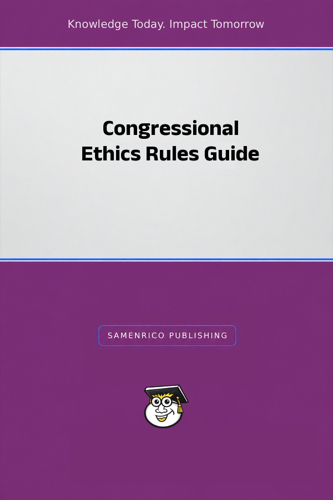
Congressional Ethics Rules Guide eBook
Navigate gift restrictions financial disclosure an
by Penny Jay
Navigate gift restrictions financial disclosure and conduct rules for House and Senate members.
Formats
Free sample
Chapter 1: The Public Trust Paradox...-- The first thing you need to understand about congressional ethics is that almost nothing you believe about them is technically true. Not the headlines screaming about corruption, not the think pieces calling for reform, and certainly not the common wisdom that "they're all criminals who should be in jail." The reality is far more nuanced, far more frustrating, and ultimately far more revealing about how power actually operates in Washington. This chapter establishes the foundation upon which every subsequent rule, restriction, and loophole is built: the constitutional origins of congressional ethics, the historical evolution from the Post-Watergate reforms to the STOCK Act, the critical distinction between what is criminal and what is merely unethical, and the structural realities of the two committees that decide whether a member faces consequences or quietly continues serving. By the time you finish this chapter, you will understand why Congress has no central ethics office, why bribery prosecutions are so rare, and why the phrase "it's not illegal" is the most damning indictment of the system imaginable.The Foundational Question: Why Does Congress Police Itself?The United States Constitution says almost nothing about congressional ethics. Read it carefully.
Article I, Section 5 grants each chamber the authority to "punish its members for disorderly behavior" and, with a two-thirds vote, to expel a member. That is the entire textual foundation. There is no independent ethics commission, no constitutional provision for a congressional inspector general, no requirement that members disclose their finances, and certainly no ban on insider trading. The Framers, for all their brilliance, assumed that elected representatives would be restrained primarily by the ballot box, not by a code of conduct.That assumption lasted approximately 150 years before it became laughably inadequate.For most of American history, congressional ethics was a matter of personal honor and occasional scandal. A member caught taking a bribe might be expelled, but more often than not, the matter was left to voters.
The first major ethics legislation—the Federal Corrupt Practices Act of 1925—focused on campaign finance disclosure, not personal conduct. It was not until the 1960s that Congress began to codify formal ethics rules, and not until the 1970s that the post-Watergate reforms created the basic architecture that still exists today.The Ethics in Government Act of 1978 was the turning point. Passed in the aftermath of Nixon's resignation and a series of corruption scandals involving members of both parties, the Act required for the first time that all three branches of government—executive, legislative, and judicial—file public financial disclosure reports. It created the Office of Government Ethics to oversee executive branch employees. And it explicitly exempted Congress from that office's jurisdiction, leaving each chamber to enforce its own rules through its own committees.This exemption is not an accident.
It is not a loophole. It is a deliberate constitutional choice that reflects the separation of powers. The executive branch has a single, centralized ethics authority because the President is a single, centralized executive. Congress, by contrast, is a co-equal branch with its own internal governance mechanisms. In theory, this arrangement respects the constitutional balance.
In practice, it means that members of Congress are judged by their peers—people who may sit next to them on the dais, share a ride to the airport, or rely on their vote for committee assignments.The result is what political scientists call the "fox guarding the henhouse" problem, and it is the single most important fact to internalize before reading any other chapter of this book. The rules exist. They are detailed, specific, and often strict. But the enforcement of those rules depends entirely on the willingness of 12 House members (six from each party) or six Senators (three from each party) to investigate, sanction, and potentially expel a colleague. That willingness varies dramatically depending on the political climate, the severity of the alleged violation, and the partisan implications of taking action.The Evolution: From Honor System to the STOCK Act The decades following the Ethics in Government Act saw a slow, often reluctant expansion of congressional ethics rules, driven almost entirely by scandal.In 1989, the Ethics Reform Act imposed the outside earned income cap (discussed in detail in Chapter 7) and banned honoraria—payments for speeches and appearances—that had become a common way for members to supplement their salaries.
The driving force was the "Keating Five" scandal, in which five Senators were accused of improperly intervening with federal regulators on behalf of savings and loan executive Charles Keating, who had made substantial campaign contributions to each of them. The Senate Ethics Committee investigated for nearly two years, ultimately issuing what amounted to a slap on the wrist to four of the five members. The public outrage was intense, but no one went to jail and no one was expelled.In 1995, the House adopted new gift rules that tightened restrictions on what members could accept from lobbyists and other private parties. The Senate followed with similar rules in 1996. These reforms were triggered by a series of exposés revealing that members routinely accepted free meals, tickets, travel, and even personal services from lobbyists seeking access and influence.
The rules established the $50-per-occasion and $100-annual-aggregate limits that remain in effect today, with the critical addition of an absolute ban on gifts from registered lobbyists and foreign agents.In 2007, in the wake of the Jack Abramoff lobbying scandal—in which a superlobbyist was convicted of fraud, tax evasion, and conspiracy to bribe public officials—Congress created the Office of Congressional Ethics (OCE). The OCE was designed as an independent, non-partisan entity that would screen ethics complaints against House members and recommend investigations to the House Ethics Committee. It was a significant reform because it removed some of the political discretion from the initial complaint review process. However, as Chapter 10 explains in detail, the OCE has no subpoena power, and the House Ethics Committee remains free to ignore its recommendations. In practice, the OCE has been effective at identifying lower-level violations but has rarely succeeded in pushing the Committee to act against powerful members.The most recent major reform is the Stop Trading on Congressional Knowledge (STOCK) Act of 2012.
The STOCK Act was passed amid public outrage over a "60 Minutes" report revealing that members of Congress had profited from non-public information obtained through their official duties—for example, selling healthcare stocks before a committee vote that would negatively impact the industry, or buying defense stocks before a contract announcement. The Act explicitly prohibited insider trading by members and staff and required expedited reporting of stock transactions within 45 days. As Chapter 6 details, the STOCK Act has been violated repeatedly, with fines imposed on dozens of members, but no member has ever been criminally prosecuted under its provisions.This historical pattern—scandal, reform, violation, weakened enforcement, new scandal—is not a bug in the system. It is the system. The rules are written by the people they govern, enforced by the people they govern, and amended by the people they govern.
Every restriction represents a compromise between the ideal of public service and the reality of political self-preservation.The Critical Legal Distinction: Bribery vs. Illegal Gratuities Before we proceed any further, you must understand…
This is the end of the free sample. Get the eBook to keep going. Buy now
About this book
Details
- Author
- Penny Jay
- Publisher
- SamEnrico
- Language
- English
- Genre
- Non-Fiction, Biography, Legal Ethics
- Released
- 2026-06-08
- Pages (approx.)
- 147
- Available as
- eBook, Audiobook

Read better in the ZLOADR app
Your eBooks on your phone or tablet. Sign in with your SamEnrico account and start reading.
More by Penny Jay
 Double Depression Treatment GuidePenny Jay$11.99
 WeChat Moments Comparison CurePenny Jay$11.99
 Family Liaison in Executive Abduction GuidePenny Jay$11.99
 Gleason Score Interpretation ManualPenny Jay$11.99
 The Atlantic’s Silent Pioneers: How Cold War Submarines Launched AI’s First LeapPenny Jay$11.99
 Glitch in the System: The 2000 Election Night That Almost Broke AmericaPenny Jay$11.99
 China Library and Study SpacesPenny Jay$12.99
 Labor Strike Contingency PlanPenny Jay$12.99
 Understanding Congenital Herpes SimplexPenny Jay$17.99
 Principal Electrical EngineerPenny Jay$11.99
 How to Become a Cd-storage-and-materials Make-up HelperPenny Jay$11.99
You may also like
 Hong Kong Handover 1997Dunn Johnnie$11.99
 Zumba For Postnatal Recovery CourseNeal Christian$11.99
 Zumba for BeginnersLadner Nikia$11.99
 YouTube Comment Mining GuideHumes Pandora$12.99
 Worry Box MeditationCarlin Rudy$11.99
 Workplace Stress MeditationNguyen Lynn$11.99
 Workplace Stress and Sleep RepairHawley Ivory$11.99
 Workplace Perfectionism CureDelaney Jeffry$11.99
 Workplace Injustice Anger GuideWallen Isabelle$11.99
 Work Addiction and Burnout LinkGreenwood Ester$11.99
 Women in Yoga and WellnessBeattie Galina$11.99
 Women in Stand Up ComedyChun Evangeline$11.99