
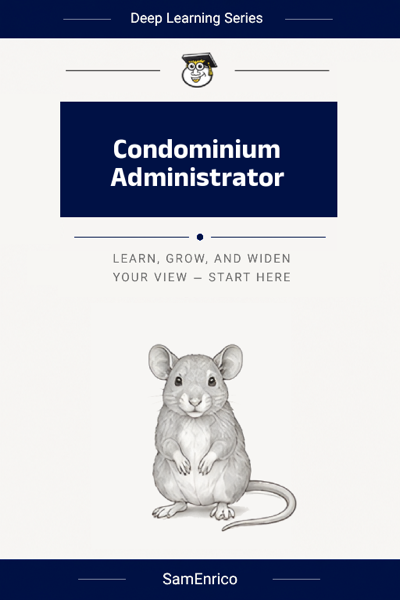
Non-FictionInformativeEducational
Condominium Administrator eBook
A Coursebook on Condominium Administrator
A Coursebook on Condominium Administrator
Formats
Free sample
Chapter 1: The Roof Crumbles at 2AM...--– The phone rang at 1:47 on a Tuesday morning. On the other end, a board president named Margaret spoke in the flat, exhausted tone of someone who had already cried and moved on to resignation. “The ceiling in the penthouse hallway just collapsed,” she said. “Water is pouring down four floors. The elevator shaft sounds like a waterfall.
I called the property manager. He didn’t answer. I called the emergency maintenance line. It went to a voicemail box that hasn’t been set up yet. So I’m calling you because someone said you wrote a book about this nightmare.
What do I do?”What Margaret did not know, as she stood in six inches of water in her bathrobe, was that her condominium had been dying for twelve years. The roof had exceeded its expected life by seven years. The reserve fund contained less than five percent of what a proper replacement would cost. The board had voted every year to keep monthly assessments flat, congratulating themselves on being “owner-friendly” while the building quietly rotted. Three different administrators had come and gone, each one warning about the roof, each one ignored or fired for being “too negative.” And now, at 2AM, physics had delivered the final invoice.This is not a story about a roof.
It is a story about systems, incentives, and the slow catastrophe of mismanaged common property. It is also the reason you are holding this book.If you are reading these words, you are likely one of three people. First, you might be a condominium administrator – a professional manager or managing agent who has inherited a building in some stage of distress, and you need to know not just what to do, but why you are doing it. Second, you might be a board member – an owner who volunteered for what seemed like a simple job, only to discover that you are now personally responsible for millions of dollars of other people’s assets. Third, you might be a unit owner who has realized, perhaps after a special assessment or a hallway collapse of your own, that your fate is tied to decisions made by people you have never met.Whoever you are, welcome.
This chapter pulls back the curtain on the ecosystem of the condominium – not as a legal abstraction, but as a living, breathing, often dysfunctional organism. By the time you finish, you will understand how condominiums differ from other forms of ownership, who the critical players are, why the shift from tenant to owner-stakeholder is the single most important psychological leap you will ever make, and how to spot the warning signs of a building that is headed toward its own 2AM phone call.The Global Experiment That Changed How We Live The condominium is a surprisingly recent invention. For most of human history, you either owned a free-standing house on its own plot of land, or you rented from someone who owned the entire building. Shared ownership of individual units within a larger structure was legally impossible in many jurisdictions until the middle of the twentieth century.Modern condominium law originated in the Mediterranean. In the 1960s, a French legal scholar named André Chadeau developed the concept of la copropriété, which separated ownership of individual living spaces from joint ownership of common areas.
The idea spread quickly to Spain, Italy, and Greece, where post-war reconstruction demanded dense urban housing but individual freeholds were impractical. The legal innovation was simple but profound: create a form of ownership where you could buy and sell your individual unit like a house, but you were legally required to contribute to the maintenance of the roof, the hallway, the elevator, and the garden.North America adopted the model in the early 1960s. The first modern condominium in the United States was a courtyard building in Salt Lake City, completed in 1961 under a new federal law that enabled FHA-insured mortgages for condominium units. Florida followed immediately, as developers realized they could sell individual beachfront units to snowbirds while retaining no long-term maintenance responsibility. By the 1970s, condominiums had exploded across every major metropolitan area.
Singapore built its first public housing condominiums in the 1980s under the Strata Titles Act, creating a model now replicated across Southeast Asia. Dubai, Hong Kong, Toronto, Sydney, London – every global city with land constraints eventually embraced the condominium as the default form of middle-class urban ownership.Today, more than seventy million Americans live in community associations, the majority of them condominiums. In Florida, condominiums represent more than thirty percent of all housing units. In Singapore, the figure exceeds eighty percent for new construction. Condominium administration is no longer a niche profession; it is a core competency of modern urban life.And yet, most people enter this world knowing nothing about it.The Three Forms of Shared Ownership: A Critical Distinction Before we go any further, we need to clear up a confusion that causes disasters.
Not every shared-ownership building is a condominium. The legal structure matters enormously for who owns what, who pays for what, and what happens when things go wrong.Condominium. A condominium is a form of ownership where you own your individual unit – the airspace within your walls – as a fee simple interest, the same as a house. The unit is your private property. You can mortgage it, sell it, leave it to your heirs, and remodel the interior (subject to governing documents).
The common areas – hallways, roofs, lobbies, elevators, pools, parking garages, landscaping – are owned jointly by all unit owners as tenants in common. You cannot mortgage your share of the roof separately; it is inseparable from your unit ownership. This is the model we will focus on throughout this book.Cooperative. In a cooperative, you do not own your unit at all. Instead, you own shares in a corporation that owns the entire building.
Your occupancy rights come from a proprietary lease attached to your shares. The cooperative corporation holds the master mortgage for the entire building, so if your neighbor stops paying their share of the mortgage, the entire building is at risk. Cooperatives are common in New York City and a few other dense urban markets, but they are less common elsewhere. The key difference from a condominium: in a cooperative, the board has enormous power to reject potential buyers, and your equity is tied to the corporation’s overall financial health, not just your unit.Planned Community (Homeowners Association). A planned community, often called a homeowners association or HOA, applies to detached houses or townhouses where each owner owns their lot and their structure, but a shared association owns and maintains common amenities – a pool, a clubhouse, a private road, a gate.
The difference from a condominium: in a planned community, you typically own the land under your house. In a condominium, you do not own the land; you own an undivided share of the land with all other unit owners.Why does this distinction matter for an administrator? Because the legal duties, insurance requirements, maintenance responsibilities, and enforcement mechanisms differ significantly. A condominium administrator must worry about the structural integrity of shared walls, floors, and ceilings…
This is the end of the free sample. Get the eBook to keep going. Buy now
About this book
Details
- Author
- Isaacs Yevette
- Publisher
- SamEnrico
- Language
- English
- Genre
- Non-Fiction, Informative, Educational
- Released
- 2026-05-06
- Pages (approx.)
- 160
- Available as
- eBook, Audiobook

Read better in the ZLOADR app
Your eBooks on your phone or tablet. Sign in with your SamEnrico account and start reading.
More by Isaacs Yevette
 Teen Social Media ContractIsaacs Yevette$11.99
 Stress Tremor GuideIsaacs Yevette$11.99
 Lying Pelvic Floor RoutineIsaacs Yevette$11.99
 Olive Oil Daily LongevityIsaacs Yevette$11.99
 The Weight Loss Sleep Apnea GuideIsaacs Yevette$11.99
 The Maroon Corsairs: The Untold Saga of the African Privateers of the Indian OceanIsaacs Yevette$11.99
 US Bank Account for Foreign LLCIsaacs Yevette$12.99
 Cape Town Tech TalentIsaacs Yevette$12.99
 The Breeder's Guide to Caspian HorsesIsaacs Yevette$11.99
 How to Start a Beauty Learning Business (Beginners Guide)Isaacs Yevette$11.99
You may also like
 Hong Kong Handover 1997Dunn Johnnie$11.99
 Zumba For Postnatal Recovery CourseNeal Christian$11.99
 Zumba for BeginnersLadner Nikia$11.99
 YouTube Comment Mining GuideHumes Pandora$12.99
 Worry Box MeditationCarlin Rudy$11.99
 Workplace Stress MeditationNguyen Lynn$11.99
 Workplace Stress and Sleep RepairHawley Ivory$11.99
 Workplace Perfectionism CureDelaney Jeffry$11.99
 Workplace Injustice Anger GuideWallen Isabelle$11.99
 Work Addiction and Burnout LinkGreenwood Ester$11.99
 Women in Yoga and WellnessBeattie Galina$11.99
 Women in Stand Up ComedyChun Evangeline$11.99