
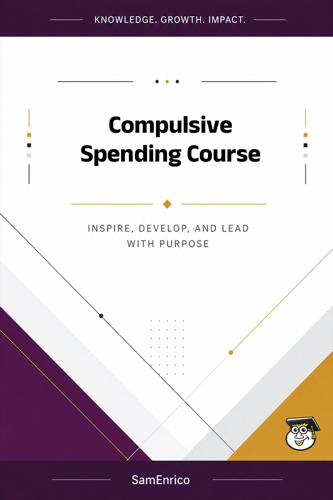
Compulsive Spending Course eBook
A 8-week program to break the buy-remorse cycle an
A 8-week program to break the buy-remorse cycle and rebuild financial health.
Formats
Free sample
Chapter 1: The Inventory of Shame--–- The package arrived on a Tuesday. You didn't need it. You didn't even want it, not really. But three days earlier, at 11:47 PM, alone in bed with your phone's blue light burning into your retinas, it had seemed essential. The confirmation email felt like a victory.
The box on your doorstep felt like an accusation. You hid it in the back of your closet, telling yourself you would return it. You never did. This is where the cycle begins: not with the purchase, but with the hiding. And the hiding is where the shame lives.Every compulsive spending cycle follows the same arc.
First, the trigger—boredom, anxiety, loneliness, envy, or that dangerous electric buzz of excitement. Second, the rush—the moment of clicking "buy now," the dopamine hit that feels like relief. Third, the arrival—the package, the receipt, the item that never looks as good as it did on the screen. Fourth, the remorse—the sick feeling in your stomach, the calculation of how many hours of work this cost, the dread of the credit card statement. Fifth, the hiding—the item shoved into a closet, the receipt thrown away, the lie told to a partner or to yourself.
And sixth, the forgetting—until the next trigger, when the whole ugly cycle begins again.This book exists to break that cycle. Not to shame you for it—you have already done enough of that to yourself—but to give you a set of tools, practices, and accountability structures that interrupt the loop at every stage. The cycle did not appear overnight, and it will not disappear overnight. But it can be broken. It has been broken by thousands of people before you, people who felt exactly as you feel right now: exhausted, confused, a little bit afraid, and deeply tired of the secret weight of their own spending.The first step, paradoxically, is not to stop spending.
The first step is to start counting.The Paradox of Clarity Here is a truth that sounds like a lie: shame thrives in vagueness. When you say to yourself, "I spent too much money last month," the statement is so broad, so foggy, so lacking in specific detail that it becomes a weapon against you. "Too much" could mean ten dollars or ten thousand. "Last month" blurs into every other month. The shame attaches itself to a ghost—and you cannot fight a ghost.But data?
Data has edges. Data has numbers. Data has dates and times and categories. You cannot argue with data. And more importantly, you cannot hide from data.
When you know, with precision, that you spent $47.23 on coffee refills in a single week, that number is not shameful. It is simply information. It tells you something about your behavior. It does not tell you anything about your worth as a human being.This is the paradox that drives the entire 8-week program: clarity dissolves shame. The more specific your knowledge of your spending, the less power that spending has over you.
Vague guilt keeps you stuck. Precise awareness sets you free.Think of it this way. If a friend told you, "I feel terrible because I ate badly yesterday," you might nod sympathetically. But you could not help them change. If the same friend said, "I ate 800 calories of potato chips at 10 PM while watching television, and I wasn't even hungry—I was bored," now you have something to work with.
Now you can ask: What were you feeling at 10 PM? What could you do instead of eating chips? The specificity opens the door to change.Your spending is no different. The Inventory of Shame is not about making you feel worse. It is about making you see clearly.
And seeing clearly is the first step toward seeing differently.Week 1: The 7-Day Spending Audit Here is your only task for the first seven days of this program. It is simple to describe and difficult to do. Track every single penny that leaves your possession for seven consecutive days.Not most of your spending. Not the big purchases. Every penny.
The $1.07 credit card fee. The $0.99 app subscription you forgot about. The $4.50 coffee you bought while telling yourself it was your last one. The $12.99 late fee on a bill you could have paid on time. The $30 in cash you pulled from the ATM and cannot remember where you spent.
The candy bar at the gas station. The parking meter. The $2 donation at the grocery store checkout that you made out of social pressure. All of it.You will record each transaction in a notebook, a spreadsheet, or a note-taking app. The format does not matter.
What matters is the completeness. At the end of each day, you will sit down—no matter how tired, no matter how much you do not want to—and you will write down everything you spent.Here is the most important instruction, and I want you to read it three times: There is no judgment in this audit. You are not trying to spend less. You are not trying to feel bad. You are not evaluating whether each purchase was "good" or "bad." You are simply gathering data, the way a scientist gathers data before forming a hypothesis.
You cannot judge your way into change. You can only see your way there.Most people who begin this exercise feel a powerful resistance around Day 3 or Day 4. They want to stop. They tell themselves they have "the general idea" already. They feel the shame rising and want to put the notebook away.
This resistance is not a sign that you are doing something wrong. It is a sign that you are doing something right. The shame wants you to stay vague. The shame wants you to stop looking. The shame is afraid of the light.
Keep going.How to Track Without Losing Your Mind For readers who have never tracked their spending before, the prospect can feel overwhelming. Here is a simple, three-column system that has worked for thousands of people:Date Amount Category Notes Mon, Day 1$4.50Coffee Work commute, bought out of habit Mon, Day 1$12.99Subscription Audible, forgot to cancel Mon, Day 1$67.23Groceries Actual needed food Tue, Day 2$0—No-spend day (unplanned but welcome)The "Notes" column is optional for Week 1, but I strongly encourage you to use it. Write down one thing: how you were feeling at the moment of purchase. Bored? Anxious?
Tired? Excited? Lonely? This emotional data will become crucial in Chapter 5, but even in Week 1, it starts training you to notice the connection between your inner state and your outer spending.For cash spending, the tracking is harder because there is no digital record. Here is a trick that works: take a photograph of every cash bill in your wallet at the start of each day.
At the end of the day, photograph what remains. The difference is what you spent. Or, even simpler, commit to using only your debit card for Week 1—not because credit is bad, but because it leaves a trail. For this single week, make it easy on yourself.What about subscriptions and automatic payments? Include them.
They are spending, even if you did not actively "decide" to spend in that moment. The automatic $9.99 to a…
This is the end of the free sample. Get the eBook to keep going. Buy now
About this book
Details
- Author
- Stanford Robby
- Publisher
- SamEnrico
- Language
- English
- Genre
- Non-Fiction, Self-Help / Course
- Released
- 2026-06-08
- Pages (approx.)
- 136
- Available as
- eBook, Audiobook

Read better in the ZLOADR app
Your eBooks on your phone or tablet. Sign in with your SamEnrico account and start reading.
More by Stanford Robby
 Food Addiction and Dopamine FastingStanford Robby$11.99
 Caregiving For Estranged ParentStanford Robby$11.99
 Small Talk for Jury DutyStanford Robby$11.99
 The Anger and Attachment GuideStanford Robby$11.99
 Blushing Anxiety GuideStanford Robby$11.99
 Titanic Lifeboat DavitsStanford Robby$11.99
 Whistleblower Conversation GuideStanford Robby$11.99
 The Tsars' Grandeur: Russia's Golden Age of Culture and PowerStanford Robby$11.99
 Mastering The Art of Wing Tsun (詠春)Stanford Robby$11.99
 How to Start a Economist Business (Beginners Guide)Stanford Robby$11.99
 How to Produce Hockey Stick PartsStanford Robby$11.99
 Termination and Exit for Global FranchisesStanford Robby$12.99
You may also like
 Meditation Pain CourseEspinosa Pennie$11.99
 Anger Cognitive Restructuring CourseWillett Nevada$11.99
 Resilience Training CourseWoodson Hulda$11.99
 Pattern Recognition CourseMcgrath Malena$11.99
 Memory Chunking CourseDeleon Noel$11.99
 Anticipatory Grief CourseOlson Becky$11.99
 Spouse Grief CourseAguiar Charlette$11.99
 Memory Palace CourseDahl Edgardo$11.99
 Scripting Your Own HypnosisAtwell Wenona$11.99
 Child Bereavement CourseAhrens Mertie$11.99
 Assertiveness Training CourseCupp Luciano$11.99
 Aggressive Driving CourseGoodwin Natasha$11.99