
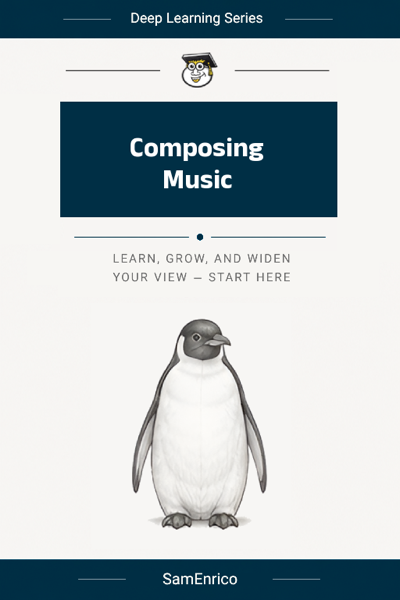
Composing Music Audiobook
A Coursebook on Composing Music
A Coursebook on Composing Music
Formats
Free sample
Chapter 1: The Constraint Paradox--Every beginner composer sits down with a blank page and feels the same vertigo. You have twelve pitches, infinite rhythms, every instrument ever devised, and the entire history of music as your palette. That freedom should feel exhilarating. Instead, it feels like paralysis. Where do you even start?
The answer, counterintuitively, is to close most of those doors. This chapter argues that unlimited freedom is the enemy of creativity, that deliberate limitations are not a crutch but a wingsuit, and that the most original music often emerges from the strictest rules. You will learn to reframe constraints as creative fuel, develop the practice of inner hearing, establish a daily sketchbook habit, and understand how this entire coursebook will transform you from someone who dreams about composing into someone who finishes pieces. Welcome to the paradox: your prison will set you free.The Myth of Infinite Possibility Most people believe that creativity requires absolute freedom. They imagine the composer as a lone genius waiting for a lightning bolt of inspiration, unburdened by rules or restrictions.
This is a seductive fantasy, and it is almost entirely wrong. Look at the actual working practices of history's most inventive composers. Bach gave himself the constraint of writing a complete cantata every week for two years while working a full-time job. Stravinsky forced himself to compose within the tiny, rigid cells of octatonic scales. Miles Davis told his band members what notes they could not play.
John Williams builds entire film scores around one or two thematic intervals. The pattern is unmistakable: the masters thrive on limits.Why does this work? Because your brain, confronted with an infinite horizon, must evaluate an infinite number of possibilities before making any decision. That evaluation is exhausting. It triggers anxiety, second-guessing, and the dreaded blank page stare.
A constraint reduces the search space. Instead of asking "what pitch should come next?" you ask "what pitch from these three allowed pitches should come next?" The decision becomes lighter, faster, and paradoxically more creative because you must work harder to make those few materials interesting. You stop worrying about missing the "perfect" note and start playing with the notes you have.Consider a simple experiment. Try to improvise a melody using all twelve pitches of the chromatic scale. Go ahead.
You will likely produce aimless, slippery lines that lack direction. Now try improvising a melody using only the five black…
This is the end of the free sample. Get the Audiobook to keep going. Buy now
About this book
Details
- Author
- Stacy Georgetta
- Publisher
- SamEnrico
- Language
- English
- Genre
- Non-Fiction, Informative, Educational
- Released
- 2026-05-06
- Pages (approx.)
- 151
- Available as
- eBook, Audiobook

Listen in the VoxFlicks app
Audiobooks and audio dramas wherever you go. Sign in with your SamEnrico account and press play.
More by Stacy Georgetta
 The Incremental Progress GuideStacy Georgetta$11.99
 Biomedical Engineering CreativityStacy Georgetta$11.99
 Forgiving an Absent ParentStacy Georgetta$11.99
 Digital Detox for Addiction RecoveryStacy Georgetta$11.99
 The France Salary Negotiation GuideStacy Georgetta$11.99
 The Siege of Chittorgarh: Akbar's Unyielding FortressStacy Georgetta$11.99
 Understanding Trophoblastic TumorStacy Georgetta$17.99
 VAT Invoice RequirementsStacy Georgetta$12.99
 African Marketplace YC GuideStacy Georgetta$12.99
 How to Become a Pipe-organ BuilderStacy Georgetta$11.99