
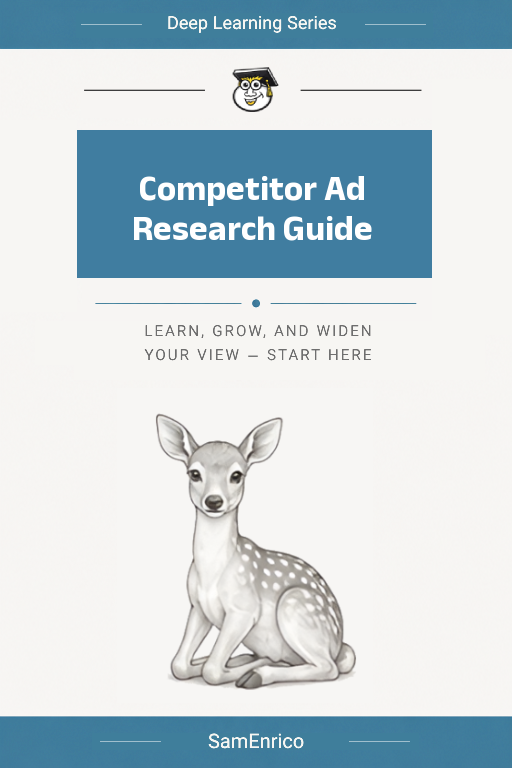
Competitor Ad Research Guide eBook
Researches competitor Facebook ads before launchin
by Head Tabatha
Researches competitor Facebook ads before launching first campaign using Facebook Ad Library for inspiration.
Formats
Free sample
Chapter 1: The 30-Day Signal--–- Most first-time Facebook advertisers believe their biggest problem is a lack of budget. They save up three thousand, five thousand, or ten thousand dollars, convinced that if they could just spend more, they would finally see results. The painful truth is that budget was never the bottleneck. The real killer of new ad accounts is not insufficient funds—it is guessing. Guessing which image will stop the scroll.
Guessing which headline will earn a click. Guessing which offer will convert a skeptic into a customer. And when those guesses fail, as they almost always do, the advertiser blames the product, the platform, or the algorithm. But the algorithm was never the problem. The problem was flying blind in a market that already publishes its winning playbook for free, every single day, on a website run by the largest social media company in the world.The Facebook Ad Library launched in 2019 as a response to the Cambridge Analytica scandal.
Initially designed for political ad transparency, Meta quickly expanded it to cover all active advertisements across Facebook, Instagram, Messenger, and Audience Network. What emerged was accidental gold for competitors. For the first time in digital advertising history, you could search for any brand, in any country, and see every single ad they were currently running. You could see the creative, the copy, the call-to-action button, and—most critically—the date the ad started running. That date is the key that unlocks everything.
It turns a chaotic ocean of random advertisements into a structured dataset of market-tested, profit-validated signals.This chapter introduces the single most important concept in this entire book: the 30-Day Signal. An advertisement that has survived on Facebook for thirty days or more is not just another creative. It is a proven asset that has cleared every major hurdle the platform places in front of advertisers. It has survived the learning phase, where Facebook’s delivery system explores different audiences to find the cheapest conversions. It has survived creative fatigue, where the same visual shown to the same person too many times stops working.
It has survived competition from every other brand bidding for the same attention. And most importantly, it has survived the advertiser’s own financial scrutiny—someone, somewhere, looked at the return on ad spend for that creative and decided to keep paying for it, day after day, week after week, while other ads around it were paused, killed, or forgotten.The 30-Day Signal is worth more than a Super Bowl commercial. A Super Bowl spot costs seven million dollars for thirty seconds of airtime. It reaches a massive audience, yes, but it reaches them exactly once, in a context where most viewers are in the kitchen getting snacks. A Facebook ad that has run for thirty days, by contrast, has been tested against real human behavior in the natural environment of the social media feed.
It has been scrolled past, ignored, clicked, commented on, and shared. Every single metric that matters—click-through rate, cost per mille, cost per purchase, return on ad spend—has been recorded and analyzed by the advertiser running it. And they decided to keep it alive. That decision is the closest thing to a guarantee that you will ever get in marketing.But the 30-Day Signal is also easy to misinterpret. Beginners see a competitor’s ad that has been running for sixty days and immediately assume they should copy it verbatim.
This is the Copying Trap, and it fails for three reasons. First, the competitor has built brand equity over months or years that you do not have. Their logo, their color scheme, their spokesperson—these carry trust that your new brand cannot replicate overnight. Second, the competitor may be running that ad as a retargeting asset, shown only to people who have already visited their website. When you copy that ad and show it to cold audiences who have never heard of you, it will bomb.
Third, even if the ad is working for them, the exact same creative may be nearing the end of its natural life. By the time you launch your copy, their audience may already be fatigued, and yours may be seeing an ad that looks stale and derivative.The alternative to copying is what this book calls Market Signal Analysis. You do not steal the ad. You read the signal. The 30-Day Signal tells you that a particular hook archetype is working in your market.
It tells you that a particular visual density—the ratio of polished stock photos to raw user-generated content—is resonating. It tells you that a particular emotional tone, whether trust, urgency, or excitement, is driving action. And because you have collected signals from ten or fifteen competitors, not just one, you can see patterns that would be invisible if you only looked at a single successful ad.Consider a concrete example. You sell leather bags. You search the Facebook Ad Library for competitors and find fifteen brands in your price range.
You sort their ads by start date and filter out anything running less than thirty days. Now you are looking at only the proven winners. You notice that ten of those fifteen brands are using the same hook archetype: the Problem Agitator. “Tired of bags that fall apart after six months?” “Does your laptop bag hurt your shoulder?” “Stop throwing away money on cheap leather.” This is a signal. It tells you that the market responds to pain-point messaging more than lifestyle aspirations.
You also notice that the five brands not using that archetype have significantly lower visual density—they rely on stock photos of models holding pristine bags in perfect lighting, while the ten winners use user-generated content of real bags on subway cars, in rain, stuffed with groceries. Another signal. Visual density correlates with longevity. You also notice the tone. The winners lean heavily into Trust—close-up shots of stitching, videos of the manufacturing process, guarantees written in plain language.
The losers lean into Excitement—celebrity endorsements, flashy colors, aspirational copy about luxury. The market has spoken. Trust beats Excitement for leather bags at your price point.None of this analysis required you to copy a single word of competitor copy. You did not steal their headline or rip their video. You read the signals they were paying to send, and you synthesized those signals into a creative brief for your own designer.
That is the difference between a competitor ad research guide that teaches spying and one that teaches strategy. Spying asks, “What are they doing?” Strategy asks, “What does their behavior tell us about what works?”The Facebook Ad Library is uniquely suited to this kind of signal analysis because it removes the noise of self-reported data. Traditional competitive intelligence tools—surveys, focus groups, third-party data providers—all suffer from the same fatal flaw: they ask people what they think they want. The Ad Library shows you what people have paid to put in front of other people’s eyes. There is no gap between stated preference and revealed preference.
Every active ad represents a real dollar bid in a real-time auction. If an ad has run for thirty days…
This is the end of the free sample. Get the eBook to keep going. Buy now
About this book
Details
- Author
- Head Tabatha
- Publisher
- SamEnrico
- Language
- English
- Genre
- research, First 30 Days
- Released
- 2026-05-28
- Pages (approx.)
- 117
- Available as
- eBook, Audiobook

Read better in the ZLOADR app
Your eBooks on your phone or tablet. Sign in with your SamEnrico account and start reading.
More by Head Tabatha
 Stress Nervous System GuideHead Tabatha$11.99
 View vs Value MindsetHead Tabatha$11.99
 Pregnancy Pelvic Floor PrepHead Tabatha$11.99
 Goat Milk And Cheese BenefitsHead Tabatha$11.99
 The Purpose Driven Team GuideHead Tabatha$11.99
 The Djinn of the Empty Quarter: Whispers from the DunesHead Tabatha$11.99
 How to Start a Body for Car Business (Beginners Guide)Head Tabatha$11.99
 Clinical Lab ScientistHead Tabatha$11.99
 African Startup Hubs RankedHead Tabatha$12.99
 The Breeder's Guide to Buckeye ChickensHead Tabatha$11.99
You may also like
 Scientific Research On TM GuideMartens Nathanial$11.99
 Research Proposal Methodology Section MasteryPauley Debroah$11.99
 Research Proposal Appendix CompilationRaines Tyisha$11.99
 Academic Researcher Distraction GuideFord Virgil$11.99
 TM Research and ScienceCovert Nicki$11.99
 Social Anxiety Research ReviewRoberge Cole$11.99
 Research Proposal Significance Section GuideBock Tory$12.99
 Research Proposal Reviewer PsychologyLugo Tawanda$11.99
 Research Proposal Research Questions DesignLara Robbi$11.99
 Research Proposal References and CitationsPatten Shanice$11.99
 Research Proposal Mixed Methods DesignCameron Omega$11.99
 Research Proposal Data Management PlanAnderson Roberto$12.99