
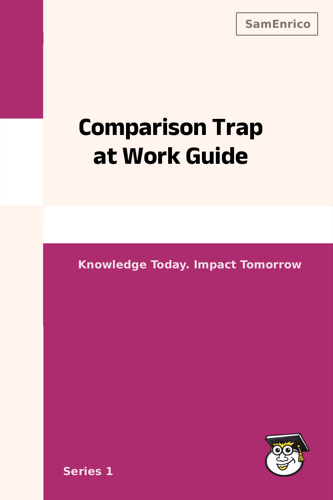
Non-FictionSelf-HelpSocial Comparison
Comparison Trap at Work Guide eBook
Stop measuring yourself against colleagues' achiev
by Hogue Nydia
Stop measuring yourself against colleagues' achievements and salaries.
Formats
Free sample
Chapter 1: The Invisible Scoreboard--–- The first time I realized I was losing a competition I never agreed to enter, I was standing in a breakroom, holding a cold cup of coffee, staring at a spreadsheet on a colleague’s screen. It wasn’t my spreadsheet. It wasn’t my project. But there, in column G, was a number that undid six months of contentment in less than three seconds. Her bonus percentage was 4.2 points higher than mine.
I didn’t know her output. I didn’t know her hours. I didn’t know that she had quietly taken on a client no one else wanted. All I knew was the number—and suddenly, my own bonus, which had felt generous that morning, looked like a consolation prize.That moment was not about money. It was about measurement.
Without any conscious decision, I had pulled up an invisible scoreboard that lives in every workplace, runs on every human brain, and almost never produces happiness. That scoreboard is the subject of this book. And before we can dismantle it, we have to see it for what it is.The Anatomy of an Involuntary Habit Comparison is not a character flaw. It is not a sign of insecurity, weakness, or poor parenting. Comparison is a neurological and social survival mechanism that evolved long before corporations, promotions, or quarterly reviews existed.
Leon Festinger, a social psychologist, formalized this in 1954 with his Social Comparison Theory. Festinger argued that in the absence of objective standards—and the workplace is full of ambiguity disguised as metrics—human beings evaluate themselves by comparing themselves to others. We do this automatically. We do this constantly. And we do this even when it harms us.Your brain is running prehistoric software in a modern office.
Thousands of years ago, comparing yourself to your neighbor told you whether you had enough food, whether your shelter was secure, and whether your status in the tribe would protect you from harm. Those comparisons kept you alive. Today, that same neural circuitry fires when you see a colleague’s promotion announcement on Slack. Your brain cannot tell the difference between a status threat that could exile you from the tribe and a status threat that involves a slightly larger office with a window. To your limbic system, they are identical.This is why the comparison trap feels involuntary.
It is. You did not choose to glance at that spreadsheet. You did not choose to feel your stomach drop when someone mentioned a peer’s raise. Those reactions are hardwired. But what happens next—whether you spiral into self-doubt or file the information as neutral data—is within your control.
The goal of this book is not to eliminate comparison. That would be like trying to eliminate breathing. The goal is to recognize when the trap has sprung and to build a reliable escape route.Healthy Competition Versus Toxic Comparison Before we go any further, we need to draw a line that will serve as the spine of this entire book. Not all comparison is bad. In fact, some comparison is essential for growth.
The distinction is between healthy competition and toxic comparison.Healthy competition is upward comparison that inspires skill-building in discrete, low-stakes domains. When you see a colleague write cleaner code, close a deal faster, or give a more compelling presentation, and your response is “I want to learn how to do that,” you are using comparison as fuel. Healthy competition has three characteristics. First, it focuses on a specific, observable behavior—not a global judgment of worth. Second, it leads to action that improves your own capability.
Third, it ends when the skill is acquired. You do not carry a grudge. You do not tie your identity to beating them. You learn, and you move on.Toxic comparison, by contrast, is a state of self-loss where your worth becomes contingent on outranking others in domains that matter deeply to your identity and livelihood. Toxic comparison is not about learning a skill; it is about winning an un-winnable race.
It has three characteristics as well. First, it focuses on global traits rather than specific behaviors (“She is smarter than me” rather than “She prepared a better slide deck”). Second, it leads to paralysis, resentment, or performative overwork rather than genuine skill-building. Third, it has no finish line. You out-earn one colleague, and immediately find another who earns more.
You get promoted, and immediately look at the next rung. Toxic comparison is a treadmill that speeds up the more you run.The table below, which you will return to throughout this book, summarizes the distinction:Healthy Competition Toxic Comparison Focuses on specific, observable behaviors Focuses on global, unmeasurable traits Inspires skill-building and learning Inspires paralysis, envy, or burnout Ends when the skill is acquired Has no finish line; the goalposts move Leaves your self-worth intact Erodes self-worth by making it contingent on outranking others Example: “Her sales call structure is effective. I will study it.”Example: “She is a better salesperson than me. I am a fraud.”Throughout this book, when we talk about escaping the comparison trap, we are not trying to eliminate healthy competition. We are trying to starve toxic comparison of its power.
And the first step is recognizing when you have crossed the line.The Three Warning Signs Toxic comparison does not announce itself with a siren. It whispers. It normalizes. It becomes the background hum of your work life until one day you realize you cannot remember the last time you felt purely good about a colleague’s success. The following three symptoms are diagnostic.
If you recognize two of them in yourself, the comparison trap is already active in your life.The Sunday Scare Sunday afternoons are supposed to be for restoration. For the person caught in the comparison trap, Sunday afternoons are for dread. The Sunday Scare is a physical and emotional anxiety that begins sometime after lunch on Sunday and intensifies as bedtime approaches. It is not about the volume of work waiting for you—though that may contribute. The Sunday Scare is about the scoreboard.
You are not dreading tasks. You are dreading the moment on Monday morning when you will see updated dashboards, new sales figures, or a colleague’s Slack message about a project they finished over the weekend.The Sunday Scare has a specific texture: a tightness in the chest, a tendency to check work messages “just to see,” and a compulsive urge to mentally prepare a defense of your own productivity before anyone has questioned it. If Sunday afternoon feels like the calm before an ambush, you are experiencing the Scare.The Silent Resume Tally The Silent Resume Tally happens in meetings, usually while someone else is speaking. As a colleague lists their recent accomplishments—a client signed, a problem solved, a presentation delivered—you are not listening with curiosity. You are mentally tallying.
Your brain runs a silent comparison: “My list versus their list. My wins versus their wins. My velocity versus their velocity.” By the time they finish speaking, you have already assigned a winner and a loser. And you are almost never the winner.The Silent Resume Tally…
This is the end of the free sample. Get the eBook to keep going. Buy now
About this book
Details
- Author
- Hogue Nydia
- Publisher
- SamEnrico
- Language
- English
- Genre
- Non-Fiction, Self-Help, Social Comparison
- Released
- 2026-06-08
- Pages (approx.)
- 136
- Available as
- eBook, Audiobook

Read better in the ZLOADR app
Your eBooks on your phone or tablet. Sign in with your SamEnrico account and start reading.
More by Hogue Nydia
 Step Twelve Carry MessageHogue Nydia$11.99
 The EQ for Firefighters GuideHogue Nydia$11.99
 Baal Shem Tov Mystical PathHogue Nydia$11.99
 Relationship Building for LandlordsHogue Nydia$11.99
 Cross Training Creative HabitHogue Nydia$11.99
 Choosing a ChiropractorHogue Nydia$11.99
 Stress Temperature RegulationHogue Nydia$11.99
 Self Hypnosis For CodependencyHogue Nydia$11.99
 The Djinn’s Double Game: A Spy Among SpiritsHogue Nydia$11.99
 The Hippocratic Code: Ancient Greece's Medical RevolutionHogue Nydia$11.99
 How to Start a Crispbread Business (Beginners Guide)Hogue Nydia$11.99
 Bootcamp Income Share AgreementsHogue Nydia$12.99
You may also like
 Hong Kong Handover 1997Dunn Johnnie$11.99
 Zumba For Postnatal Recovery CourseNeal Christian$11.99
 Zumba for BeginnersLadner Nikia$11.99
 YouTube Comment Mining GuideHumes Pandora$12.99
 Worry Box MeditationCarlin Rudy$11.99
 Workplace Stress MeditationNguyen Lynn$11.99
 Workplace Stress and Sleep RepairHawley Ivory$11.99
 Workplace Perfectionism CureDelaney Jeffry$11.99
 Workplace Injustice Anger GuideWallen Isabelle$11.99
 Work Addiction and Burnout LinkGreenwood Ester$11.99
 Women in Yoga and WellnessBeattie Galina$11.99
 Women in Stand Up ComedyChun Evangeline$11.99