
Non-FictionMental WealthHabit Maintenance
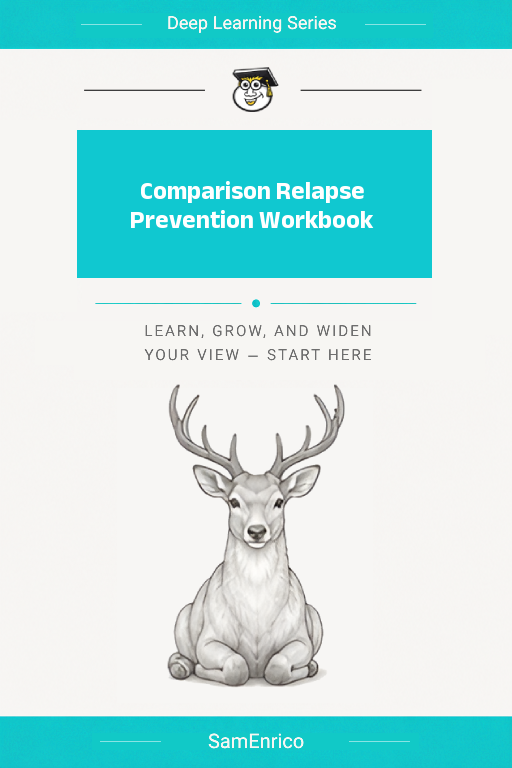
Comparison Relapse Prevention Workbook eBook
Build systems to avoid falling back into compariso
Build systems to avoid falling back into comparison habits after detox.
Formats
Free sample
Chapter 1: The Dopamine Wave--–- Three years ago, I deleted Instagram for the thirty-seventh time. Not because I wanted to be productive, not because I was making a philosophical stand against technology, but because I had just spent forty-five minutes looking at photos of a stranger’s vacation to a place I had never heard of, and I felt, quite simply, like a failure. I was not a failure. I had a good job, a loving partner, and a roof over my head. But none of that mattered in the aftermath of that scroll.
What mattered was that someone else was in a turquoise ocean while I was on a beige couch. Someone else had a better life, and I was stuck in mine.The absurdity of this realization did not stop me from reinstalling the app four days later. Nor did it stop me from repeating the cycle—delete, reinstall, delete, reinstall—for another eighteen months. I told myself I lacked willpower. I told myself I was weak, envious, and shallow.
I told myself to just stop comparing myself to others, as if that was a helpful instruction rather than the equivalent of telling someone with asthma to just breathe.It took me two years to understand something that this chapter will teach you in the next twenty minutes: the problem was never my character. The problem was my neurology. And once you understand that, the shame dissolves, and the real work can begin.Why This Chapter Matters Every workbook, every therapist, and every well-meaning friend has told you to stop comparing yourself to others. But no one has explained why it feels so compulsive. No one has told you that the same neurological machinery that keeps a smoker reaching for a cigarette or a drinker reaching for a bottle is the same machinery that keeps you reaching for your phone when you are lonely, bored, or tired.This chapter is not about motivation.
It is not about inspiration. It is about mechanism. By the time you finish reading, you will understand exactly what is happening inside your brain during a comparison spiral. You will learn the three-tier language this book uses to distinguish between a harmless glance and a full collapse. And you will be introduced to the Phased Protocol—a practical, shame-free roadmap that resolves the confusion of whether you should quit social media entirely or simply cut back.Let us begin by dismantling the single most damaging myth about comparison: that it is a choice.The Myth of Choice Imagine telling someone with a nicotine addiction that they should simply choose not to crave a cigarette.
Ridiculous, right? A craving is not a decision. It is a neurological event, as involuntary as a sneeze or a heartbeat. And yet, when it comes to social comparison, we treat it as a moral failure. You did not choose to feel inadequate after seeing your coworker’s promotion post.
You did not choose to spend twenty minutes spiraling through a former classmate’s wedding photos. These behaviors are the outputs of a well-trained neural circuit—one that has been reinforced thousands of times.This is not speculation. The research on behavioral addictions—gambling, gaming, social media use—has consistently shown that the brain’s reward system does not distinguish between a slot machine payout and a notification bell. Both deliver a small hit of dopamine, the neurotransmitter associated with anticipation and reward. Both create a craving loop.
And both leave you wanting more, not less, after the reward arrives.Here is the cruel irony of comparison: it promises relief but delivers deficiency. You feel a twinge of boredom or loneliness. You open an app. You scroll. For a moment, the discomfort fades because you are doing something.
Then you see something that makes you feel inadequate—a body, a vacation, a salary, a relationship. The inadequacy hurts. So you scroll more, hoping the next post will make you feel better. It does not. It makes you feel worse.
But by then, you are trapped in the loop.You are not weak. You are not broken. You are riding a neurological wave that has been engineered by trillion-dollar companies to keep you scrolling. The first step to recovery is accepting that you are not the villain of this story. You are the target.Introducing the Comparison Wave Throughout this book, we will use a single, consistent metaphor: the comparison wave.
This replaces the scattered language of earlier drafts (loops, engines, spirals) and gives us a unified way to talk about what happens during a craving.A wave, like a craving, has a predictable structure. It rises from calm. It swells to a peak. It crashes. And then it recedes, returning to calm.
You cannot stop a wave from forming. But you can learn to surf it—to ride it without being pulled under.The comparison wave follows this exact pattern:Stage 1: The Calm (Baseline)You are not thinking about comparison. You are reading a book, cooking dinner, working, or walking. Your dopamine levels are stable. Your mood is neutral or positive.
This is homeostasis.Stage 2: The Cue (Trigger)Something disrupts the calm. A notification buzzes. You see an ad. A coworker mentions a promotion. You are waiting in line, bored.
You feel a flicker of loneliness at 10 PM. The cue is rarely dramatic. It is almost always mundane.Stage 3: The Rise (Craving)Your brain releases a small pulse of dopamine in anticipation of relief. The craving is not yet pleasure—it is desire. You feel an itch to open an app, to check a profile, to see what others are doing.
This rise typically lasts 30 to 90 seconds. During this window, you have a choice, though it does not feel like one. The craving is urgent, insistent, and uncomfortable.Stage 4: The Peak (Action)You open the app. You scroll. You compare.
The dopamine hits its highest point not when you see something wonderful, but when you see something uncertain—the moment before you know whether the post will inspire you or crush you. This is the same mechanism that makes slot machines addictive: variable rewards.Stage 5: The Crash (Aftermath)The comparison ends. You close the app. And then the feeling arrives: inadequacy, envy, shame, or simply a vague sense that your life is not enough. Dopamine plummets below baseline.
You feel worse than you did before the craving started. This is the crash.Stage 6: The Secondary Rise (More)Because the crash is painful, your brain immediately seeks relief. The most available relief is more scrolling. So the wave begins again, often higher and faster than before. This is how a five-minute break becomes a forty-five-minute collapse.Understanding the wave is liberating because it reveals that your behavior is not random.
It is mechanical. Predictable. And therefore, changeable.The Three Tiers of Relapse: Lapse, Relapse, Collapse One of the most common reasons people give up on recovery is that they define failure too broadly. They check a profile for thirty seconds, decide they have ruined everything, and then spend three hours spiraling out of spite. This is the abstinence violation effect, which we will explore in depth in Chapter 9.
For now, the solution is a clear, consistent, and shame-free vocabulary for what happens when you slip.This book uses a…
This is the end of the free sample. Get the eBook to keep going. Buy now
About this book
Details
- Author
- Turpin Lucienne
- Publisher
- SamEnrico
- Language
- English
- Genre
- Non-Fiction, Mental Wealth, Habit Maintenance
- Released
- 2026-05-30
- Pages (approx.)
- 131
- Available as
- eBook, Audiobook

Read better in the ZLOADR app
Your eBooks on your phone or tablet. Sign in with your SamEnrico account and start reading.
More by Turpin Lucienne
 Einstein's Nobel LegacyTurpin Lucienne$11.99
 Drug Dependency Nutrition RecoveryTurpin Lucienne$11.99
 Metta for Sleep DisturbancesTurpin Lucienne$11.99
 Anapanasati for DrivingTurpin Lucienne$11.99
 Food Dream MeaningTurpin Lucienne$11.99
 Parent Home Safety GuideTurpin Lucienne$11.99
 Hypochondria Body ScanTurpin Lucienne$11.99
 Financial Stress For AddictsTurpin Lucienne$11.99
 Billy Crystal 700Turpin Lucienne$11.99
 The Lioness of Meroë: Amanishakheto's Golden CampaignTurpin Lucienne$11.99
 The Celestial Calculators: How Ancient Egypt’s Astronomers Charted the CosmosTurpin Lucienne$11.99
 The Line in the Sand: The Israel-Gaza Conflict ExplainedTurpin Lucienne$11.99
You may also like
 Hong Kong Handover 1997Dunn Johnnie$11.99
 Zumba For Postnatal Recovery CourseNeal Christian$11.99
 Zumba for BeginnersLadner Nikia$11.99
 YouTube Comment Mining GuideHumes Pandora$12.99
 Worry Box MeditationCarlin Rudy$11.99
 Workplace Stress MeditationNguyen Lynn$11.99
 Workplace Stress and Sleep RepairHawley Ivory$11.99
 Workplace Perfectionism CureDelaney Jeffry$11.99
 Workplace Injustice Anger GuideWallen Isabelle$11.99
 Work Addiction and Burnout LinkGreenwood Ester$11.99
 Women in Yoga and WellnessBeattie Galina$11.99
 Women in Stand Up ComedyChun Evangeline$11.99