
Non-FictionSelf-HelpResearch Based
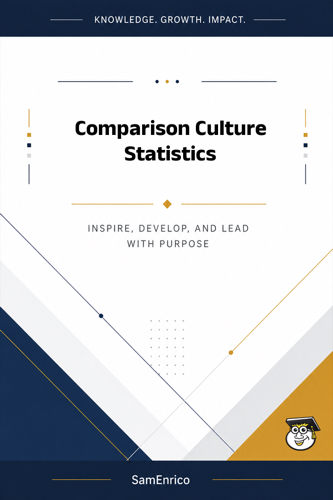
Comparison Culture Statistics
Data driven understanding of social media's impact
Data driven understanding of social media's impact on mental health and self esteem.
Formats
About this book
Free sample
Chapter 1: The Algorithmic Mirror--–- On a Tuesday morning in October 2024, a nineteen-year-old university student named Maya did something that would have been unthinkable fifteen years earlier. She woke up, reached for her phone before her glasses, and spent forty-seven minutes scrolling through Tik Tok before speaking a single word to another human being. By the time she got out of bed, she had watched approximately 140 short-form videos. She had seen three influencers her age on luxury vacations, two couples with seemingly perfect relationships, four fitness transformations, and one “day in the life” video featuring a teenager who claimed to make $47,000 per month selling digital products. Maya did not post anything.
She did not like anything. She simply watched. And by the time she stood up, she felt, in her own words, “like I was already behind and the day hadn’t even started.”Maya is not an outlier. She is statistically typical.According to a 2025 study of 2,400 young adults across six countries, the average user between the ages of eighteen and twenty-nine spends 127 minutes per day on social media. But raw screen time, as this chapter will demonstrate, is not the variable that predicts psychological harm.
The variable that predicts harm is what the screen shows you. Maya’s forty-seven minutes of scrolling were not neutral. They were curated, sequenced, and optimized by an artificial intelligence system designed to maximize one metric: engagement. The system learned, over thousands of iterations, that Maya stays on the app longer when she sees content that triggers social comparison. It learned that she lingers on videos featuring people who look slightly better than her, not dramatically better.
It learned that she scrolls past content that makes her feel good almost immediately but returns to content that makes her feel insufficient after a few seconds of reflection. The algorithm is not malicious. It is simply efficient. And efficiency, in the attention economy, means feeding the comparison machine.This chapter dismantles the common assumption that comparison culture is a byproduct of human vanity, low self-esteem, or weak willpower. Instead, it argues that comparison is now engineered…
This is the end of the free sample. Get the eBook to keep going. Buy now
Contents
- Chapter 1
- Chapter 2
- Chapter 3
- Chapter 4
- Chapter 5
- Chapter 6
- Chapter 7
- Chapter 8
- Chapter 9
- Chapter 10
- Chapter 11
- Chapter 12
Details
- Author
- Levin Wilfredo
- Publisher
- SamEnrico
- Language
- English
- Genre
- Non-Fiction, Self-Help, Research Based
- Released
- 2026-06-08
- Pages (approx.)
- 136
- Available as
- eBook, Audiobook

Read better in the ZLOADR app
Your eBooks on your phone or tablet. Sign in with your SamEnrico account and start reading.
More by Levin Wilfredo
 Secret Garden SleepLevin Wilfredo$11.99
 Pelvic Floor during DeliveryLevin Wilfredo$11.99
 The Challenge the Food Police GuideLevin Wilfredo$11.99
 Faith Practice Health BenefitsLevin Wilfredo$11.99
 Silk Road's Shadow: The Untold War on the Dark WebLevin Wilfredo$11.99
 The Breeder's Guide to Dexter CattleLevin Wilfredo$11.99
 Non Resident LLC Insurance GuideLevin Wilfredo$12.99
 Nairobi Startup Success StoriesLevin Wilfredo$12.99
 How to Become a Loom Changeover OperatorLevin Wilfredo$11.99
 Engineering Services ManagerLevin Wilfredo$11.99
You may also like
 Hong Kong Handover 1997Dunn Johnnie$11.99
 Zumba For Postnatal Recovery CourseNeal Christian$11.99
 Zumba for BeginnersLadner Nikia$11.99
 YouTube Comment Mining GuideHumes Pandora$12.99
 Worry Box MeditationCarlin Rudy$11.99
 Workplace Stress MeditationNguyen Lynn$11.99
 Workplace Stress and Sleep RepairHawley Ivory$11.99
 Workplace Perfectionism CureDelaney Jeffry$11.99
 Workplace Injustice Anger GuideWallen Isabelle$11.99
 Work Addiction and Burnout LinkGreenwood Ester$11.99
 Women in Yoga and WellnessBeattie Galina$11.99
 Women in Stand Up ComedyChun Evangeline$11.99